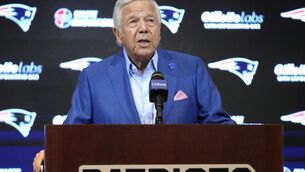
Hush descends as impossible dream dies

Famously, Clough had taken a comparatively small, backwater club to the summits of both English and European football — but would Keane not concede that a similar feat was simply impossible in the modern age?
“Impossible? I wouldn’t like to use that word,” he replied.
“I am a bit of a dreamer, there’s no doubt about that. I do have dreams that I can achieve things. Now, whether a club like Ipswich can go on and win the European Cup (smiles) is very, very difficult, I have to say. But I hate using that word impossible.
“But you talk about Brian Clough — listen, the man was a genius, let’s not kid ourselves that he wasn’t.”
Never mind dreams of European conquest: having fallen well short of his stated goal of taking Ipswich Town into the Premiership inside two seasons, it’s pretty clear now that Roy Keane is no genius when it comes to management.
But then I would argue that he was no genius at football either, at least not if we define genius as the kind of x-factor possessed by someone like George Best whose apparently innate ability to make the ball do his will seemed at times to border on the supernatural.
Keane had something else: a ferocious drive and appetite for victory which, allied to his superior command of the basics of the game, turned him into that equally rare phenomenon: virtually a self-made footballer of greatness who, if he didn’t often illuminate games with moments of exquisite skill or imagination, frequently dominated them by sheer force of personality and the raging desire to always do what was best for his team.
People always said the problem Keane was going to face when he swapped the pitch for the dug-out was that, at the defining moment of kick-off, he would effectively have to surrender his ability to dictate the outcome of a game, instead relying on players who would have far less in their lockers than he had possessed, to do the right thing.
But, there’s nothing unusual in that. When the whistle blows, every game of football becomes, at least in part, an exercise in responsibility without power for a football manager — which is why you see so many of them apparently undergoing nervous breakdowns over the course of 90 minutes.
The trick is to exercise your influence to positive effect even when the scope of that influence is strictly limited.
Remarkably, in what was his very first attempt at management, Keane seemed to have bridged the gap, dragging Sunderland up from the basement of the Championship to the Premier League over the course of one memorable season at the Stadium of Light. In some quarters, he was even being fast-tracked for international honours. Recall, that when Steve Staunton departed as national boss, one excitable report the morning after informed the nation that the next managers of Ireland would be a dream team of Alex Ferguson and Roy Keane. (It’s a pretty safe bet that the yarn hadn’t been run by Keano, mind you. Or Fergie).
As it turned out, Sunderland’s Championship success was Keane’s managerial honeymoon, season in the sun and pinnacle of success all rolled into one, almost as if the reputation of the man had been enough to galvanise the players and the club before a harsher reality set in.
At least, from Keane’s point of view, his departure from Wearside was on his own terms, the Corkman complaining of interference from above before promptly getting on his bike. The end of his Portman Road reign is both much more ignominious and altogether more prosaic.
Too much significance can be attached to reports that the abrasive edge of his character rubbed some players up the wrong way, even if some or all of the more colourful gossip is true. Managers are not in the business of winning popularity contests; they are in the business of winning games. And, over a season and a half at Ipswich, Keane’s team simply didn’t win nearly enough. If they had, Keane would still be in his job and those players who found him intimidating or distant or simply unfathomable would be too busy enjoying the acclaim of the crowd to complain. They would, you might say, feel the fear and do it anyway.
Results are the great leveller in football and it’s results which exposed his deficiencies as a manager and laid Roy Keane low.
In his defence, he can point to limited finances, injury setbacks and even some basic bad luck as factors which handicapped progress at Portman Road. But, again, many successful managers have had to wrestle with the same problems.
The truth is that, for all that he’d been such an inspirational figure on the field of play, Keane clearly lacked the same motivational quality when it came to getting the best out of a limited group of players who were struggling to drag themselves out of a rut.
He was also anything but sure-footed in the transfer market, a crucial aspect of the job in which his lack of judgement was matched by the absence a useful sounding board. Even the maverick genius that was Clough was happy — in their most productive years together — to yield to the superior insight and knowledge of Peter Taylor when it came to the vital business of selecting players.
If it’s true that you learn more from failure than success, then we might well see Keane return to management in the future. Or it may be, as many insist, that his personality is simply not equipped for a role which demands extraordinary flexibility of character.
Having watched yesterday’s tumbleweed proceedings at Portman Road — a Roy Keane press conference without Roy Keane — all we can say for sure right now is that, suddenly, the world of football has become a much less interesting place.
- Contact: liammackey@hotmail.com