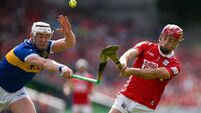
Glen-Piarsaigh derby games up there with biggest rivalries


It brings together two of the city’s biggest rivals. Both are situated on Cork’s north side with most of the players,
management and supporters drawn from the same areas. It is a ‘younger’ rivalry when compared to those which grew over many years between the Barrs, the Glen and the Rockies.
After one county final between two of those rivals, a supporter commiserated with a noted inter-county player, who was on the losing side. He retorted that “it was only a game”.
One can imagine that player being reminded at the following AGM that for supporters it wasn’t ‘only a game’ and it was, in fact, a matter of life and death or in the words of Bill Shankly, “much more serious than that”.
The GAA is sustained by local rivalries. The idea of playing for one’s parish or area and doing battle with one’s near neighbours, for the “honour and glory of the little village”, is still a phenomenon in rural Ireland. However, the intensity (some might say
bitterness) of the rivalry that existed between the so called ‘big three’ has dimmed in the 21st century.
The record books over the last 10 years go some way to explain its decline. In that period, only Glen Rovers (4) and Bishopstown (1) of the city clubs contested county finals. These were against the Riverstown-based Sarsfields club.
If you look further back at the previous decade, only Blackrock (4) and Na Piarsaigh (1) contested finals, coming up against Newtownshandrum, UCC, Imokilly and Cloyne.
Keen rivalry is sustained by regular big game encounters, particularly at the business end of competitions. Memories of games and the retelling of tales (usually exaggerated and embellished) associated with great victories over traditional ‘enemies’ inspire the younger generations and keep the fires of a rivalry stoked.
Among the big three, tales of defiance and bravery in the face of the old enemy are few and far between
lately.
My own club, St Finbarr’s, haven’t contested a county final since the 90s. Their arch rivals on the south side, Blackrock, haven’t won since 2002. In the halcyon days of the Cork championship, a fixture between these two drew many neutrals to the game. The same went for any meeting between either of the pair and Glen Rovers.
In those times the three teams were almost on an equal footing. Each was capable of defeating the others on any given day and the champions would have been favourites for the Munster club title.
This is no longer the case. Glen Rovers are champions. They are chasing three in a row while the Barrs and Blackrock are somewhat below the necessary standard.
The Rockies have won many minor and U21 titles in recent years. However, they have yet to make an impact at senior.
It could be argued that the intensity of the rivalries on the inter-county scene has diminished over the last 10 years. Some inter-county players refer to the mixing of players from rival counties at third level colleges as an explanation. The same happens with club players. Maybe
rivalries are scaled down as players from different clubs get to know each other in school and college.
Cork underage development squads may be playing a similar role in softening the rivalries.
Underage blitzes for six to 11-year-olds against ‘old enemies’ based on enjoyment and fun may also contribute to the downgrading of the passionate rivalry that once existed when the mere sight of the rival jersey was expected to stir the blood.
It wasn’t just a fierce “Mórtas Cine” — pride in the clan/club — which drove teams on against their traditional rivals. There was also an animosity and mistrust that existed between these institutions.
Live television contributed to the demise of the Railway Cups. Christy Ring was once asked would live television kill hurling? His opinion was that it wouldn’t, but that it would soften the game considerably. How right he was.
The interpretation of the rules for tackling, applied at inter-county level has filtered down to the club where, in the opinion of many, the games are refereed over-zealously.
The shoulder tackle is virtually gone from the game and hard pulling on the ground or in the air is almost non-existent. In the recent Cork/Dublin minor semi-final, a Cork player picked up a yellow card for pulling on the ball in the air, in spite of the fact that it wasn’t dangerous. Hard
pulling and tackling always increased the tempo of club games and the temperature in the stands also rises.
There are four senior hurling clubs on the south side of Cork. In historical terms, Douglas and Bishopstown are newcomers. Although there may be no love lost between any of the city teams on the field of play, Douglas and Bishopstown are too ‘young’ yet as senior teams to have built up traditional rivalries.
Of course, there are strong
rivalries between near neighbours in East Cork, while the rivalry between Sarsfields and Glen Rovers is building slowly.
However, the days of big crowds flocking to contests between sides laden with inter-county stars are no more.
Currently, only the Na Piarsaigh v Glen Rovers game remains as the one fixture capable of reaching the intense heights of yesteryear and attracting a sizeable crowd of interested neutrals.