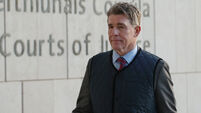
FitzGerald’s legacy is secure despite Varadkar’s spectacular own-goal
TAOISEACH Brian Cowen and his party certainly did not distinguish themselves with the cabinet reshuffle during the week, but the contortions of Leo Varadkar helped to take some of the spotlight off the Government. Varadkar pulled off one of the most amazing foot-in-mouth stunts ever seen on the opposition frontbench.
He began with an attack on the Taoiseach for botching the cabinet reshuffle. “The Taoiseach is no Seán Lemass, Jack Lynch or John Bruton,” Varadkar said. “He is a Garret FitzGerald. He has trebled the national debt and effectively destroyed the country.”
Varadkar might have been aiming at the Taoiseach, but he fired at FitzGerald and figuratively shot himself in the foot. Then he proceeded to put both feet in his mouth and trample on himself. He predicted that the reshuffle will prove to be Cowen’s final act, “so he should enjoy writing boring articles in the Irish Times in a few years”. This was an obvious allusion to FitzGerald, who writes a weekly column in that newspaper. “I stand over my criticism of Garret FitzGerald’s performance as Taoiseach and his ongoing criticism of Fine Gael, but what I said in the Dáil was over the top,” Varadkar admitted.
Anyone can make a mistake but, having recognised the mistake, it is the height of arrogance to stand over it. He is behaving like an old-style bishop.
Ironically, while Varadkar was standing over his remarks, the Vatican was announcing that the Pope had accepted the resignation of Bishop John Magee, who served as private secretary to three popes — Paul VI, John Paul I and John Paul II. Could it be that Varadkar has not noticed that times have really changed, that Irish people are loath to tolerate such arrogance, even from a bishop.
There is an old saying in Leinster House that no one ever talked his or her way in there, but many have talked their way out. Varadkar should cop on to himself and engage his brain before shooting his mouth off again.
Nobody should criticise him for saying what he honestly believes, but anyone in a position of responsibility should first consider what he is saying. Fine Gael published a policy document this week, but it got swamped in the comments on Varadkar’s outburst, which must rank as one the most spectacular own-goals ever scored in Leinster House.
There always has been an element within Fine Gael suffering from what might be called the Blueshirt syndrome. This is the party’s tendency to be overly impressed by invective against Fianna Fáil, whether the arguments are rational or not. Fine Gael was established in 1933, following the merger of Cumann na nGaedheal, the Centre Party and the Blueshirt organisation. Cumann na nGaedheal had been planning to dismiss Eoin O’Duffy as Commissioner of An Garda Síochána, but when de Valera fired him they tried to turn O’Duffy into some kind of political martyr. They selected him as the party’s first leader, even though he was a fascist flake who sought to emulate Benito Mussolini, the Italian dictator.
Fortunately, Fine Gael got rid of O’Duffy the following year, but more than three-quarters of century later the party is still tainted with his Blueshirt. James Dillon, who became Fine Gael leader in 1959, was another who made a name for himself bashing Fianna Fáil, but it got him and Fine Gael nowhere.
During Dillon’s seven years as leader of the party, Fine Gael never managed to get near power. Of course, only three of the party’s 10 leaders ever became Taoiseach. You would think by now they would have got the message that hysterical invective hasn’t really worked. They have only been fooling themselves.
The first member of Fine Gael to become Taoiseach was John A Costello, but he was never leader of the party. The first leader to be elected to the office was Liam Cosgrave in 1973.
On November 30, 1972, the party was about to oust him as leader because he was not prepared to vote against the government’s Offences Against the State Bill. He insisted on putting the country first. Then suddenly two bombs went off in Dublin, and those shook the Blueshirts to their senses.
Garret FitzGerald admitted that he and others were wrong that night. He paid warm tribute to Cosgrave as “the man who stood firm and had, in tragic circumstances, been proved right.”
FitzGerald became the second Fine Gael leader to be elected Taoiseach and the only one to be elected to the office twice. Probably no one would rate him as the greatest of our Taoisigh. It seemed Charlie Haughey won all their political battles, but FitzGerald did win the war.
Although both had strong Northern backgrounds, they had different outlooks. Haughey had a kind of Napoleonic complex. He was prepared to serve in order to achieve his ends. Yes, he did the state some service, but he also introduced a culture of corruption. He did even more harm playing the green card in relation to Northern Ireland. His involvement in the Arms Crisis was utterly reckless. FitzGerald, on the other hand, had a much broader vision. As the son of a Northern Protestant woman, he understood the unionists’ fears of the Republic, and he sought to turn this state into a pluralist Republic that Northern Protestants would not fear. This would have to be the first step towards unification.
As early as 1972 he outlined his views in his book, Towards a New Ireland. Before achieving unification, he noted it would be necessary to introduce constitutional changes in relation to the special position of the Catholic Church as well as the ban on divorce. He also called for the repeal of the law prohibiting the sale and importation of contraceptives.
Jack Lynch’s government put through the constitutional amendment eliminating the Catholic Church’s special position, and Haughey introduced the legislation authorising the sale of contraceptives.
FITZGERALD failed to get an amendment through doing away with the ban on divorce, but John Bruton succeeded almost 10 years later.
Despite Varadkar’s abuse in relation to the economy, FitzGerald actually played a major role in helping to turn the economy around in 1987. It was he who outlined what became known as the Tallaght Strategy. After Haughey was elected Taoiseach in 1987, FitzGerald made it clear Fine Gael would support the government if it took the measures that needed to be taken “for the sake of our country.” He provided the leadership and Alan Dukes implemented the promise, and the economy was turned around.
FitzGerald’s greatest legacy was in helping to secure the Anglo-Irish Agreement, which Haughey cynically opposed. But later, on regaining power, Haughey used it to help develop the peace process in the North. The Anglo-Irish Agreement was undoubtedly a major step leading to the Good Friday Agreement.
If it were only for his part in achieving the Anglo-Irish Agreement, FitzGerald would deserve to be remembered and respected. In his quiet, dignified way — in the face of huge clerical opposition and cynical political posturing — he provided real leadership in changing Ireland from an episcopal dictatorship to a modern, pluralist republic. For this he deserved our appreciation. If Leo Varadkar can’t see that, he should go back to medicine.
CONNECT WITH US TODAY



Be the first to know the latest news and updates