State’s dereliction of duty forces parents to cough up cash for schools
But when the latest request arrived this week from the primary school my three girls attend, I didn’t feel emboldened enough by Ms Hanafin’s entreaties to refuse payment. Ms Hanafin may be the Education Minister — and she gave me my reassurance live on national radio — but I can’t bring her along with me to the school. I can’t march her into the principal’s office and get her to say, “This man doesn’t believe he should pay and I support him in that.”
As any parent of a school-going child will realise, I’m writing about “voluntary contributions” to the upkeep and running of local schools. Parents have become used to requests for money from schools, of which there’s hardly one in Ireland which has enough money to meet its daily running costs after it has paid its teachers. To make up the shortfall, schools are reduced to begging from the parents.
Unfortunately, this can take the form of begging with menace. When Today FM explored this topic on The Last Word recently, we were inundated with messages, outlining the demands for specific amounts of cash which had been made. In some cases, the requests, euphemistically called “voluntary donations”, are better described as demands. If the parents don’t stump up the required cash, the consequences can be embarrassing or humiliating.
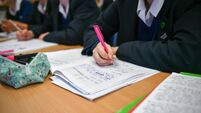
We heard stories of children finding their names on lists on classroom doors, detailing those who hadn’t paid. We were told of children having their names called out in class to be asked by teachers why their parents hadn’t handed over the money. We were told of days when children who contributed a small amount were allowed not to wear the school uniform that day, but those who didn’t pay up weren’t. Imagine being the children who couldn’t afford to wear their favourite clothes?
You may wonder why this is happening, especially as we have enjoyed 10 years of economic boom and increased prosperity that we’re told is the envy of Europe. It’s quite simple, really. This Government consistently does not give enough money to its primary schools, either in absolute terms or relative to almost every other European country. Per head, Irish spending on education is one of the lowest in the developed world relative to our wealth.
The recent OECD report, Education at a Glance 2007, stated that, on average, OECD countries spend 6.2% of GDP on education. Ireland spends just 4.6%. It gets worse. Half of the nation’s children are being educated at primary level but less than a quarter of the budget is spent in this sector. For every €5 spent at primary, €7 is spent at second-level and €10 at third-level.
Admittedly, the costs in educating in later life can be higher, but if children at primary level are to be given a good grounding, they need access to computers and proper sports facilities.
But for many the needs are more basic. In our local school last year we paid to replace old, draughty windows, at a cost of about €20,000. There would have been a wait of years had we relied on the Education Department to make the required capital allocation. But, in fairness, there are other priorities. Many schools have requirements which are far more basic, especially in getting pupils out of pre-fab classrooms, or rat-infested buildings.
We are fortunate there is no lack of money in our school, because of the generosity of voluntary contributions and several well supported fundraisers. It has been spent well, too, especially on beneficial extra-curricular activities.
But that’s not the point. There should be no need for any fundraising. It is wrong.
There is a principle here. Article 42.4 of the Irish Constitution states the “State shall provide free primary education”. Clearly, the State is in breach of that provision.
Now, I’m well aware of the old joke that when people say, “It’s not the money, it’s the principle”, it’s really the money they’re cribbing about.
I can afford to write a cheque each year (even though I still end up wondering if I should be giving more and worry whether I’ve been generous enough). I don’t begrudge my local school the support. The children are happy there and we are happy with the education they receive.
Yet I’m aware of the practical problems which may exist for other parents. Many people simply cannot afford to pay because of straitened financial circumstances. Some might not care, but others may worry greatly as a result. Some will make sacrifices which should be unnecessary just so they can contribute, or to avoid the insensitivity of those who demand money from them or their children.
Alternatively, many who can easily afford to pay may not be generous or might not pay anything at all. Therefore, people who may not have as much easily disposable income might end up paying more than wealthier people.
It is no wonder, then, that commercial companies are seeking to exploit the financial problems of schools by offering products or services to the pupils and their families on apparently favourable terms. Some may give things for free but it is on the basis of developing a long-term brand investment, making children familiar with a corporate name or product, or in persuading parents to buy more of those products now.
EVERY parent is aware of the pressure created by proof-of-purchase schemes, such as collecting tokens which can be exchanged by schools for sports gear or computer equipment. That these schemes offer very little to the schools — because the volume of goods which need to be purchased are so enormous — is not always immediately apparent. Often, as much money may be spent on advertising, involving expensive celebrity endorsements and other promotional literature, as actually goes to putting useful materials into the schools.
The schools acquiesce to this commercial exploitation, however, because they need the money to pay bills (with VAT added) to State suppliers of services such as electricity, gas, water and waste disposal. The whole thing stinks.
You may wonder why parents go along with this. Why they don’t just band together and refuse to make the voluntary payments that keep the schools going? Surely it would force the minister into providing the finance to make good the under-funding and to fulfil the Government’s constitutional requirement? There are enough taxes to be paid without these stealth taxes, too.
Few parents are going to take that chance when the education of their children is at issue. They are not going to allow the heating to be turned off, the water to be disconnected and the waste to accumulate.
Finance Minister Brian Cowen is bashing his colleagues over the head as part of the pre-budget process, making it clear he will give them nothing more than an inflation-linked increase in their money to spend during 2008. If the required money has not been made available over the past decade, what are the chances of it being forthcoming now as the Government’s finances deteriorate?
The Last Word with Matt Cooper is broadcast on 100-102 Today FM, Monday to Friday, 4.30-7pm.


CONNECT WITH US TODAY



Be the first to know the latest news and updates