Small dangers lurk for friendly heron
The heron isn’t as delighted and regards Luca with a wary eye. Luca holds forth the fish — he holds it by the tail, rather than using a tongs — and the heron advances. In the blink of an eye it seizes the fish, and gobbles it. Luca cries out with glee.
Following a recent ‘incident’, the heron has reason to be circumspect about small boys, albeit it stays clear of humans except when it is hungry and they offer fish. “Timeo Danaos et dona ferentes,” said Virgil, a wise Roman, meaning ‘I fear the Greeks when they come bearing gifts.’ For the heron, it is “Timeo pueri et piscium ferentes”, meaning ‘I distrust small boys bearing fish.’
Unfortunately, little Luca, normally a good-natured child, decided to see how the heron would react if he tossed the fish tongs at it. The bird took great umbrage, ruffled its feathers, and flew onto the balcony, from whence it glared down at the small boy.
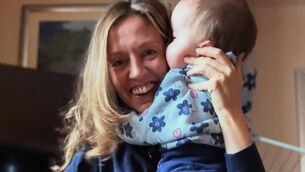
Most children cannot resist chasing pigeons in the park. Perhaps it’s an assertion of human dominance over species smaller than ourselves. Not dominance over nature — they do not tear the heads off flowers. And Luca hugs rather than hassles smaller children in the playground; photographs bear this out.
Luca and the bird are probably, in heron-span — grey herons live to be 30 — about the same age. Perhaps the boy tossed the fish tongs by instinct, an experiment in territorial imperative, while the bird, also by instinct, realised that youth is unpredictable and, while adults might be trusted within limits, their offspring should be given a wide berth.
As for humans of any age coming in close proximity, we never attempt to touch the bird, tossing its fish into the stream or extending it on a tongs at arm’s length.
To make it too comfortable with humans would do it no favour and perhaps Luca, unknowingly, taught it a lesson in misplaced trust.
However, with those it knows, it is a very companionable bird. The other afternoon, making notes for a book review, I sat on our wooden balcony for almost two hours while the heron stood on the balcony rail, at first preening carefully and then putting its head under its wing and taking forty winks while standing on one leg.
I read my book while it dozed a few yards away. Later, it flapped onto a nearby table, on which it has made a ‘nest’ of twigs, and sat down as might a chicken on a clutch of eggs. And so, the afternoon passed, with myself and the heron enjoying perfect peace and a sort of bizarre companionship.
Regarding companionship, I have found grandchildren to be a great pleasure and hope to have two or three more before I go. They are, universally, darlings when young, and even when teenagers remain engaging. Of course, they get into scrapes. As a teenager, I did the same myself — ‘robbed’ an orchard for a few apples, or gave the schoolyard bully back as good as I got. However, while they were considered simply ‘mischief’ in my time, the former may now be described as trespass and larceny and the latter labelled an assault.
It is a pleasure to be able to assist one’s grandchildren as young adults, helping them compose a CV or to make an application for college or a job.
Meanwhile, I miss young children about the place and was glad to have Luca come to visit. Now that he’s gone, I notice that I had quickly slipped into old habits.
When I get back to the house late at night I whisper, forgetting that there are no children to wake, as of yore.
A reader wrote to say that I’m the last chance of survival for her garden, colonised by a tribe of rabbits that forage like eating-machines. In winter, they ate the bark off her trees; now, they defoliate every shrub and excavate and eat their roots. They dig holes everywhere, just “for the fun of it”. Poor woman!
Circumstances obviate her keeping a cat or dog, but she hopes that some kind reader may send advice to me c/o the Irish Examiner, which I can pass on.
CONNECT WITH US TODAY



Be the first to know the latest news and updates