Strict return-to-office policies could drive workers away, union says
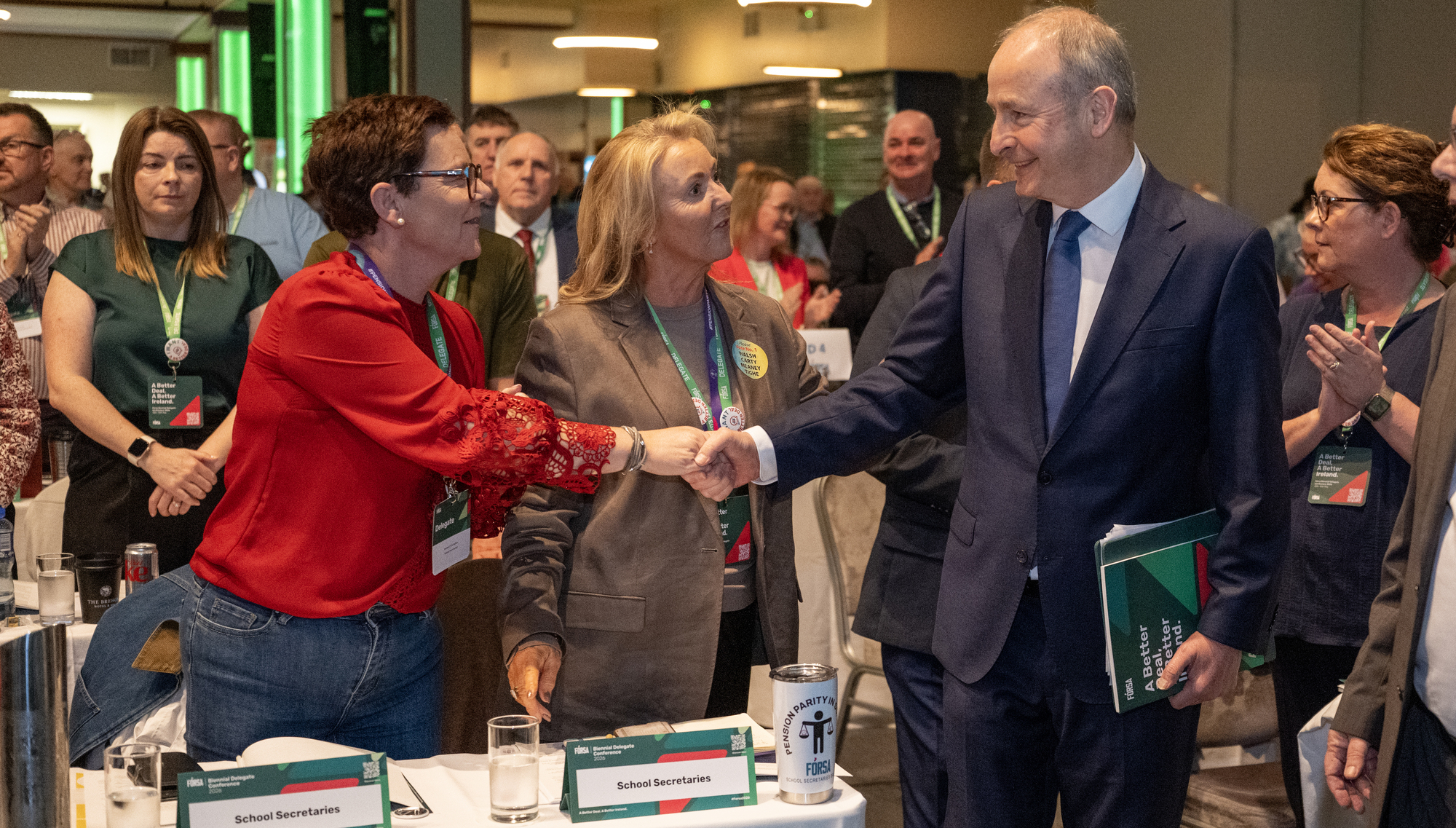
(Left to right) Fórsa delegates Victoria Luke (School Secretary, St.Mary's School, Rochestown) and Noreen O' Callaghan (School Secretary, Watergrasshill NS) welcome Taoiseach Micheál Martin to the union's biennial delegate conference at the INEC in Killarney on Thursday. Photo: Domnick Walsh © Eye Focus LTD
Employers have been warned that strict return-to-office policies could result in an exodus of staff with almost half of workers saying it would force them to look for another job.
The Fórsa trade union has published major new research showing that remote and hybrid working is now a mainstream labour market experience, with 38.4% currently working remotely at least one day per week, while 61% of respondents said they would prefer hybrid or fully remote work over the next two years.
The union now wants remote and flexible working arrangements to be included in upcoming negotiations on a new public service pay deal.
Speaking at Fórsa's biennial conference in Killarney, Taoiseach Micheál Martin said flexible working is now a permanent feature of the modern workplace but many people are not aware of their legal right to request remote working.
"That is why a national information campaign is underway to drive awareness and encourage increased use of the legislation."

But he said that not every service can be delivered from a distance and the challenge is to ensure that flexible working arrangements are fair, consistent, and support the delivery of high-quality public services.
Mr Martin added that there has been some criticism that the legislation is balanced in favour of employers and the WRC will now look to revise the code of practice, in consultation with employer and worker representatives to address this perceived imbalance.
"This review forms part of the Government’s wider strategy regarding remote work, including broadband rollout, and home‑working tax relief.
"In addition, at the request of the Irish Congress of Trade Unions, I asked the National Economic and Social Council to carry out research into the impact of remote and hybrid work in Ireland. That report will provide us with a greater evidence base on the full range of economic, social and environmental impacts to inform future policy," Mr Martin said.
Managers taking part in the Fórsa survey, which was presented to delegates at the conference, also reported positively on productivity, while respondents consistently reported that staff on remote or hybrid working performed as well as, or better than, when on fully on-site working arrangements.

For example, just 6% of respondents said meeting deadlines was problematic when working remotely, compared with 23% who identified this as a difficulty when working on-site.
This is reflected in the finding that 86% of managers supervising remote-working staff said employees seldom or never missed work-related deadlines, compared with 73% among fully on-site teams. Similar patterns emerged in relation to communication and collaboration.
The research also indicates employers risk creating retention challenges through rigid return-to-office policies. Four in 10 workers said they would look for another job if access to remote work was reduced, while just 28% said they would accept the change.
Fórsa campaigns director Kevin Donoghue said: “For many workers, hybrid working is no longer viewed as a perk or temporary pandemic arrangement. It has become part of the new normal of working life."
“But this research also shows that the future-of-work debate now extends far beyond office walls. Hybrid working affects commuting patterns, congestion, childcare, family life, local economies, climate policy, regional development and participation in communities.”
- Elaine Loughlin is political editor of the Irish Examiner

CONNECT WITH US TODAY



Be the first to know the latest news and updates