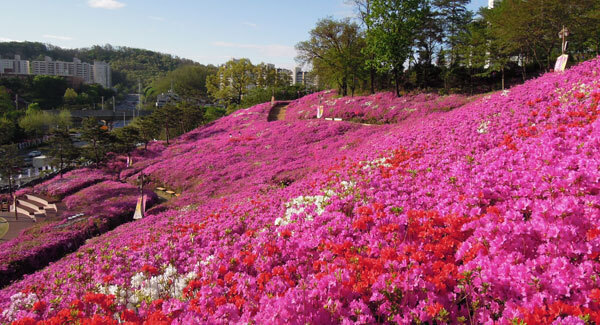
Japanese azaleas are a far-eastern favourite
Japan has a long and rich history in gardening and garden design.
Japanese gardens work with the miniature, and while there are many different styles of gardens native to that country, they are nearly all designed as aesthetically beautiful, contemplative spaces with meditation in mind.
Many tend to envisage water and water features as an intrinsic part of Japanese gardens, but Zen gardens never used water, rather different coloured stones and sands to create the effect of water.
Bonsai is a Japanese art form which dates back to the 7th century and involves pruning, root training and shaping to produce trees to mimic in miniature their natural form — but they’re considered far more contemplative as the entire tree is visible.
I can appreciate the skill involved and I do admire a well-trained and maintained Bonsai, but another part of me thinks it is perverting nature and I think it’s unfair on the tree — but maybe that’s just me thinking a bit too much about it — can trees really feel? Do they strive to outgrow their Bonsai pot and grow to their true potential?
Do they feel trapped? Now there are some questions to contemplate.
Many native Japanese plants are commonly grown in gardens in this part of the world and one group that come into their own over the next few months are the Japanese azaleas.
Naturally dwarf, and growing to as little as 30cm to 120cm, depending on the variety, they bring much to the garden in terms of texture and form.
Their dense compact habit gives them a real presence in the garden all year long, making them worthy visitors even though their blossom, stunning as it is, lasts for only a short time. Azalea blooms are one of those features in a garden that even though short-lived, is a must-have for the spring garden — that’s if your soil pH allows. These showy beauties do like to be on the lower side of 7 on the pH scale — slightly acidic soil.
Good gardening is all about choosing the right plant for the right place and if you can get this right then your garden should always work well for you. Established plants shouldn’t get too big for where they are planted, and feeding of established plants shouldn’t be necessary.
That is, of course provided they are in the right place. If your soil is on the wrong side of 7, or alkaline, then azaleas will not thrive.
They may survive and they may even flower, but they will not flourish. Yes you can dig an extra-large hole, line it with plastic and fill this with an ericaceous or acid compost, and this will work well to a degree, and for a time.
However, I do believe that nature will win out in the end for after a while that acidic compost will become spent, lime will leach in from the surrounding soils.
Much better in my opinion to grow these specimens in ornamental pots and planters filled with ericaceous compost than persisting with them in the wrong soil.
If you are lucky enough to have a soil with the correct pH for growing these beauties then fill up with them, because believe me when I tell you that, when in full bloom, you will struggle to see the green of the foliage.
Even the strongest of winds seems to have no effect on neon-flowered azaleas as they stand solidly. They are so dense they should blow over in any strong wind but once again the wonder of nature is evident in their design.
So many stems and leaves create a labyrinth of growth which allows the air to travel through the plant without pushing it over. It must be this seemingly effortless strength and resilience that make it such a popular plant in Japanese and Zen gardens.
Azalea ‘Silver Sword’ is one that brings more than just a short-flowering period. Cerise pink/ light red blooms are produced in abundance as with other varieties, but when not in flower, its beautifully variegated foliage brings much to the garden.
Grey/green leaves are edged with a creamy margin which gives ‘Silver Sword’ a bright and lighter feel than many of the darker green forms.
Growing to about 80cm this is a plant that will thrive in a humus-rich soil in a semi-shaded position. Similar to the camellias, azaleas should not be planted facing east or south as the early morning sun can burn the flower buds over winter leading to these buds opening up into brown flowers.
During a hot summer a position in full sun will also lead to leaf scorch.

CONNECT WITH US TODAY



Be the first to know the latest news and updates