Why I'm backing campaign to get lad mags behind the counter
BEFORE we start, can I just say that I do not believe in, or support, censorship of anybody by anybody on any grounds. Providing it does not involve children or animals, and everyone is adult and consensual, then do what you like. Just one thing — don’t do it in my face. Or my kids’ faces.
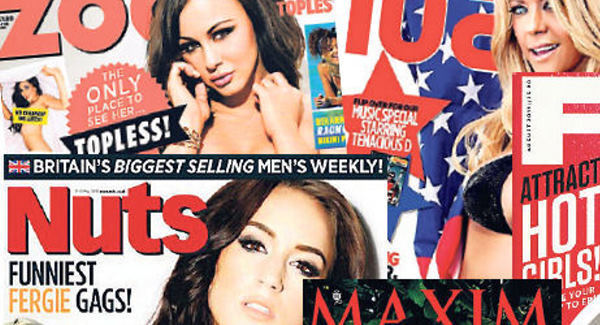
When my 12-year-old walks into a shop to buy her horsey mag, or my nine-year-old to buy his football mag, they should not have to visually digest a close-up of a female arse on the cover of the Daily Sport. Nor should they have to look at unclothed, sexually posed young women on the cover of mags like Nuts, Zoo, FHM and others.
They may consciously dismiss or ignore the images — they are too young to be interested — but what’s happening subconsciously? The not-very subliminal message is that it’s normal for a woman, or parts of a woman, to be naked on the cover of a magazine for the purchasing pleasure of whoever. That naked women can be bought for entertainment. That women are just bits. Tits, bums, compliant faces. With whipped cream.
Anyway, turns out quite a few other women are not too keen on this either. Lose The Lads’ Mag is a campaign backed by, according to The Sun in a piece headlined ‘Writs Out For The Lads’, “a gaggle of crusty lady lawyers”. The Sun, already on the run from the No More Page 3 campaign, is clearly feeling sensitive at the moment, reflected in its almost comically 1970s description of the lawyers threatening retailers with legal action for stocking sexist material in the workplace.
The campaign was started by feminist organisations UK Feminista and Object, who suggest that sexist, sexually explicit, or pornographic magazine covers in everyday shop environments lead to “an intimidating, hostile, degrading, humiliating or offensive environment” for both staff and customers, particularly of the female variety. That such covers should not be there. A Loaded and FHM writer, speaking to the BBC, called the campaign “a deeply sinister and disturbing attempt by a group of fundamentalist, fanatical feminists ... to bully supermarkets into removing lads’ mags from the shelves”.
So. Speaking as a sinister disturbing fundamentalist fanatic who wishes for her daughter and son to continue to grow up in a world of fairness, respect and equality, it seems reasonable that these titles remain available — just not in our faces. Lads mags should be like tobacco products — available, but not visible. This respects the consumer’s right to ogle naked 22-year-olds, and the rights of the rest of us to go about our business without feeling alienated, disrespected, or furious that our kids have got this stuff at eye level.
Naturally, the Irish retail response has been swift and defensive. Vincent Jennings of the Convenience Stores and Newsagents Association in Ireland, responded to the Lose The Lads’ Mags Campaign (which was a letter from 11 lawyers to the Guardian wishing to “immediately withdraw lads’ mags and papers featuring pornographic front covers from their stores”) by saying that retailers had the absolute right to sell whatever titles they like, and would never ask their staff to handle anything illegal.
But it’s not about illegality. It’s about ethics. It’s about rejecting the commodification of women’s bodies for entertainment. You know, old school, outmoded, sexism. Just as we don’t display cigarettes so that children won’t see them, neither should they be exposed to women portrayed as unwhole people, fragmented for sexual entertainment purposes.
This does not mean the mags should cease to exist — that would be outright censorship, counterproductive and repressive – but they should not be visible. The online forum Mumsnet has long campaigned for this, and says that most major UK supermarkets support its call for ‘modesty sleeves’. I’d go one further — screen them off, like ciggies.
For Kat Banyard, founder of UK Feminista, this is insufficient. “For too long, supermarkets have got off the hook, stocking lads’ mags in the face of widespread opposition, but this time we have the law on our side,” she told the Guardian. “Every shop that sells lads’ mags — publications which are deeply harmful to women — are opening themselves up to legal action.”
Meanwhile in Dublin, new offices were recently acquired by German company Manwin on Grand Canal Quay, where 33 staff will be hired. Manwin — the clue is in the name — is the company owned by Fabian Thylmann, who likes to call himself the ‘King Of Porn’. His company controls YouPorn, and Dublin will become a centre for the biggest porn distributor in the world. There have been no objections. Not a peep.
Are these two stories connected? After all, they are both about the consumption of naked women for entertainment. Yet this is not about naked women as much as it is about the everyday public availability of naked women.
We all know the internet is awash with porn. Some say that this is its primary purpose: access to unlimited porn of limitless variety in the privacy of your own whatever. In this instance, children and animals can be, and sometimes are, involved. Pinterest, the picture sharing social media site, is currently under investigation in Utah for unwittingly allowing images of child pornography to be shared.
But for the most part, internet porn is exactly what is says it is — consensual, by adults for adults, and not in your kids’ faces because computers and handheld devices have privacy settings and parental controls. Accessing YouPorn is an intentional act. Walking into your local newsagents for a packet of crisps and being eye level with someone’s nipples is not. Sophie Bennett, campaigns officer for Object, said: “Lads’ mags dehumanise and objectify women, promoting harmful attitudes that underpin discrimination and violence against women and girls. Reducing women to sex objects sends out an incredibly dangerous message that women are constantly sexually available and displaying these publications in everyday spaces normalises this sexism.”
Or as my nine-year-old son put it: “I don’t like those pictures. They make me feel weird.”

CONNECT WITH US TODAY



Be the first to know the latest news and updates