The cost of education can often catch people out
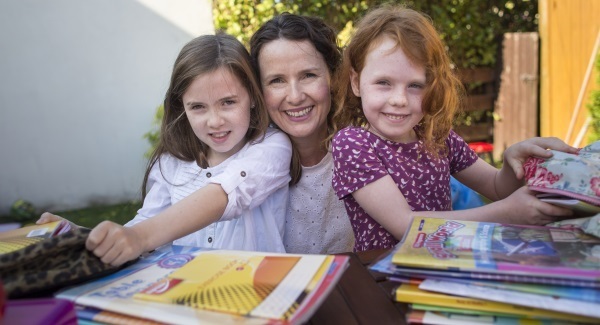
SHINY new shoes, a schoolbag that’s way cooler than last year’s and the incomparable smell of a brand new pencil case — my memories of going back to school are all good, and revolve around getting new things more than ABCs.
I’m sure for my parents it was a different story — paying for four children to go to school in 1980s Ireland was no easy task.
And today, it’s tougher than ever, with parents of older children footing the bill for tablets on top of everything else.
With my own kids’ back to school costs, I tend to spread the buying over four months to limit the impact, so when the Irish Examiner asked me to track my spending, I was curious as to the outcome.
Uniform and shoes

My children need crested uniforms from specific shops, so they’re not cheap.
However, they are good quality, so this year we only had to buy a full uniform for my youngest, who is starting junior infants.
For my older two, I replaced two shirts and a tracksuit. The skirt my middle child will wear in September has been worn for two years already and it’s still in good condition — the same goes for her jumper.
My kids only have one of each uniform item and I wash them at weekends.
I imagine if we could buy in a department store, we’d buy more of everything, and when I did a straw poll among friends, this seemed to be the case — those buying crested uniforms only bought one.
But not all crested uniforms are good value, as my friend Cathy points out.
“I had to buy a poor quality and expensive school uniform from a designated shop, and this is a Deis school too.”
Another friend, Nicola, also has to buy from a specific shop for her secondary school student, and finds it very frustrating.
“It’s colossal money, poor enough quality and I don’t mind telling you, it breaks me every year.”
For the last 11 years, Barnardos has conducted a survey on what parents pay to send their children back to school. This year’s report shows that 87% of parents with primary school children must buy a uniform, and just 16% of those are non-crested.
“Barnardos recognises the value of uniforms in giving the school a sense of identity and the majority of parents favour uniforms as it treats all children equally,” says June Tinsley, head of advocacy at Barnardos.
“However, crested uniforms are far more expensive than generic uniforms so Barnardos is calling on schools to review their school uniform policy from a value for money perspective and explore options such as iron-on crests, reducing the number of crested uniform items, switching to generic uniforms, and holding secondhand sales.”
Unlike uniforms, new shoes were something we couldn’t avoid this year, and I braved the children’s footwear department with three kids one busy Saturday afternoon.
For three pairs of shoes I paid €148. I’m conscious that this was discretionary spending — I could have paid between €15 and €25 a pair if I’d gone to a department store. But from experience, cheaper shoes don’t last a full year, and admittedly there’s probably some childhood conditioning at play here too, but either way, I always buy them one pair of “good” shoes before school starts each September.
At least we can buy any type of shoes as long as they’re black – Nicola has to buy specific shoes for her daughter.
“We’ve a choice between two pairs; black or brown, at €75 or €100. And if they choose to wear a scarf, even that has to be bought from the designated shop, so that it’s the ‘school shade’ of red.”
Books

Our school has a good book rental scheme for textbooks, so we only buy workbooks, costing €186 in total.
Many parents find the requirement to buy workbooks particularly irritating, because they can’t be passed on or bought second hand.
“Parents are frustrated about workbooks,” says June Tinsley.
“Over the years there have been some improvements with regard to books, such as the greater availability of school book rental schemes at primary school level, however they’re not universal and they’re not comprehensive.”
Mum of four Susanne, who is also a teacher, sees the issue from both sides. “I find back to school a very expensive time.
"The primary school that my three younger children go to has a book rental scheme, which halves the cost of the books. Some of the workbooks still need to be bought though.
“In some of the higher classes, the children don’t write in the workbooks, which is great. However as a teacher, this is harder to do in the younger classes, so the cost of the workbooks is a necessary evil.
"As teachers, we need them; with 30 children in the class, it would be impossible to work without workbooks.”
Stationery and class extras

I spent about €30 on stationery, buying it online along with the books. I don’t know how long it will last — by October, homework is delayed every evening because we don’t have a single pencil in the house.
My friend Elizabeth has the same problem. “We have to buy things like Twistables and Pritt sticks for school use.
They last about three minutes and despite buying several packs for each child I’ve had notes home telling me that they have none and I need to purchase.
There should be a supply on each table and they should stay there.”
MY TWO older children already have pencil cases but I did buy one for my junior infant — letting him pick his own. Happily he had no interest in the one for €34.99 (yes, for a pencil case) and opted for one that was €1.29. Long may this frugal attitude last.
Class extras like PE, art supplies, and computer software are paid for by parents in 73% of schools, and it’s another cost that tends to frustrate. The reality is, schools are underfunded by the State, and seek out ways to cover running costs through charging for classroom resources, asking for voluntary contributions, and fundraising, explains Tinsley.
“The Department has cut back on capitation rates and schools are running on less money, as the population is going up. Barnardos is calling on the minister to invest the €103m that’s required to provide a genuinely free primary school system.
"It would cover all school books and workbooks, it would remove any need to pay voluntary contributions and cover classroom resources, it would restore the capitation rates back to 2010 levels, and would provide free transport for those using the transport scheme.
"It’s cheap — the department budget is €8bn so €103m is change. It’s really in the minister’s gift to do this — what we’re calling on is political leadership to run with it.”

In the meantime, there are practical things parents can try, says Susanne.
“Most schools have a small fund to help parents in difficulty — don’t be afraid to ask about it.
Talk to your parents’ association about setting up a book rental scheme, and talk to parents of children in older classes to see if they have uniforms you could buy secondhand.
Schools and teachers are constantly trying to reduce costs to help reduce financial stress.
Remember lots of us are parents too, facing the same costs.”
My own final figure of €957 took me by surprise — even without buying uniforms every year and with a book rental scheme in place, it’s high, especially for what is supposed to be a free primary education system.
June Tinsley puts it succinctly: “Education is the great leveller but if cost is such a barrier from the outset, then you’re not going to be able to participate wholeheartedly.
"One parent has told us that their teenage children are offering to drop out of school because it costs so much — that’s not what we as a society should be recommending.”
CONNECT WITH US TODAY



Be the first to know the latest news and updates