Leaving cert preparations: Keep mindful of exam stress
They’ve done their lessons; they’re busy revising, but it’s all been about academic achievement. Imagine if, during the year, they’d been taught some mindfulness meditation too?
In England, such courses are becoming commonplace. The first school to try this was Tonbridge school in Kent following a course designed by Oxford and Cambridge psychologists. The benefits were enormous. Through mindfulness, the pupils were able to concentrate better; and be more confident in their dealings with teachers and friends. Making them less stressed, there were obvious benefits at exam time.
The course, called .B (‘dot-be’) was developed by teachers Richard Burnett and Chris Cullen, and was adapted from a mindfulness stress reduction programme founded by Jon Kabat–Zinn. A series of nine lessons, the title stand for Stop. Breathe. Be. Put simply, it helps focus their attention.
The idea is new in Ireland. The Sanctuary Meditation and Mindfulness centre in Dublin started training teachers to administer the .B programme in October last year. But, as yet, few schools practise it.
Helen Byrne isn’t teaching in schools now; but as an enthusiastic proponent of Mindfulness, and the .B programme, she used it when she taught pupils in first and sixth year.
“At the start the 18-year-olds were not much more articulate about their emotions than the younger pupils. It was clear that we fail to teach teenagers about their internal experience. We have various programmes like SPHE, and CSPE, but we don’t really address someone’s inner landscape, emotional intelligence or resilience.
“That means that when teenagers come up against difficulties, and exams, they can’t control their levels of anxiety. They can either get themselves into a state of high anxiety, or else they may switch off. There’s no middle ground; no awareness of the moment to reduce overwhelm. They haven’t learned those skills, and, most likely, their teachers haven’t learned them either.”
Helen would start by teaching the students to recognise how their body was feeling. Once they were comfortable with this, she asked them about their emotions.
“The key with mindfulness is to realise that our body reflects our emotional state. If we discover parts of our body are tight and tense, that will be a key for what is going on in our mind.”
How will this help in an exam?
“The first thing is for the student to realise what is going on, and to do that through their body. Our minds race. We have 64,000 thoughts a day, so we don’t have easy access to our minds. We go into our bodies first to get grounded.
“If the teen lets go of their mind, and becomes aware of their heart beating fast; their shallow breathing, the tension in their shoulders or tightness in their tummies, they can quietly breathe into the areas where they feel the tension. They can soothe themselves. They can take a breath or two, settle down and recognise their thoughts.
“Anxiety comes from a desperate need to control the outcome. We can only control input. Because they have practised mindfulness, they will realise their thoughts of doom are not real, but are just the symptoms of stress. Through practise they will tune into the physical space, recognise the anxiety, acknowledge it, and calm themselves to a certain extent. That doesn’t mean they won’t have a level of anxiety; in exams that is natural. But they will be able to control it.”
Anthony Keane teaches the .B programme in Hartstown Community College, Clonsilla. He says that it promotes really good robust mental health.
“I teach it both formally and informally,” he says. “I teach the course to transition years, and I am always surprised, and encouraged by the results. There are amazing benefits. Through it people develop skills of warm compassion to themselves. It makes you self-aware, and if teachers practise it, it gives them a much better attitude towards their pupils. They are likely to be caring, compassionate teachers.”
Another guidance counsellor, Gemma Byrne, is currently training formally to teach Mindfulness. She’s already teaching it informally at the Dublin boys’ secondary school where she’s based.
It’s especially effective, she says, in one-to-one counselling. And it’s definitely useful for sixth years coming up to exams.
“At the end of a relaxation session, I’ll maybe do a visualisation of an exam. I’ll get them to take conscious breaths while they’re waiting for their paper. If they feel themselves getting anxious, I’ll suggest they put down their pen, focus on their breathing, do a quick body scan, to give themselves a break.”
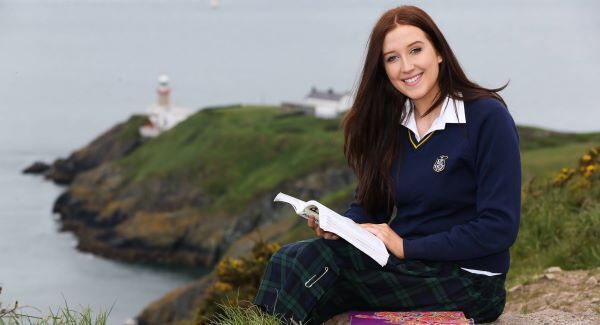
Sophie McKenna, 18, is putting in her last study hours before the exams hit.
She’s supremely placed to practise meditation; her mother, the writer Siobhán McKenna teaches stress meditation. And when her sister faced the exams, Siobhán gave her lots of techniques to help her survive.
Sophie says she doesn’t need such props. And that’s because, in her mother’s words, she has a mindful way of life.
“I don’t know if I got it from mum, but I’m aware of my thoughts and I keep my thoughts positive,” she says. “I’m careful not to dwell on things that will make me stressed. I’ve learned that I have to accept my capabilities. And that there’s no point in stressing too much.
“Our guidance counsellor at Santa Sabina in Sutton is good too. She’s great at giving people stress guidance, and she teaches us to be realistic too. She will say, ‘if you don’t make the grades, there is another route. There are other ways to get a course without repeating.’”
“I am working hard. I go to my granny’s house where there is no internet and no distractions. I leave my phone behind, because that can stress me. It’s not all work. I played tennis yesterday. I think that helped my study. I went home and felt energised afterwards.
“Some of my friends are stressed. They’re scared of failure. I just accept what will happen, and trust that everything will work out ok.”
7.11 breath. Breathe in to the count of 7. Breathe out to the count of 11. That will instantly lower your heartbeat and reduce stress.
Body scan. Identify where the stress is in your body. Breath into that area.


CONNECT WITH US TODAY



Be the first to know the latest news and updates









