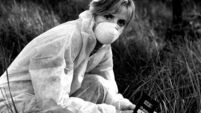
Meet the Irish photographer using military technology for his refugee-related exhibition
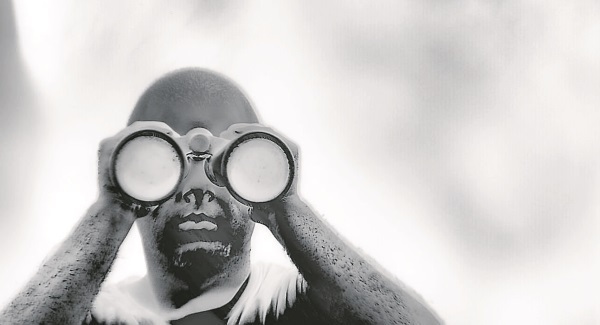
WHEN I meet Kilkenny native Richard Mosse, he’s directing the finishing touches to the paint-scented exhibition space of The Curve in the Barbican Centre, London.
Along with collaborators Ben Frost and Trevor Tweeten, they’re ensuring Incoming, their three-year project on refugee and illegal migration, is just as he envisaged back in his warehouse studio in New York, which involves tinkering with the backlight of panoramic stills of refugee camps and adjusting sound levels of the three-screen film, hampered only slightly by the London Symphony Orchestra rehearsing next door.
The four-piece project follows Mosse’s Deutsche Börse Photography Prize-winning exhibition of The Enclave in 2013, which used a defunct military camera that turned camouflage-green into a trippy pink to create surreal and striking imagery of the civil war in the Democratic Republic of Congo. For Incoming, the military equipment used was a high-spec thermal camera with such accuracy that it is able to identify faces from 6km away, day or night.
“In a way, the two works are in dialogue,” he explains, after one of the final run-throughs of the 52-minute film. “If The Enclave was looking backwards at a part of photographic that’s extinct, then Incoming is looking forward.

“I was using this military technology against itself. I’m trying to use it to meditate on the refugee crisis, to reveal aspects of it that maybe would be overlooked. It’s a good space to reveal how our governments regard the refugees. It’s really about western subjectivity - that’s why I titled in Incoming, because there are significant meanings to that word.”
Part documentary, part political statement, and always beautiful in its delivery, it depicts journeys from either the Middle East or from Africa, where nationals flee danger, persecution, or climate change as their lands are no longer arable. To capture the various stages of migration, Mosse and his crew travelled across three continents to find key points of their journey.
“The Sahara Desert was the most dangerous place, because of Al Qaeda,” he explains. “But we had 18 soldiers as escorts — it felt like a whole platoon.
“We wanted to film in Mali, but there was a full-scale war there, so instead we intercepted the refugees in Niger, which isn’t particularly safe either.”
Between almost voyeuristic glimpses of everyday life, a choice few scenes shock their way into memory: a smiling face with eyes made soulless by the heat-detecting camera. The Jungle refugee camp in Calais set alight, looking like a raging inferno through the lens. Two children in a refugee camp playing near a patrolling security guard, a reversal of the invisibility-dynamic between refugees and the West. A medic’s handprint as they attempt to warm up a body rescued from the sea. A key scene in a morgue, where the femur bone is extracted from putrefying body of an 11-year-old girl for its DNA.

“That was pretty horrific to film,” Richard recalls. “The smell was mortifying. The camera neutralised the gruesomeness in a way that was effective for communicating that narrative — had it been shown in colour, would have been too much for an exhibition.
“I expected to come out and vomit, but actually I came out feeling somehow lifted by the humanity of these Greek pathologists who treated the bodies with the utmost care. Of course, Greece doesn’t have to do this. It’s a bankrupt nation, these people are stateless.”
Interest in this exhibition is palpable; it will be shown in the Barbican before moving to Australia later in the year. The million dollar question: Will it be shown in Ireland?
‘It’s not scheduled but I’d like to show it, especially as I’m spending more time in Ireland,” he says.
His family isn’t the sole reason for his more frequent visits; last year, he bought a home in Co Clare as a retreat from New York life.
“It’s very special, it’s a tiny stone cottage in a national park,” says Mosse. “It’s very modest and isolated, and I spend about a quarter of my time there now.

“New York is great for making work and it’s arguably the epicentre of the art world, but it’s great to be able to recharge your batteries, to be able to think, sleep and walk on the hills. The best ideas are when you’re retreating from the world.”
The son of Nicholas Mosse of the pottery empire, and from a long lineage of sculptors, stone-carvers, and painters, 37-year-old Mosse remembers an art-filled childhood in Kilkenny.
“We had artists come in and out the house, poets too, they were a crazy crew,” Mosse recalls. “But no one I knew was a photographer, so that was my way of carving out a niche.”
He studied in prestigious places such as King’s College, Goldsmiths, and the Yale School of Art, before finding a niche as “a documentary photographer, trying to inhabit the contemporary art world”.
It was with his ‘pink period’, as he describes, that his work began to make a global impression, so much that it seeped through to popular culture with Netflix film Beasts of No Nation. This, in addition to exhibitions in Ireland, Florence, Berlin (where he also lived), Amsterdam, Iceland, and the world-famous Venice Biennale
In the last few years, he’s made New York his base, but proving that you can take the man from Ireland etc, he underplays the move.

“New York isn’t going to make you a better artist, it’s just that you have to play a different game,” he says. “Some people don’t like that game and they find it ridiculous, and they’re probably right.
“I enjoy all that, but I don’t spend too much time in New York anyway, because of my field work I’m on a plane every week. So I don’t go to openings or hob-nob with curators as much as I should. Most of the time I’m out there making my work.”
Indeed, it’s a determined artist that spend months flying to hard-to-reach places; not only the Democratic Republic of Congo, but in three continents for this piece alone.
“Especially when you travel a lot, you compromise on the rest of your life,” he says, as our conversation wraps up. “But I refuse to change that because I’m committed to my work. I believe in it.”


CONNECT WITH US TODAY



Be the first to know the latest news and updates