Book review: Some Luck
Jane Smiley
Mantle, €17.99, hb)
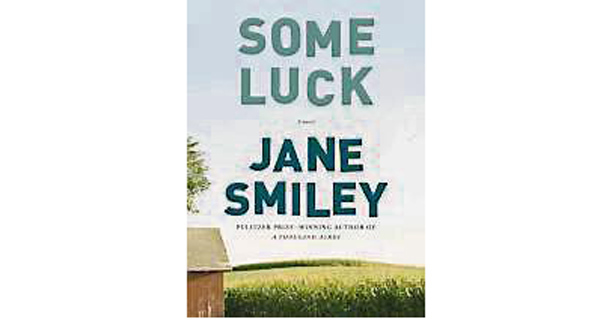
Jane Smiley returns to the agrarian American mid-west setting of her 1992 Pulitzer Prize-winning A Thousand Acres for Some Luck, the first book in a proposed ‘Hundred Years Trilogy’ that will span a century in Iowa from 1920, with young farmer Walter Langdon — returned from the trenches of WWI — experiencing the blend of joy and terror that comes with being a new father who has just bought his first farm.
Walter’s pragmatic voice (“Oat straw was also a beautiful colour — paler than gold but more useful.”) is by no means the only one to be heard in Some Luck.
The story offers perspectives from Walter’s wife Rosanna and their growing brood of children — Frank, Joe, Mary, Lillian, Henry and Claire — all of whom have distinctive takes on the experience of growing up on a farm in rural America.
The novel covers the years from 1920 to 1953, and so incorporates major events in recent American history, such as the Wall Street Crash, the Great Depression, the rise of American Communism, WWII, and the post-WWII development of the Cold War.
Rather than deal with these events head-on, however, Jane Smiley tends to refer to them obliquely, or at a tangent (WWII is the exception, given that we follow in Frank’s footsteps as he fights his way from North Africa, across Sicily and into Italy).
Events such as the Wall Street Crash, for example, merit no more than a couple of lines of conversation between two characters, as they give voice to their fears that the crash might affect produce prices in the Mid-West.
The same applies to the Great Depression. While there are references to the ‘Oklahoma Dustbowl’, and times do grow leaner (and a ham-fisted attempt at an armed robbery by desperate men causes some excitement), the Langdons and most of their neighbours escape the worst of the deprivation and poverty — although, as always, prices keep on falling.
Despite the huge sweep of the story, however, given the backdrop of momentous events, the number of characters who appear and the timespan involved, Some Luck is a very intimate kind of epic, and one that is rooted in the domestic concerns of Walter and Rosanna Langdon.
Indeed, the recurring motif of the book is the physical manifestation of family domesticity, the house: at various points in the novel, the characters’ good and bad times are reflected in the kind of house where they live, and the condition of that house.
The novel opens with Walter walking out on his new farm and evaluating the farm’s prospects, but eventually turning to the solidly built home that lies at its centre; the devastation of the Great Depression is characterised by abandoned houses, which turn into eyesores on the landscape; and the novel concludes with the young Claire struggling to cope with the news of a momentous death, and the emotional churn inside that leaves her feeling ‘like an empty house’.
Beautifully descriptive in its depictions of an Iowa landscape at the mercy of volatile and extreme weather conditions — blistering sun in summer, savage blizzards in winter — the novel is an elegy for a forgotten generation but also a cautionary fable against mythologising their world (“Every house is in a dark wood,” warns Frank after his experience in WWII, amplifying the recurring fairytale motif, “every house has a wicked witch in it, doesn’t matter if she looks like a fairy godmother ...”)
All told, it’s an engrossing, bittersweet love letter to a people whose experience of a relentlessly changing world taught them to appreciate its natural charms but never underestimate its perils.
CONNECT WITH US TODAY



Be the first to know the latest news and updates

















