A fictional creation rooted in historical fact
TRIED for conspiracy to repeal the Act of Union in 1844, Daniel O’Connell was found guilty as charged. O’Connell believed the jury had been rigged, says Andrew Hughes, because it was packed with 12 Protestants in order to get a conviction. So, when the guilty verdict was duly delivered, O’Connell whispered to one of his co-defendants, ‘That jury would have convicted us of the murder of the Italian Boy’.”
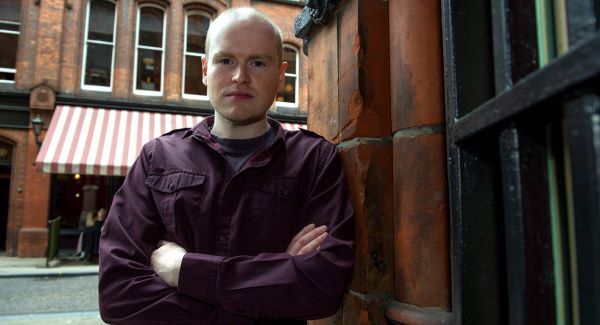
Wexford-born historian Andrew Hughes has just published his debut novel, The Convictions of John Delahunt. It’s an account of John Delahunt’s trials and tribulations, delivered from the Kilmainham cell where, in the early months of 1842, the condemned Delahunt waits for the hangman to arrive. It’s a time and a world that seems a million miles removed from the chic environs of Dublin’s Brooks Hotel, where I meet with Andrew Hughes; and yet, so persuasive is John Delahunt’s first-person narrative of early-Victorian Dublin, I feel obliged to tell Hughes that it’s likely I’ll refer to him as ‘John’ at some point in the interview.
It’s intended as a compliment, but Hughes — understandably — winces. That’s because John Delahunt is the most charming and lethal sociopath in Irish literature since Freddie Montgomery in John Banville’s The Book of Evidence.
At the time he first encountered Delahunt, Hughes was researching Lives Less Ordinary, a historical account of Dublin’s Fitzwilliam Square.
“Even though I had no intentions back then of writing a novel,” says Hughes, “I started looking for reports about the ‘Italian Boy’, and that’s when I came across the name John Delahunt. Delahunt wasn’t the suspect, he was the Crown witness and he had sworn information against Richard Cooney for the murder of the ‘Italian Boy’. So I researched a little more and realised that 10 months later John Delahunt comes forward as a witness to another crime, the murder of the young boy Thomas Maguire. Suspicion arose — as in, how could this man be witness to two capital crimes in so short a time?”
Exploring a variety of sources, Hughes discovered that John Delahunt was a paid informer for Dublin Castle, a man with a vested interest in seeing criminals brought to justice. The more serious the crime, of course, the more money a man like John Delahunt could earn for his informing. The temptation to invent information, and to pervert the course of justice for profit, proves overwhelming for Hughes’ version of John Delahunt, who is a fictional creation rooted in historical fact.
We first meet Delahunt while he is being examined in his cell by the phrenologist Dr James Armstrong.
“Dr Armstrong subsequently wrote a report, which was published in a phrenological journal in 1842 under the title, ‘John Delahunt: The Murderer’,” says Hughes. “In there is an interview with John Delahunt, plus his findings — all the bumps and lumps of Delahunt’s skull, which Armstrong was sure proved that Delahunt was always going to become a murderer.
“When I read that I thought it seemed like a good first scene to me. Delahunt in his condemned cell waiting for the hangman, and this weird early-Victorian science quack comes in. Armstrong thinks phrenology is cutting edge in terms of medical theory, but Delahunt sees through it. So immediately you have this way of setting up a character who sees through the absurdities of his age.”
Delahunt’s jaundiced take on Victorian Dublin allows the reader to identify with the character, but it’s also true that Delahunt is a charmingly erudite sociopath who is fully aware that he is trying to emotionally manipulate his potential readers.
“Despite the terrible things he does throughout the book, that we know he’s going to be punished for, we have to be able to identify with him in some way,” says Hughes. “Maybe not sympathise with him, or empathise with him, but we have to see that the situations that he finds himself in are not due to his intrinsic badness or evil. He’s found himself faced with these strange circumstances and he’s trying to do what he does to get by. The problem is his character, this kind of sociopathic tendency, and when these situations arise he very easily chooses the most expedient way to get through them, whether it’s informing on his friends or bumping someone off or whatever it happens to be.”
The Convictions of John Delahunt is a satisfying novel on a number of levels. It boasts the structure and content of a murder mystery and the vivid period detail of a professional historian, all delivered in a formal literary style. So — is it a crime novel, a historical tale or a literary offering?
“I didn’t really set out to write a particular kind of book,” says Hughes, who wrote the novel while attending a historical fiction writers’ workshop at the Irish Writers’ Centre, a course run by American author John Givens.
“I don’t think anybody sets out to write in a certain style — you write the book that you’re able to write. I think I was more influenced by the historical sense that I had from working with archives, and that kind of voice, that cadence of speech and vocabulary. And because it’s a Victorian novel, you’re going to be influenced by 19th century writing, but I was more influenced by Russian 19th century writing than English writing.
“Maybe I felt that the Irish have more affinity with that style of writing. Maybe because there’s always this hint of political turmoil in the background in Russia, and we could say the same for Ireland, especially the Ireland of that time. Or Ireland of any time,” he laughs.
He cites Dostoevsky’s Notes from the Underground and ‘fellow Wexford man’ John Banville’s The Book of Evidence as important influences, along with the work of Cormac McCarthy, “because in his writing very real violence is always on the sidelines, it’s always a possibility. And then, when it does break out, McCarthy doesn’t shy away from describing it in vivid detail”.
Given its content, however, the style of The Convictions of John Delahunt is surprisingly understated.
“I just thought I’d try to keep things as natural as possible,” he says. “It’s also true that people don’t actually change all that much throughout the ages. We’ll always have those kinds of characters, and I don’t think you have to ladle on that kind of arch Victorian ‘speech’. I also think that that’s more of a feature of Victorian journalism, that kind of sensational language, which might influence people who are writing novels of the period. But I made a decision early on to keep a natural approach to dialogue and description. It’s too easy to fall into a parody of 19th century writing.”
Despite its historical setting, the novel has a strong contemporary resonance. Hughes attributes that to the fact that our modern way of thinking about crime and justice is rooted in the Victorian era.
“It has stuck with us,” he says, “even in terms of Law and Order, and CSI. I suppose it’s because the Victorian period was the first time of organised police forces and detective work and tracking down criminals in a structured way. And then there was the media to report on it, and sprawling populations to revel in it.
“I didn’t have any sense, starting out, of writing any contemporary social commentary,” he continues. “But actually, as I wrote this historical book, I found that there were parallels with today’s world. Dublin back then was going through an economic slump the way it is today, Delahunt loses his home to the banks … but again, that feeds into this idea I have that times change, but the same things happen over and over again.”

CONNECT WITH US TODAY



Be the first to know the latest news and updates

















