When Jesse met Máirín: Raising a hand for women's equality through the years
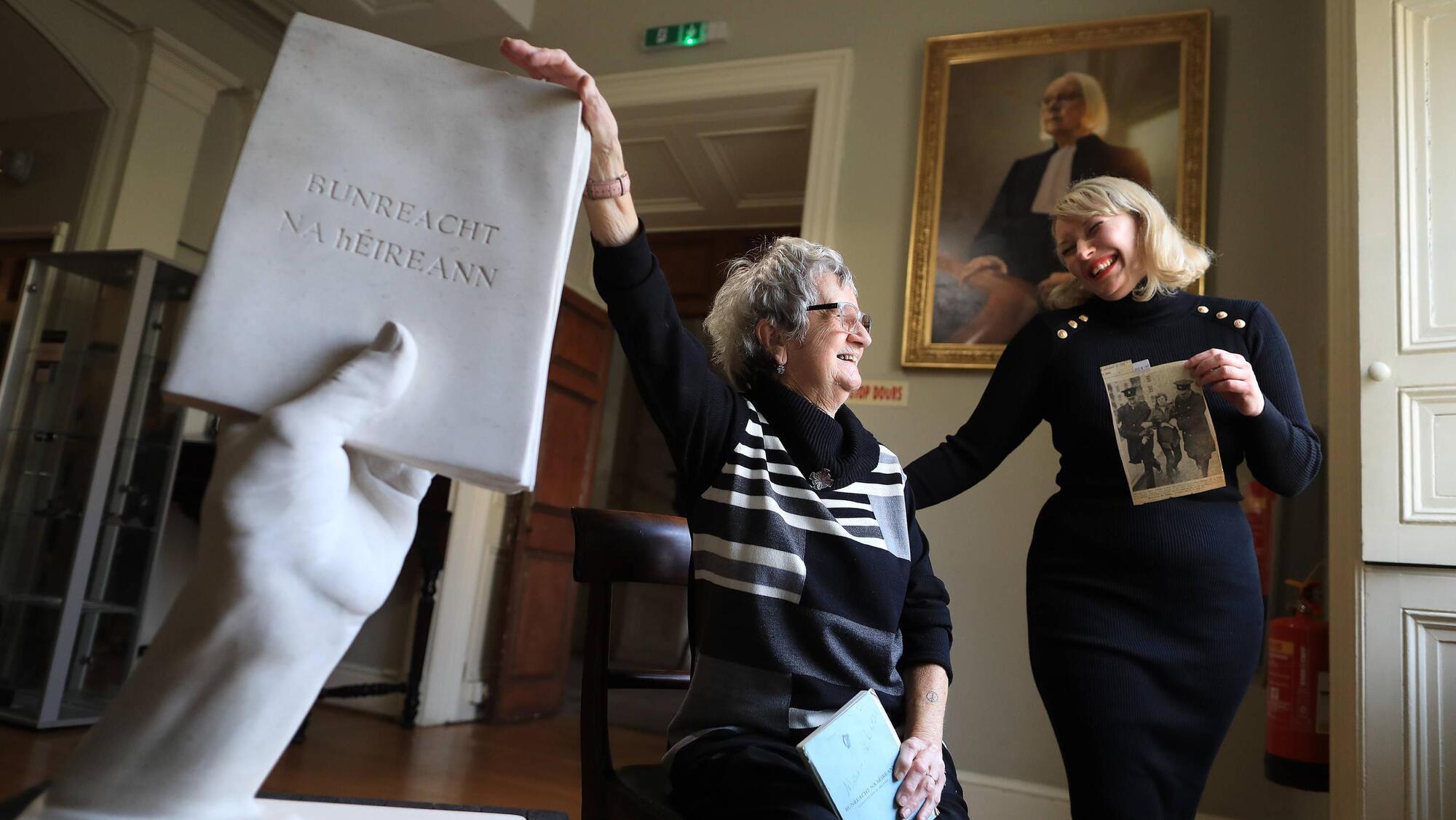
Máirin de Burca and artist Jesse Jones with a new piece, The Left Arm of Commerce, unveiled at King’s Inn in Dublin. Picture: Julien Behal
When artist Jesse Jones began a creative residency in King’s Inns, Dublin, she was given unprecedented access to the home of the Bar of Ireland and training ground for barristers. She immersed herself in the law, living in a cottage on the grounds, walking through the buildings and trawling through the archives.
The fact that she mainly had the place to herself when lockdown struck gave her an even more intimate connection to her surroundings. It was fitting that the muse struck one day as she walked through the grounds.
“I saw the Three Graces [the mythological daughters of Zeus] that are there in the park and one of them is missing its left arm. That really struck me as a metaphor for this sense of absence,” says Jones.
The absence in this case was the lack of acknowledgement given to the contribution of women to the law and the legal system in Ireland. This can be seen most obviously in the fact that in King’s Inns, there are only three portraits of female judges among the depictions of dozens of men.
“In a way, that [missing arm] became a simple metaphor for wanting to think about the gaps in our legal history and how women were excluded from the law, which still impacts on women’s lives today,” says Jones.
When it came to the subject of her planned artwork, Jones chose pioneering activist Máirín de Búrca, whose legal challenge in 1975, along with Mary Anderson, resulted in women being allowed to sit on juries for the first time since 1927. De Búrca and Anderson initiated the challenge after they had been arrested for taking part in a housing rights protest and realised that they would be going before a jury of 12 property-owning men, the criterion for selection at that time.
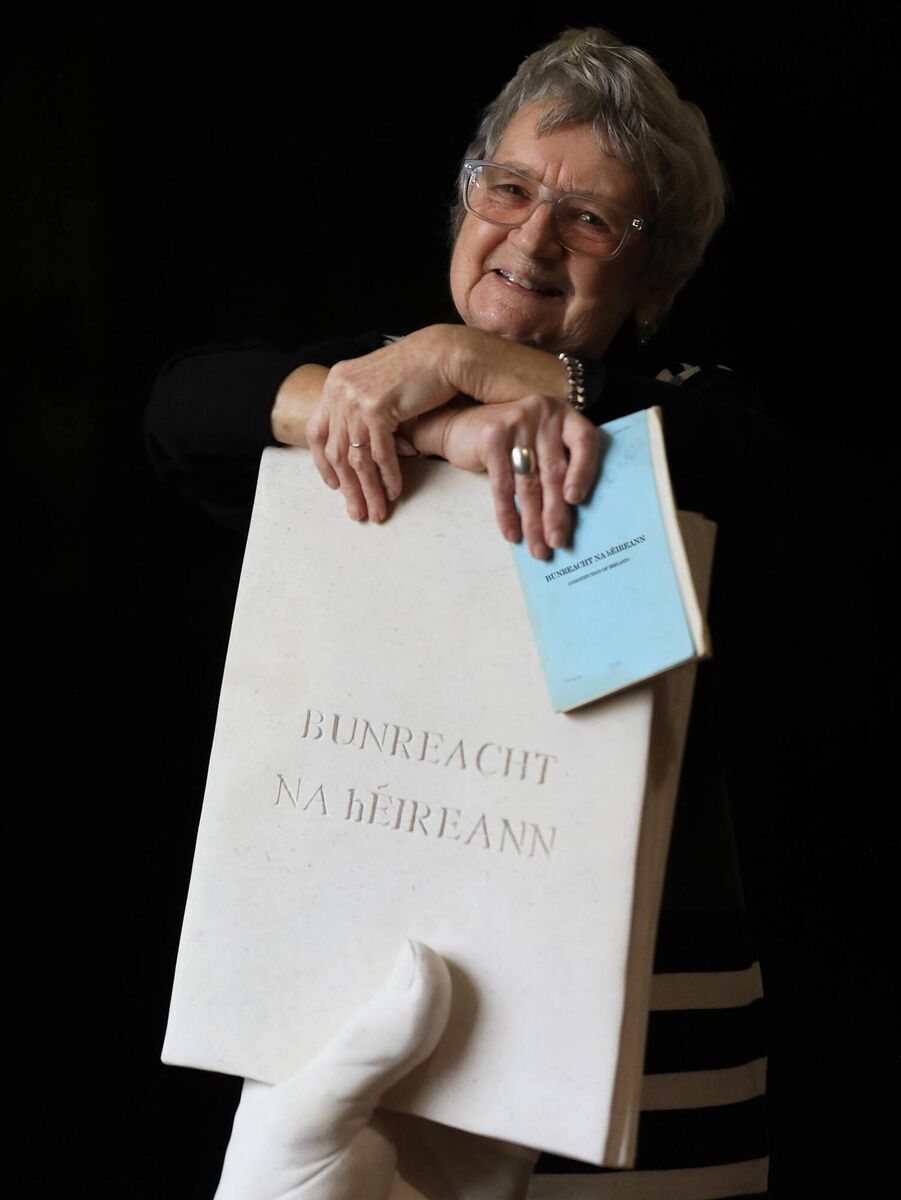
The resulting work by Jones, The Left Arm of Commerce, is a sculpture in Portland stone, depicting de Búrca’s arm and hand, holding her own copy of Bunreacht na hÉireann.
“I was thinking what would it be like if we had a monument to somebody who was disobedient to the law and in the process was able to be part of a massive change? I had always known about Máirín and I was always very interested in her housing activism from the Dublin housing campaign in the ’70s. She just felt like somebody whose story and its connection to the law could intervene in that space and break down that conversation about what does it mean to be part of the people who make the law in this country,” says Jones.
The permanent sculpture was created through 3D printing rather than the traditional casting method, before being rendered in stone.
“It was like a medical procedure. It is basically taking thousands of tiny photographs that all get stitched together so you get a really accurate version of the person’s arm. It is like a casting but with photography, which I found fascinating as a filmmaker, that a photograph can become stone. To make my first ever permanent piece in stone has been transformative in terms of the way I make work.”
The sculpture, which was unveiled last night, is positioned across from a portrait of former Supreme Court judge, Justice Mary Laffoy.
“That was a particular moment in terms of these two women in conversation with legal agency and legal history. There is that nice relationship between these two women and their impact on the history of Irish law,” says Jones.
She also wanted to acknowledge the work that remains to be done in terms of addressing the inequalities of the Irish legal system.
“We still have all these gaps and omissions. There are definitely parts of the law which don’t take into account women’s lives and women’s lived experiences. We saw that so much during the pandemic with the rise of domestic violence and how little that is supported in terms of the courts in Ireland, how women are retraumatised and often have to face their abuser in court."
Jones says we still have a long way to go in terms of equality. "We need examples of moments when we win to order to keep fighting. That is why I felt that Máirín was a great example — here is a moment when we did win and it is important it is held in the history of the King’s Inn and that students that go to law school in Ireland know that women had to fight to be on juries.”
For de Búrca, 83, the sculpture is personally gratifying but also an acknowledgement of the achievements of the wider Irish women’s liberation movement, of which she was a founding member.
“You don’t expect at my age, or at any age, to be the recipient of such an honour. I am really chuffed about it. This is not false modesty — because nobody could accuse me of being falsely modest — but I do see it as a recognition of all of us in the women’s movement in the late '60s and early '70s. I would never claim that we were responsible for every benefit that occurred to women over the last 30 or 40 years but I think we did give the process a good push.”
Jones says it was emotional when De Búrca got to see the completed sculpture. “The process has been a long one as I made the sculpture in lockdown. and production was delayed. To finally see it in the space is a moment of relief at getting it over line. It really feels likes it belongs there. Usually I make films and performances — it is the first time I have made a permanent artwork.
"It was a nerve-wracking experience to make something that was going to be there for that long. Obviously, Máirín’s reaction was the most important to me. She just kept saying it would be there longer than she will. There was that sense of permanency.” De Búrca herself says she is very happy with the final result.
“It is a beautifully realised piece of sculpture. I know that Jesse put her heart and soul into it and that shows,” she says.
The whole process has been hugely rewarding for Jones and she says she is grateful for the scope that the creative residency, made possible by the partnership between Dublin City Council Culture Company and The Honourable Society of King’s Inns, gave her.
“Artist’s residencies and creative residencies are highly important and we just don’t have enough of them in the country at the moment — especially when productions are delayed with Covid and we maybe don’t have as many public moments of art until we come out the other side. But artistic research is something that can be really enlivened during this process.
"I was so lucky to get to do a module in jurisprudence — as an artist, I never would have thought that would happen to me. I was living in a law school and studying law. It gave me a connection to another discipline where I started to see that it does have a strong impact on the world, it is not just an abstract thing any more.”