‘You wouldn’t do this to a dog’
IT’S hard to know what to expect when 226 men are unlocked from cells after 12 hours inside. Particularly when they’ve only had a plastic bucket to use as a toilet and the bulk of cells, about the size as a box bedroom, have two men packed into them.
The ‘slop out’ room in A1 wing in Cork Prison comprises two large and filthy toilet bowls. It’s a narrow, open room, with a container of disinfectant on the floor, a mop beside it, and another mop holding a window open. It has a concave floor, with a small drain in the middle.
As the clock ticks past 8am, we are taken to C block and into the C1 landing. This is where prisoners who are best behaved stay.
Accompanying us is chief officer John Connolly, an imposing 6ft barrel of a man, 35 years in the job, 13 of them in Cork Prison.
There are single cells and a more relaxed regime in C1. The lino, although grey, is gleaming and the slop out room is less scary than A1. The walls are clean and white, and the bowls are clean. There is a long drain in the floor.
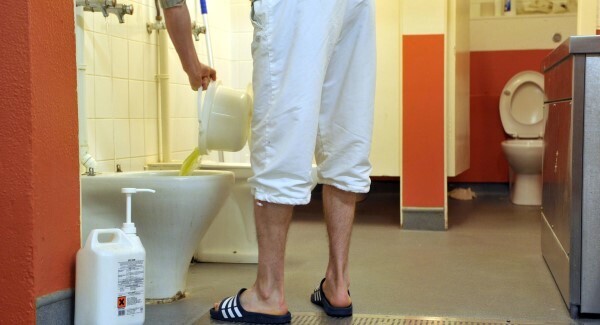
At 8.09am the cells are opened individually and men make for the slop out room carrying white buckets with lids. There’s little ceremony or drama to the ‘slopping out’. It is similar to a quick pit stop: Contents are emptied quickly into the toilet, the bucket is washed out with a tap over the toilet, and disinfectant is spayed into it.
It’s over in a matter of seconds. Then the next person goes through the motions. Despite the presence of a journalist and photographer, accompanied by prison staff and officials from the Irish Prison Service, there are jokes and banter between the inmates.
Some only give the quickest of rinses to their bowls. Others don’t bother with the disinfectant. None seem to wash their hands.
“Ye get used to it after a while,” one prisoner says. “It was bad at first, but I’m here four years.”
The inmates grab milk and fruit from a trolley and are back in their cells. Some queue for the cubicles, toilet roll in hand, with one quipping from inside, “take a photograph of this”.
— — — — — — — —
We are brought to an outdoor area outside the main A and B block and confronted with an odd sight, which requires only a brief explanation from prison staff.
Little white bags are caught up in the barbed wires outside a wall on the block and on an adjacent wall. This is where inmates have defecated into the bags and shoved them out through narrow slits in the grills at the cell windows. A specialist company has to come in from time to time to remove them.
“The big thing here,” Connolly says, looking up at the bags, “is obviously the lack of in-cell sanitation and overcrowding, having two people to a cell, sometimes three.”
He says this is due to the sheer amount of committals — ie, those sent by the courts to the prison. “The biggest issue is the volume coming in for not paying fines. We have to process them and they literally go back out.”
Walking around outside, the separate buildings, grey and grim, comprising the prison are packed tight together. Inside you can feel the age in the walls, but they are painted brightly, in reds, magnolia, peach, and white, and lino floors throughout are spotless and gleaming.
At the second landing in the Bl block, or B2, the rubbish bin near the slop out room is overflowing and bags lay on the ground.
On B3, tops, shorts, towels, and other clothes are draped over heaters that run along the middle of the landing, looking down to the lower floors.
At 9.10am, the cells are unlocked again. On B3, with 31 inmates on the landing, it is busier and there is more of a rush to slop out.
First is a muscled man carrying cutlery and a rubbish bag. He laughs as he washes his plate and utensils, while a guy beside him empties his bucket into a toilet. Grabbing him on his way out, he says he doesn’t mind it now, that he’s used to it. At one stage there is a little queue to get in, with four men already inside.
Later, we talk to the muscled youth in his cell, which he shares with a friend. Neither of them look particularly hardened. Aged 24 and 22, and from Cork, they are in for assault, 12 months and 18 months respectively.
“It’s grand,” says the muscled guy, “I thought it be worse. The slop out rooms smell bad [but] OK.”
His friend says the slop out rooms are “disgusting”, but that they were OK as they were both “hygienic”. They busy themselves in the school during the day and the gym at night.
More serious-looking guys are hanging out on the landing. One big fella is mopping the floor of his cell and outside. The inside of his cell is decked out impressively in posters, mainly Rasta ones. He’s doing 16 months and has six done.
“The slopping out is bad, the worst part,” he says. “The smell can be awful. Some guys do a shit in bags and throw it out the window.”
Guys on the other side of the landing are messing with him as we speak. “Sure go in for the night with him and see what it’s like,” says one.
When it’s put to him that some people on the outside mightn’t care what their toilet conditions are like, he says: “We do our punishment already. You wouldn’t do this to a dog.”
The inmates are given 20 minutes or so to use the toilets, clean up, hang out, and have a chat. There’s little sense of hostility.
“We’ve very little agro here,” says Connolly, “nothing like the gangs and violence in some other places. We have older staff, too, they have a good relationship with the prisoners. A lot of the staff have teens, so it’s similar to here.”
The governor goes around to each of the landings during the morning meeting the inmates and dealing with any issues. We see him busily crisscrossing between cells, landings on our tour.
— — — — — — — —
Down from B3 is A3, a protection wing. There are two categories here, those on white card and those on blue, who are on a more restrictive regime. “Those on white are protected from the general population and can mix with other white cards. Those on blue are protected from the general and from white,” Connolly explains. “They might be here for drug issues, feuding, afraid with mixing with people. Most of it is over money owed.”
Another officer says the white cards get half-an-hour in the morning out in the exercise yard and that about half of them take it. They get an hour-and-a-half in the evening and most take that. He says the blues get an hour in the afternoon, but “very rarely” come out.
Connolly says there used to be only two to three on blue, but there are nine now, making it difficult to manage them. At the same time, he points out that the numbers on protection have dropped, from 60 in 2012 to 26, due to the introduction of enhanced regimes, which allow inmates more benefits and entitlements if they behave well.
We travel down some steps into the surgery. Connolly says there is a “very good healthcare system”, with six nurses, a full-time doctor and psychologist, and part-time psychiatrist.
Ed Stack, a prison orderly, joins us and warns of imminent developments as a result of the Haddington Road Agreement. “We have a nurse night duty, but they are looking to get rid of her under Haddington. We are going to go back 25 years.”
He is clearly concerned, pointing out they had three attempted hangings at night. “I’m here 25 years and all the major incidents are at night. I’m very worried.”
— — — — — — — —
We ask to be brought to the D wing. It is here that the atmosphere of our visit shifts. We step down to D1, known as medical. It’s darker and claustrophobic, as if descending to a basement. We are taken right to the bottom, where there are two special cells: A safety observation cell and a close supervision cell.
The safety observation cell is for serious medical issues, such as after an attempted suicide. Inmates are held for a short period and checked every 15 minutes.
Inside it is like something from a dystopian sci-fi movie. The floors and walls are made of special cladded material, which have a bit of give when you press against them.
“If you bang your head you can’t do serious damage,” Connolly says, adding that an inmate “can run at the door”. The cladding is beige in colour with a blue mattress on the bed and brown bedding folded over, which can’t be torn. There is a television behind a screen and proper in-cell toilet by the bed.
He recalls a situation where an inmate once ripped a mattress and stuffed the foam into his mouth, killing himself. That can no longer happen. “The worst thing for a prison officer is to find someone hanging or after self-mutilating.”
There’s a strange feeling here in the bowels of the prison. The safety observation cell is controlled by the medical staff, while the one next door, the close supervision cell, is controlled by the governor.
Prisoners are put in here for discipline reasons. “We’ve had hostage takers here, inmates who are totally uncontrollable, who are sent here for discipline. They are nothing but trouble, engaged in dirty protests. These are prisoners who want to take on the system. They are sent to Cork. It’s horrendous for staff dealing with them.”
Two months is the maximum anyone can be held for discipline.
There’s a corridor that leads down to these special cells. There are three cells on this dark, tight corridor, no more than 6.5ft in height. It’s grim and claustrophobic. One of the cells is open and a man is sitting on the edge, looking blankly ahead of him, in a bare cell with long slits for windows. He stands as soon as we enter. He’s wearing misshapen clothes and doesn’t seem to be particularly well. As it turns out, he’s in for a relatively minor crime and appears to have mental health issues. He’s terrified of mixing with the other inmates.
We meet another prisoner in a tiny gym, an intense man, aged 35, he says. In the next breath, he says he’s done 20 years in all, including for manslaughter and theft. “I won’t be back,” he says when asked what he’ll do once he gets out.
The higher floor is D2, which is a discipline wing. The corridors are dark and narrow. Like D1, there are toilets on one side and three cells on the other. This is where the ‘red cards’ are held, the highest grade of protection prisoners.
“The reds are kept away from everyone,” Connolly says.
Two of them are occupied. The one that opens is grim, a dim blue light overhead, which we are told the inmates prefer to the brighter white light. There are no personal effects in these rooms.
“They are here because of their behaviour. This is discipline sanction,” Connolly says. “They can be held for a max of two months. That would be very serious. Normally it’s a week.”
There are on average two periods of exercise, about an hour each time, in an adjacent, and separated, small yard. One of them is out at the time, in what is a small, bleak yard, covered in metal grills and high, grey walls.
The prisoner is quite small and is wearing a long jacket. His head is bowed, as if in serious concentration. He looks up and he has a young face. He’s 22, we’re told, and from Dublin. He doesn’t object to us taking photographs, but he oozes intensity. He marches up and down in straight line, keeping his head bowed, his hands clasped behind his back, wearing a path into the concrete.
— — — — — — — —
Walking out to the main exercise yard for the A and B blocks is a relief after the trip to D block. Orange and white footballs dot the barbed wire along the wall, where they have been punctured and otherwise enmeshed, adding a surreal bit of colour to the greyness.
There’s not that many prisoners out — a line of seven or so on one side and a lone man in the far corner, hunched down. Past them is a separate yard for the protection prisoners, where despite the cold, a man is playing handball bare-chested with another guy.
One officer mans the hut halfway down (there is another post up on a tower). He explains that “their [the prisoners] conditions are our conditions”.
He says: “You get to interact with them, develop relationships, the problems they have. They’ll tell you about their families and stuff.”
He says it is “one of the best jobs” in terms of work colleagues: “I had a sick child and they [his colleagues] donated hours for me and the management agreed”.
— — — — — — — —
We make a quick detour to the visiting centre, which is known to be inadequate. There are about 10 inmates with visitors in a room with a low ceiling, no divides or cubicles between families, and a high, wide partition between the visitor and the visited. The visitors, mainly women — girlfriends and mothers — have to step up on the bar under the chair to get enough height to get over the 3ft partition, which also juts out a foot as a counter. They have to strain themselves to hear, such is the clatter. There is a strict no touching rule in the prison so inmates who are dads cannot hold or touch their children. Those on enhanced regime (the best behaved) can get family visits on Sundays, where they can touch each other.
— — — — — — — —
Often at the heart of prisons, the workshops certainly seem to be popular in Cork.
In the joinery workshop, they have a hurley repair section, used by clubs all over the country. The place echoes with drills, saws, and banging when we enter.
“There’s a savage demand for hurleys, particularly during the summer,” we are told.
The place is certified by the Munster GAA Council and some of those who work here apparently do work for some clubs after they leave.
Between this and the joinery side, they have up to 26 in the workshop, with a waiting list to join.
The computer/print workshop has a positive atmosphere and Nicky Donovan, who runs it, seems to be highly regarded by the prisoners there. “We’d be lost without her,” says one. “She’s like a mother to us.”
There’s about 12 in the class, which also has a waiting list.
Donovan explains they do everything here from birthday cards, calendars, historical booklets, and prison ledgers, to various Red Cross training manuals for prisoners and European Computer Drivers Licence courses.
The library is clean and well stocked, where ‘True Crime’ and ‘Sport’ is popular. On the DVD front, it may be no surprise that Love/Hate is a current favourite.
— — — — — — — —
The school is in full swing when we arrive and we are greeted by a busy principal, Katherine Coakley, who brings us first to the art room.
“They love it here,” she says. “It’s a nice space. The environment is relaxed. It’s a positive space. They get a chance to express themselves and make things for their families and children.”
Some 150 have done Fetac courses and about five are doing their Leaving Certificates.
The woodworking class is also busy and inmates make things such as small rocking horses for their children. They must do a health-and-safety course first, as they learn how to use jigsaws, sanders, blades, and drills.
The home economics class is also popular, where inmates learn not only basic cooking skills but also nutrition, skills they can bring back home.
“It’s good,” says one of the inmates, “ye get to learn about food and how to cook. I was only able to do Pot Noodle before.”
There’s also a crafts class, where prisoners learn how to handstitch and use the sewing machine, and, again, make the likes of quilts, for their wives and kids.
Elsewhere, the school provides all the normal subjects.
“Even if the bricks and mortar here is very old and run down you can still do an awful lot,” Coakley says.
Can the prisoners change?
“I do see changes in them. The school is a good place. For a lot of prisoners, the school has a positive effect on them.”
— — — — — — — —
John Connolly retired at the end of December, after 35 years in the job. He has been a chief officer since 1997, the longest service three-bar chief (the highest at that rank). He’s been serving in Cork, his home county, since 2000.
He believes prisoners must be treated properly: “They are still human beings. We must disassociate from the crime they have committed. If we did not we could not do our job. That would be the attitude of any prison officer.”
Can and do prisoners change in prison?
“Possibly they do change their ways, but success cases are a minimum.”
He adds: “But you have to realise where they are coming from. They come in here with no structure to their lives. Here, they are called for breakfast, given breakfast, called back to their cells, brought to workshops, school, given lunch, and so on. They get structure here. But when we open the gate and they walk out with a bag on their back, then it begins again for them. There is nothing for them.”
CONNECT WITH US TODAY



Be the first to know the latest news and updates