UNEMPLOYMENT FOCUS: DAY 3 - Tipperary signs of downturn painfully visible
AS A microcosm of how things have fallen in Tipperary when it comes to jobs, the case of the famous “Clonmel Chardonnay” is as good as any.
Little more than five years ago, Bulmers was in the middle of an expansion drive which would see its premises on Clonmel’s Waterford Road being greatly extended, an access roundabout to cope with traffic in and out of the factory with its dozens and dozens of storage tanks was constructed, and crucially for the local economy, a workforce growing in size to almost 700.
Today, the tanks are still there but the demand for the area’s most famous drink has slumped in comparison to its most successful years.
The numbers employed at Bulmers were recently down to about 220.
Once, company management spoke about its Magners brand cracking the UK market in “long alcoholic drinks” but a succession of bad summers was among the factors that led to the drink failing to live up to initial heady expectations.
It could rise again, expand production and have to take on more staff to cope with the workload, who knows? That’s a hope forlornly held by many across the economy.
From Nenagh to Carrick-on-Suir, Roscrea down to Cahir, the familiar tale of job losses, factory closures and empty commercial premises has been played out, just as it has throughout the country.
Back in 2006, official figures showed that the total number of people on the labour force, aged 15 or over, was 70,907 — with over 39,000 of those located in the county’s “south riding” area and the rest in north Tipperary.
From that number, 5,724 were listed as being out of work.
Last year, the labour force had risen to 75,328 but the total amount of people classified as out of work had jumped to 14,996. That’s a staggering more than three-fold increase in the amount of people on the dole, with the vast majority of those having lost their jobs or had to give them up for one reason or another.
The near-death of the property sector and its countless knock-on effect throughout many professions and trades is an obvious factor, but there are also many businesses which have had to close their doors throughout Tipperary, or cut back on trade and employment because of the recession, as a result.
While the cutbacks at Bulmers in Clonmel may be among the better-known casualties of the downturn, a steady stream of bad news has made its presence felt over the last few year.
Last summer, international pharmaceutical giant Johnson and Johnson announced it was closing a production facility in Cashel, the Cordis Corporation, which had only opened amid a fanfare of excitement and presumed prosperity five years beforehand. The news meant 133 people would find themselves out of work.
Further north, the well-known shopping centre O’Connor’s of Nenagh, which was a staple of the commercial and retail life of the area for many years, was forced to shut its doors for the last time with the loss of 70 jobs last May.
At the time, director Rory O’Connor said that the centre had been “struggling for a while” and had not been able to restructure its debts in time to save the business.
A couple of years previously, Procter and Gamble closed its plant in Nenagh, with 280 jobs held by people across north Tipperary and beyond being lost as a consequence. That came not long after the 2007 downgrade of Nenagh General Hospital, a move that also had ramifications for the local economy.
Other major industries to be hit in the north of the county in recent years include closures at Miza Pharmaceuticals, CM Offray, and GMX Moulinex, with the result that the manufacturing base is thin on the ground in the region.
Other cuts which will ring unwanted bells for people in the county have come at places like Kellys of Fantane, a major concrete supplier, and Liam Carroll Transport, where 100 people lost their jobs when that company closed down.
Tipperary town has not been immune to the bad news either, with one of its flagship employers since 1997 closing down early last year.
Pall Manufacturing was widely welcomed when it opened, in an area often ignored by major industry, and once employed about 250 people. However, the healthcare multinational let 150 employees go in 2003 when it closed its medical division and, in Feb 2011, announced it was closing altogether. In all, 97 full-time and part-time staff lost their positions in the machinery and equipment divisions.
In Clonmel, the likes of Merriott Radiators (formerly Barlos) and Fair Oak Foods, are on a list of formerly major employers whose premises are now empty, run-down and with apparently little hope of being filled by an alternative business in the near future.
And that’s not to mention the smaller outlets in the town centres where the lamented stories of high rents and rates coupled with declining spending money amongst the public has led to the dreaded “closing down sales” across all retail sectors.
Clonmel is a classic example of a large town where town centre retailers are struggling to keep their heads above water. Only a few years ago, new shopping areas such as the Marystone Centre and the Market Place, the latter anchored by Superquinn and an Omniplex Cinema, were bustling with activity and a wide variety of shops and eateries.
Now, both areas have the shutters and locked doors in front of more than half their outlets. Some of the shops moved to out-of-town facilities with free parking but most gone for good.
The three main shopping thoroughfares of O’Connell St, Gladstone St and Mitchel St are also littered with closed shops, while the once popular O’Connell Mall, opened just a couple of decades, is now shut off to the public.
For those employed in the sector, it’s been a case of the dole queue in most cases rather than walking into alternative employment.
Tipperary is known for the quality of its land — “at the heart of the golden vale” — and this has been to its advantage over the years, with agriculture and also the bloodstock and training industries proving to be vital employers over the years.
This remains the case, with the horse racing industry and its offshoots apparently bulletproof when it comes to the economy, at the top level at least, where Coolmore outside Fethard, and Ballydoyle outside Rosegreen dominate, but is joined by many other, much smaller, stud farms and training establishments across the county.
However, the consolidation of some farms into bigger, ranch-style operations is now a factor while growing automation has implications for job numbers. Meanwhile, the shutdown of Ireland’s once-booming sugar industry has also had a big effect in the county — the most obvious example of this being the now empty and near-derelict Siúcra factory in Thurles.
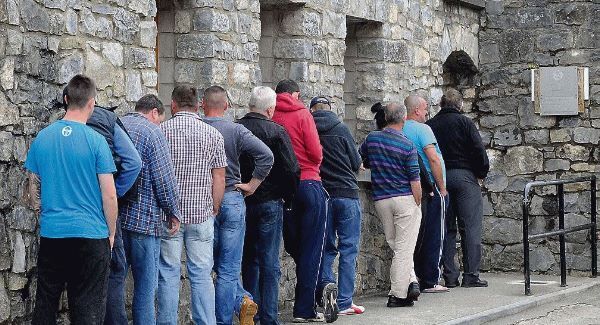
The padlocked factory gates, the permanently-shuttered shops, the derelict sites, the dole queues which have trebled in length in the space of five years — they are the physical, visible signs of the pain of unemployment in Tipperary, 2012.
By Conor Kane
It may not earn him an invitation to stand for election but businessman and author George Mordaunt believes the best way to cut unemployment numbers is to put a time limit on the dole.
Owner of a car dealership in Clonmel as well as having an involvement in other businesses, Mr Mordaunt hit the headlines in 2010 when he spoke publicly, honestly and passionately about the effect of the recession on his commercial and personal life.
He has since written a widely- acclaimed book, Shepherd’s Pie, on his experiences in business, and is now in demand as a public and media speaker as well as still running his motor sales company.
“You need to lean on your creative side to try and increase or create footfall to trade your way out of this and the Department of Social Protection needs to do the same,” he told the Irish Examiner.
“There are many, many ways of taking people out of unemployment and, at the same time, enhancing or inducing the employer to do so. I’d gladly hire two people right now if I thought there was a way to ease them into our budgets over the next two years. One way to do this, he says, is to redirect an unemployed person’s dole money to a “sponsor company” after a defined period of time — say, 15 months — and that company would take on that person with 60% of their wages coming from social welfare and the balance from the employer.
This 60% social welfare could be phased out over two years, by which time the new employee would be fully salaried by the business. “We have achieved three things. We have taken somebody and put them into the workplace which is a very positive thing. We have eased the burden on the taxpayer because over a set or agreed period of time you’ve phased out the social welfare for that individual and phased in a full salary for that individual, with money that will be spent in the community. Then I, the employer, can be supported by getting an extra two or three percent on my Vat payments as a rebate if I keep my individual on my books for three years.
“We have got to stop enabling all these people, sitting at home watching daytime TV and getting paid for it,” Mr Mordaunt says, adding it’s not the people who find themselves on the couch that he blames — but the regime that keeps them in such a situation.
“We’re talking about factory workers here, normal PAYE workers. In truth, those guys have become very skilled in manipulating the system.”
Is he confident of a sea-change in such attitudes at official level? “I just don’t see it in [Social Protection Minister] Joan Burton’s office and in the people around her. They’re not ruthless enough and they’re not creative enough.
“As Michael O’Leary said recently, he doesn’t need children’s allowance money... They [the Government] don’t have the leadership or the balls to make those statements.”
The Mordaunt family business had three car showrooms in Clonmel, and another in Kilkenny, before the recession kicked in, and is now down to its original, core base on Clonmel’s Waterford Rd.
With that paring-back of operations has come an inevitable loss of jobs but, according to Mr Mordaunt, such developments should not mean the end of the road for workers made redundant — as long as their expectations are realistic.
“Every person I made redundant over the last four years who wanted to go back to work, went back to work. I’d say there are jobs, but you have to remove an element of pride because some people will still shy away from certain jobs, because they believe they’re beneath them.
“You have to get people to accept that, while it may not have the earning capacity they require, it is better to get back into the workplace.”
State agencies whose brief is to encourage any projects which lead to the creation of jobs insist there is help out there for anyone with ideas.
Sometimes it can take a jolt for a long-fermenting plan to take shape and it’s not unknown for that jolt to take the form of the scourge of redundancy.
For those who might find themselves on the long jobless list but who feel they have the enterprise and the spark of creativity to do something about it — not just for themselves but for others — there are doors out there waiting to be opened.
Overall on the jobs front, the news hasn’t been that good in Tipperary this year. Ten jobs at the new Maxi Zoo retail outlet in Clonmel is one of the only Enterprise Ireland-backed projects to affect the south of the county while, in the northern half, there was better news for Ballina when medical devices company Technopath announced the creation of 40 new jobs.
When it comes to IDA projects, there have been two site visits to Tipperary so far this year and it remains to be seen what, if anything, emerges from those.
The last major development at an IDA-backed firm was last September. That was at the MSD pharmaceutical plant in Ballydine, outside Kilsheelan in the south of the county. Taoiseach Enda Kenny opened a new research and development facility there which has seen 70 new jobs created since 2007 and has the potential for another 50 in the coming years.
According to the IDA, Tipperary south has “a well-established life sciences sector” and the authority “promotes opportunities for Tipperary” in this area. At the moment, 3,500 people are employed at 12 IDA companies in the county.
On a smaller scale, anyone setting out with a business idea has the option of approaching the county enterprise board or Enterprise Ireland — the latter if the project is likely to result in manufacturing exports or service exports.
Supports from the county enterprise boards are usually provided to cover costs which arise from starting a new business or expanding an existing business and advice is also available from staff at the boards.
Other services which can be obtained from enterprise boards include skills training for business, mentors and support, management development, e-business advice and web development.
Enda McDonnell of Enterprise Ireland told the Irish Examiner that feasibility funding is available for entrepreneurs who have business ideas but need to establish their viability, while intensive workshops give budding business people an idea of what’s involved.
“It’s about being in a position to make that leap because it takes a lot of investment to develop an export business,” he said, before adding that Enterprise Ireland can help ensure that one’s own pocket isn’t badly affected just by testing out the viability of a project.
“It’s not just about funding but also about the capability [of the business person]. One aspect is the feasibility for companies and individuals that have a business idea and need to kick the tyres on that idea. The whole point is that they’re not put at a [financial] disadvantage.”
Meanwhile, for existing companies thinking of expanding into overseas markets, EI’s Going Global Fund is available to help test if such a move is worthwhile, “before they go to the cost and expense”.
Mr McDonnell agreed that, in population terms, the south-east has been “lagging behind” the rest of the country when it comes to new enterprise in recent years, but Enterprise Ireland are aiming to change this in areas like Tipperary.
One such example is Declan Crosse, from Tipperary, who was one of the winners of the €200,000 fund for boosting start-up companies across the south-east. The funds he received will help develop his biomass boiler manufacturing company, Wood Energy Solutions.
The IDA, for their part, offer employment grant aid for the creation of jobs in defined areas of the country, with the level of aid available “dependent on the location of the operation, the viability of the company’s business plan and the value/status of jobs being created”, a spokesperson said.
EU state aid rules permit grant aid up to 10% for large firms (global headcount of over 250 employees) while maximum rates of aid for small and medium enterprises are 30% and 20%, respectively.
By Stephen Rogers
‘JOBS initiative” “stimulus package” — two phrases that the more than 200,000 long-term unemployed must be sick of hearing.
As the economy began to slide into difficulty five years ago they were slogans which would have inspired hope — at that stage though there were only 175,000 long- and short-term dole claimants. Now the total stands at more than 460,000 with almost half of them claiming benefit continuously for more than one year.
Much has been made of the fact that the total number of dole claimants has fallen — in fact the figure for Jul 2012 (460,323) was almost 10,000 less than the figure for Jul 2011 (470,284).
However, even with fluctuations caused by seasonal employment changes, the total figure has dropped below 430,000 just once since the start of 2011. And in spite of the lower numbers on the Live Register in Jul 2012 than the same month last year, the Central Statistics Office still puts the “standardised unemployment rate” for the country at 14.8% for Jul 2012. It was 14.5% in Jul 2011. Last month, 4,750 men and 5,157 women joined the register every week.
The current Government was voted in, not just on the back of failures of individuals in the previous administration, but also on the promise of finally putting the economy back on track.
For all the hype, the election promises have not delivered the return people were hoping for.
To date, the Government’s much vaunted Action Plan for Jobs 2012 has been a success — for the art of spin. In the first quarter review, the Taoiseach proudly announced that 80 out of the 83 measures promised for the quarter had been met. Then after the second quarter, we were told a further 72 out of 77 measures had been successful for that period.
Do long-term unemployed really care that “Two visa programmes are operational for entrepreneurs from outside the EU — Immigrant Investor Programme [and the] Start-Up Entrepreneur Programme” or that “a survey on demand for credit from SMEs” had been published, thereby ticking two of the Government’s boxes.
It appeared at the end of last month that Fine Gael and Labour were finally putting their money where their mouths are by announcing a €2.25bn capital investment stimulus package which would not only improve infrastructure but also create jobs.
However, as was pointed out by economist Jim Power in this newspaper, “the fanfare is totally unjustified and smacks of a Government seeking to cover the last few days of the Dáil term in a cloud of hype and spin, and distract from the issues still smothering the economy”.
Jobs will be created by the move. But the majority will be temporary construction roles and, as Power points out, “it is not certain in any event that Irish firms and workers will benefit under the EU tendering process”. In fact, the 13,000 jobs the Government says the plan will create is the same as the 0.8% employment growth that has already been factored in for 2013.
Nonetheless, if and when the projects go ahead, they will provide a boost to the sector which has contributed most to surge in dole claimants. Employment in construction fell from a high of 269,900 in 2007 to 102,600 in the first quarter of this year.
But what will the plan do to alleviate the crippling unemployment in pockets all over the country? For example what has been done for Limerick City, home to seven of the State’s top 10 unemployment black spots.
There have been many references, even from those close to the Government, to the disparity in joblessness in urban versus rural areas. Limerick has the highest unemployment rate of any county at 28.6%, while Dublin has the lowest at 17.1%.
Economists have warned that while there have been small drops in dole claimants at different times over the last 12 months, emigration is playing a big part in keeping the numbers signing on down.
They also warn that there is unlikely to be any significant improvement on the jobs front until the economy starts to grow again on a sustained basis.
At the end of last month, Agriculture Minister Simon Coveney admitted he and his colleagues had not made enough progress in tackling unemployment. However, he also said there was no one action or jobs plan that would solve the unemployment problem.
“There is no government stimulus package that will solve all the problems,” Mr Coveney said.
“It will be people themselves and companies and the private sector that will help recovery. We must rebuild an economy, a country, stone by stone.”
The long-term unemployed have waited a year to get off the dole queue. A stone-by- stone recovery is the last thing they need to countenance.
‘One week I had work, the next week I didn’t’
Every weekend in the area where Andrew Dunne lives, a party is going on in some house or other with young people gathering.
The most usual cause of these parties is not a 21st or an engagement, but emigration.
But for Andrew and his family, this is not an option. “I gave 10 years in England already, before I got married and settled down. I’m not going to turn around now and say, ‘right, I’m 45 years of age, where will I go?’
“I wouldn’t bring my kids up anywhere else. The only place I’d rear my kids now is here, where I am. Why should I have to emigrate when it’s not my fault?”
Out of work for the last couple of years, Andrew has gone from travelling all over the country to earn a living, pay for his house, support the family and pay his debts, to sitting at home all day watching the unpaid bills mount and waiting for the bailiffs.
Before last Christmas, things came to a head when Andrew couldn’t afford to pay a €300 fine for his untaxed car. Gardaí ended up bringing him to prison in Portlaoise early one morning, before he was released and sent home to Ballingarry in Co Tipperary that evening.
“That was for not having tax on my car. I just didn’t have it, I said there was no point in them fining me. What kills me is that I went along with everything for years when I was working. I put a deposit on a house which cost €227,000. We got a mortgage for €200,000 and spent four or five months buying stuff for the house, so everything was bought and paid for out of our own money. We thought we were on the ball, on the ladder with a house that was worth €300,000. Then the arse fell out of the whole lot.”
Andrew worked in the building trade, running sites for developers, before going out on his own in 2007. “Everyone was telling me I was a fool to be doing it for someone else and making him money. I met a group of builders and they were begging me to work for them so I got a machine and got a few lads and set up on my own. I was making good money, working hard for it, but one week I had work and the next week I didn’t.
“That was it, and I had a machine bought and a 4x4 bought and a car bought and when things went bad I started falling behind on payments. The next thing I couldn’t get work and, because I was self-employed, I got nothing [in social welfare] for a year.
“The way things are gone now, the only way to get a bit of work anywhere is if you knew someone in Dublin and then it would cost €50 a day to work up there.
“There’s not a thing here.”
‘In the end, we said let’s give up the house’
Self-employed as an electrician and then in the building maintenance game, John Murray saw the bottom falling out of his economic world towards the end of the last decade.
Since then he and his family have lost their home and given up much of what they enjoyed during the Celtic Tiger.
“Flying it,” he remembers from that time. “No problems at all. I had my BMW and all the perks. I was living in my own home, but handed it back to the bank about two-and-a-half years ago.”
When things were good, he and his wife and sons lived in Ballindine in Kilsheelan, Co Tipperary. He worked for 10 years as an electrician and, then, became involved in building maintenance, picking up some public contracts within the construction industry. But it all went flat and, since then, he’s found himself on the unemployment list.
He traces it back to the mid-2000s. “I noticed that a lot of jobs I had priced and was fairly sure of getting, people were cancelling and the grants weren’t there for the work. People just decided things were going to get worse, they could see the writing on the wall.”
John “tinkered away on my own” for a while but, by the end, wasn’t making enough money to pay himself and, all the while, the bills and debts were building up.
“Losing the house was coming for a while but, in the finish, myself and my wife just sat down one night and had a chat. Our solicitor had advised us on what we could and couldn’t do so, in the end, we said to each other, ‘I think we should give it up’. She thought I wanted to keep it and I thought she wanted to keep it but why put ourselves under this sort of pressure?”
Recently he’s picked up some part-time work in Piltown, across the Kilkenny-Waterford border, but for a long time couldn’t even sign on as he had been self-employed.
John can’t see things improving on the employment front in Ireland. “I don’t see it changing, not unless there’s a turnaround and there’s no sign of that. All this bank debt needs to be written off and money needs to be found somewhere and pumped back in to the economy.”
* UNEMPLOYMENT FOCUS: DAY 1 - Ireland's job crisis
* UNEMPLOYMENT FOCUS: DAY 2 - Cork jobless total has trebled since 2005


CONNECT WITH US TODAY



Be the first to know the latest news and updates