Irish sky watchers ready for Perseid meteor spectacle
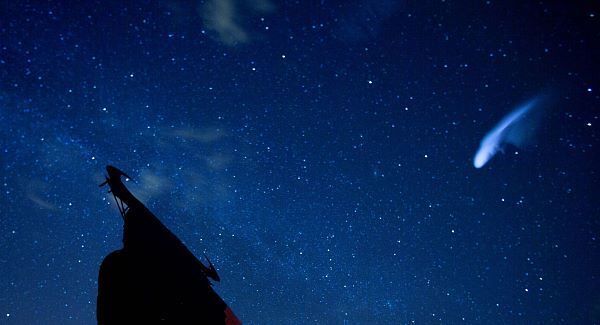
The shooting stars are due to peak on Friday, with 80 or more of the meteors streaking across the sky every hour.
Some experts predict the frequency could be double that figure.
This year’s spectacle will be more dramatic than usual as the Perseids reach the high point in their 12-year activity cycle.
The meteors consist of small particles, most of them no bigger than a grain of sand, shed by the Comet Swift-Tuttle that enter the Earth’s atmosphere at 59 kilometres per second and then burn up.
Planet Jupiter has shifted the debris stream so that more of it lies in the Earth’s path, boosting the meteor count.
According to the Astronomy Ireland website, the Perseids have been observed for around 2,000 years, and are the result of Earth passing through a cloud of dust left behind Comet Swift-Tuttle.
As the Earth moves through this cloud, the particles fall into our atmosphere and burn up, creating spectacular streaks of light in the sky, known as meteors or shooting stars.
This shower is named after the constellation Perseus, from which the meteors appear to come from in the sky.
If you trace back the path of a Perseid, you will find that it appears to come from a point in the north east, maybe halfway between the horizon and the zenith (the point straight above your head).

This year Astronomy Ireland wants people to take part in a Nationwide Perseid Watch, where you simply count the number of meteors — or shooting stars — you see.
“To take part in the Nationwide Perseid Watch, simply go outside and look up,” said Astronomy Ireland.
Count how many meteors you see every 15 minutes (if possible, start on the hour or quarter past the hour), and note it down.
“Then email us your report with your name, location, and the night you observed.
“The best night to watch the meteor show is Thursday night, but you can observe on any night around this date.
“You also do not need a telescope or any special equipment to view the Perseids.”
Robin Scagell, vice-president of the Society for Popular Astronomy in Britain said: “Every 12 years the Perseids are slightly stronger, and this year you could expect to see about 80 of them every hour under the best conditions, or more probably one a minute.
“Usually the Perseids are fairly dependable. There might be some long gaps and then you’ll see two or three at once.
“They’re fairly swift and dash across the sky quite quickly leaving trains behind them.”
Quoted on the website Space.com, Nasa meteor expert Bill Cooke said a Perseid “outburst” this year could result in 150 to 200 of the shooting stars per hour.
This is over-optimistic, according to Mr Scagell, who said 80 per hour would be a good tally.
CONNECT WITH US TODAY



Be the first to know the latest news and updates