Hopes of breakthrough in teachers row remain slim
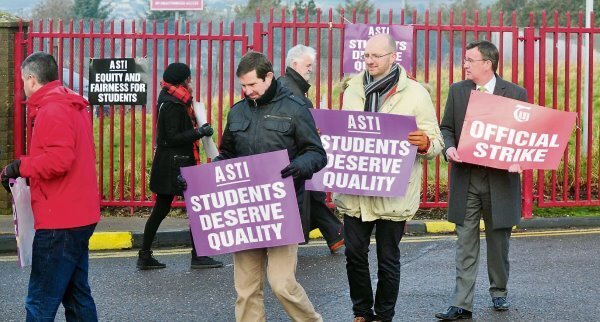
Second-level unions and Education Minister Jan O’Sullivan say they remain willing to discuss the impasse over who assesses Junior Certificate students. But neither side showed signs of budging yesterday from their current positions.
Around 340,000 students lost out on another day’s education at 720 second-level schools in the second strike in seven weeks by members of the Association of Secondary Teachers Ireland (ASTI) and Teachers’ Union of Ireland (TUI).
With the threat of another strike and further disruption to students as resolution remains elusive, union leaders and the minister said yesterday they are open to meeting again following an invitation by independent talks chairman Pauric Travers.
But the unions are standing firm in opposition to their 27,000 members being required to mark their own students for any aspect of the Junior Certificate.
Although she has agreed that final written exams would continue to be externally assessed by the State Examinations Commission, Ms O’Sullivan wants two pieces of coursework in second year and third year marked within schools, something she says is happening in many other countries for national exams.
TUI general secretary John MacGabhann said unions would go into talks on exactly the same basis as they had last week and in November.
“We are perfectly happy to go into meaningful, robust, discussions without pre-conditions. There was no breakthrough in last week’s talks but they achieved greater clarity as to the relative positions [of both sides],” he said.
“The fact there are further talks would indicate at least that there is some belief that further progress can be made,” Mr MacGabhann said.
He said any short-term inconvenience to students and families was regrettable, but the disruption is taking place with a view to long-term maintenance of educational standards.
“The aim is to ensure students, whether this year or in 20 years’ time, continue to have access to a public education system that has the values of equity, fairness and independence at its heart,” he said.
Ms O’Sullivan told the Irish Examiner she believes it is positive that Mr Travers, who chaired the short-lived talks in November and again last week, thinks there is scope for discussions.
“I’ve had good professional engagement with the unions, there isn’t a breakdown, there’s a willingness on both sides to continue to work on this,” she said.
However, she insisted the reforms will continue, having successfully opposed a Sinn Féin Dáil motion this week that sought to have the rollout of junior cycle changes paused until agreement with unions is reached.
“If they can respond in some way in relation to the school-based assessment issue, and give us some room to sit at the table, I think we’ll have a fruitful discussion. But they can’t continue to say they won’t move an inch in this area,” she said.
“There’s a lot to be lost by having another strike because that’s going to be very disruptive, particularly for Leaving Certificate students,” the minster said.
“I moved a certain distance. We have to see some movement on their side,” she said.
Despite union assurances that industrial action is being taken in students’ interests, Irish Second-level Students’ Union education officer Joanna Siewierska said a second strike was unfair to students at all levels, particularly those preparing for State exams.
She said the education of herself and other Leaving Certificate students is being disrupted at a very crucial time, with mock exams starting the week after next.
“The closing of secondary schools needs to stop. It is adding unnecessary confusion to the junior cycle discussion. Again, we respectfully ask teachers to return to talks with the minister,” she said.
ASTI and TUI members have also been refusing since, last April, to take part in training or meetings related to the junior cycle changes.
CONNECT WITH US TODAY



Be the first to know the latest news and updates