Tommy Martin: Jack was a quasi-religious figure at the height of it ... reshaping the national destiny to his will
When I think of the Jack Charlton years, I think of things happening that weren’t supposed to happen.
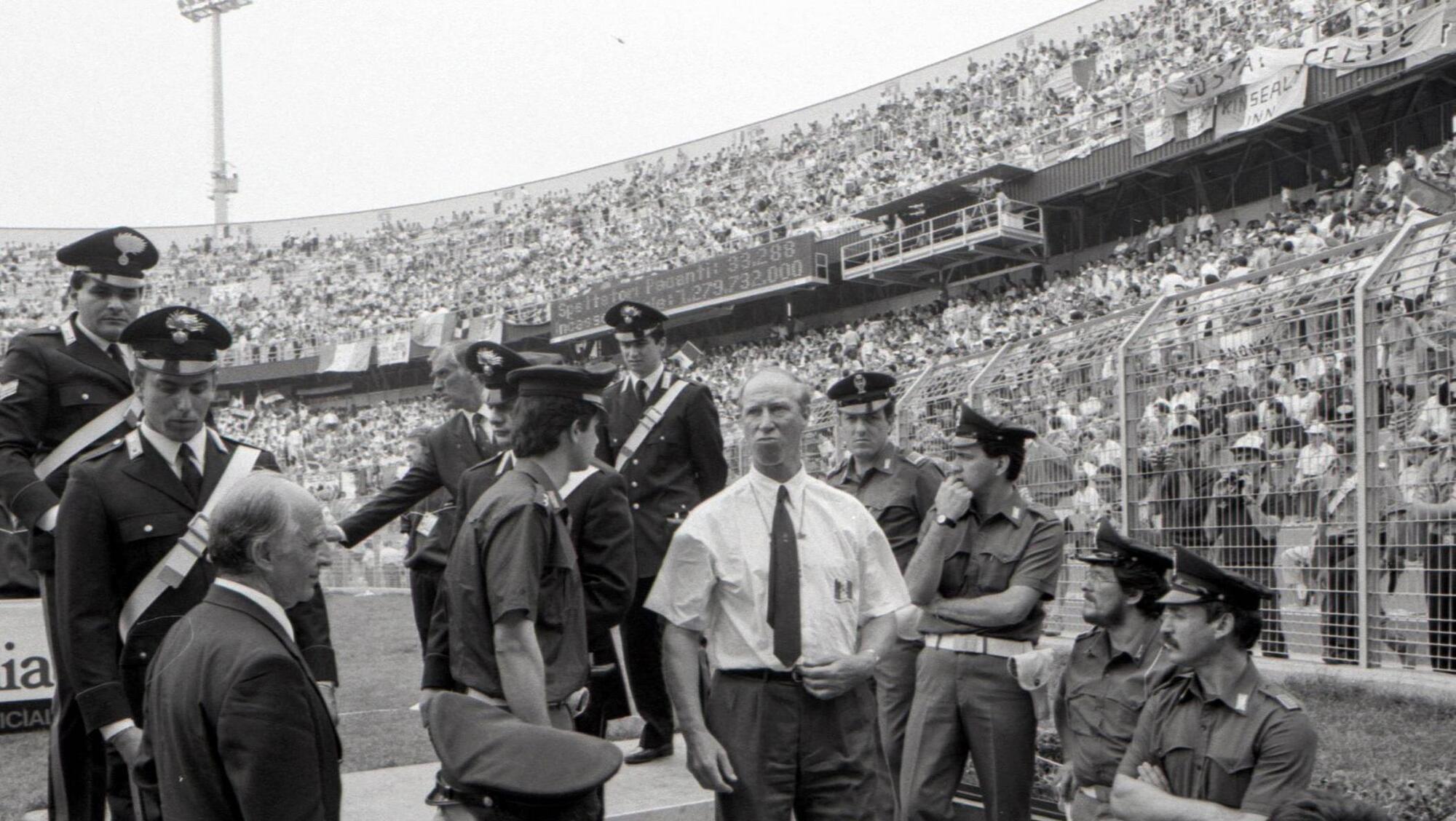
I think of the Saturday night of the 1990 World Cup quarter-final against Italy and the 20-minute mass our parish priest said so that he and his flock could get home for the match.
I think of the days before Lansdowne Road got floodlights, when important qualifiers would be played on weekday afternoons and a big, dusty television would be wheeled into the classroom so we could watch the matches. “Our school has a television?” we marvelled.
I think of a slip being handed to parents by our GAA club in June 1988 informing them that U12s training was being moved to after the Ireland – England match, a concession which I’m pretty sure required Croke Park approval at the time.
I think of Josie Joe, the local man who hitch-hiked all the way to Genoa. And he made it too, or so he says.
The church, the education system, the GAA, a continental landmass – none of the great certainties meant anything in the Jack Charlton Years.
And none of it was supposed to happen. That Sunday in June 1988 we watched the ITV studio team talk down to us in the build-up to the big game. Even the feat of qualifying for what was then an eight-team tournament didn’t earn the respect of English football orthodoxy.
“Beardsley and Lineker will be rubbing their hands together,” said Brian Clough, cutting to the chase once the fiddly-dee-dee condescension had been done.

And through it all Jack watched on, giving away with the occasional smirk that he was the only person in this whole escapade who seemed to think that this was supposed to happen.
You know the rest. Italia ’90, beating England 1-1 at Wembley, Giants Stadium, homecomings and hooleys. And we can’t stress this enough: none of it was supposed to happen.
Like somehow persuading my parents to let me watch the 1994 Italy game in the pub at the age of 16 – of course I wouldn’t be drinking, it was just for the atmosphere, promise.
Getting a lift to Hiudaí Beags in Gweedore with David Sharkey and Odhran McBride and Houghton’s goal going in and going on to the nightclub and the rest of the night being a blur and for the first time in my life getting absolutely, utterly, helplessly drunk and being frightened as I was carried home, not at what my parents would say, but because I was not a child any more but not yet an adult and didn’t know what I was supposed to do with myself.
I remember that feeling now when I think of that night in Giants Stadium, my mind entangling the two though they are, in reality, entirely unrelated.
The Charlton Years were responsible for individual coming-of-age melodramas no more than they were responsible for ushering in the Celtic Tiger. So why is it hard for anyone who lived through them to separate the achievements of a workmanlike football team from life-changing personal chapters and seismic shifts in the national story alike?
It could be because the Charlton years persist in the memory as a series of great, shuddering jolts.
All these things that weren’t supposed to happen did happen and, yes, almost every moment of it was joyful and liberating. But change and the dismantling of old certainties were the essence of the Jack Charlton Years, and that’s why they intertwine in our stories of ourselves, our country and our football.
Fittingly for a man who could be dictatorial and ruthless, Jack Charlton led Irish football’s Great Leap Forward. The clarity of his vision and the strength of his personality cult took the game in this country to places it could never have imagined going.
That the fear and self-loathing around the football team matched that in the broader Irish psyche at the time of Jack’s arrival wasn’t entirely coincidental. Irish football’s low standing was down to the same oppressive class and cultural dogma that had depleted the general national character.
The homogenous, Gaelic monoculture of de Valera’s aspirations stultified and suppressed those on the margins, including those who played soccer.
The garrison game, the townie game, the foreign sport. Despised and marginalised and un-Irish.
Maggie Thatcher’s game, as some back home used to say, ignorant to the bitter irony of that phrase.
It was impossible to say these things again once three-quarters-of-a-million people lined out to welcome the team home from Italy.
Like the old line about the French Revolution, it’s too early to fully understand the legacy of the Charlton Years on Irish football. Brian Kerr likes to quote a line the athletics impresario Billy Morton once said about the FAI back in the 1960s. “There’s too many bicycles parked outside Merrion Square,” Morton would say, referring to how soccer, as the working class game, had neither the imprimatur of Official Ireland that the GAA enjoyed nor rugby’s patronage by the professional classes.
The bicycles stayed figuratively parked outside Merrion Square long after Merrion Square, bicycles and, indeed, Jack were gone, but it’s possible to see the recent gutting of the FAI’s banana republic as the culmination of the way the Charlton Years dragged the game into the light of national scrutiny.
Every great leap forward has its victims. There is that infamous moment early in Charlton’s reign when he stormed into Liam Tuohy’s dressing room at half-time in an Irish youths game against England.

When Brian asked Tuohy how things had gone, Tuohy simply shook his head gravely.
Tuohy had led the Irish youths to the European Championship semi-finals in the USSR in 1984 at which they had lost narrowly to the host nation, followed by a place at the World Championships the following year. He was lost to the FAI after that run-in with Jack and along with him another way of doing things.
The flame of a delicate, idealistic alternative to the Charlton juggernaut has flickered ever since, even through the great days. Eamon Dunphy’s stand against his methods made him a national pariah during Italia ’90. Among the souvenir tat in our local supermarket was a t-shirt which featured a cartoon image of Jack swatting an anthropomorphic fly bearing Dunphy’s face. I remember feeling sorry for Dunphy and uneasy about the bullying, not realising that he was big and ugly enough and probably quite relishing the whole thing.
It’s part of Jack’s enduring legacy that the debate carries on to this day with his successors, of whom it is asked whether success can be achieved playing the ‘right’ way. Jack did it his way, but understood that every Irish triumph involves the turning around of the odds that small nations are by definition presented with.
We have always had to use native cunning to rebalance those odds. The guerrilla warfare of Michael Collins brought an empire to the negotiating table; corporate tax jiggery-pokery helped bring hitherto unimaginable economic prosperity.
Jack tilted the game in our favour by finding a way to play that horrified our betters – footballing guerrilla warfare – and by reaping the sorrowful fruits of emigration. It was his fortune to find a nation yearning for change to go with him. He was a quasi-religious figure at the height of it, a God Emperor who seemed to be reshaping the national destiny to his will.
There was madness in it – people jumping in fountains, credit unions raided, priests cutting mass, men hitch-hiking across Europe, drunken teenagers losing their bearings – but he alone seemed in control.
When the camera cut to him amid the tension and jubilation and chaos he would puff on a fag and then smirk because – don’t be daft – of course all this is supposed to be happening.