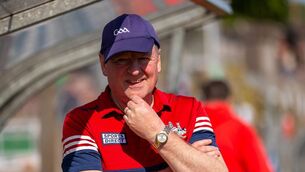
GAA attempts to halt abuse against refs
It’s a culture that has been tolerated for too long, he said here last night after presenting Vodafone GAA Referee awards to Pat McEnaney from Monaghan and Aodan MacSuibhne from Dublin.
The respective officials in charge of last season’s All-Ireland finals (the fourth for McEnaney, MacSuibhne’s second) were honoured in the presence of their wives, Rosemary and Aine. Making the presentation, Vodafone director of communications Tara Delaney said that referees matched the dedication and commitment of players and coaches in an extraordinary way.
Mr Kelly, who won’t comment on the current ‘sin-bin’ controversy until Monday (after the O’Byrne Cup final), spoke of the continuing efforts at official level to promote a more positive image of refereeing. Recognition in the form of a prestigious awards presentation like this was one tangible way of doing so.
Hoping for a more positive approach from team managements and players, he said that, while referees were not immune from criticism, it should always be balanced.
His views were echoed by MacSuibhne, who agreed that it was good for referees to be “brought back to earth” at times. “A certain level of criticism - once it’s balanced - is very acceptable to us,” he stated. “There’s nothing better after refereeing an All-Ireland final than going out to a club game and being told that not only are you the worst referee in Dublin, but the worst official to take up a whistle. That’s part of our games. They are very passionate.
“Each time I go out, I put my reputation on the line. I am prepared to accept the criticism. I’m not saying it’s any easier, but you learn to live with it.”
McEnaney said that he had a very high threshold, when it came to criticism. Being involved for a long time meant that he wasn’t the best person to be asked if the level criticism was increasing. However, when GPA chief Dessie Farrell expressed amazement at the amount of abuse dished out to referees in club matches, not just in Dublin but all around the place, he had to be concerned.
“Definitely the referee is the made the scapegoat at times, but it’s fair to say that we do make mistakes. Constructive criticism by managers, players and the media is acceptable when we make mistakes and we have to be big enough to accept them.”
Longer term, he feels that Gaelic games may benefit from new technology in resolving contentious issues. “People like controversy, it’s what keeps our games on the front pages. If you look at the game between Man Utd. and Spurs and that ‘goal’ - they talked about that for days afterwards. It was major news. If there had been TV technology there would have been none of that. The incident would have died there and then.”
MacSuibhne said he would prefer to see micro-chip technology being used to track the flight of the sliothar rather than having to wait for video replays. The success of any new technology would depend on decisions being quickly reached. “Hurling certainly could not be held up and stopped for two minutes while being viewed from different angles - whether the ball was over the bar or whether it crossed the line. Until that technology is in place, I would not even be considering it.
“You might come across a few controversial umpiring decisions, but look at all the games played over the course of the season. It should be kept within the balance that’s there.
“The new rules will promote skill. It might be seen that awarding two points for a skill (sideline cut) that’s gone out of the game was brought in for a certain number of players. I think it creates a new incentive for (all) players, but there’s nothing at all wrong with the rules of hurling.
“The one thing I would caution against is, if we are coming up with two points for a line ball, we’ll be wondering what next skill we should give two points for. We should remember that goals win matches and the difference between scoring a goal and any other skill has to be commensurate. We should always ensure that it’s always going to be the important score.
It was the second time All-Ireland referees were honoured outside the country, with MacSuibhne and John Bannon winning awards during the 2003 San Diego tour.
CONNECT WITH US TODAY



Be the first to know the latest news and updates