Bush camp stands firm despite protests
Baghdad kept up its war of rhetoric with Washington, accusing it of trying to intimidate the UN Security Council into adopting a new draft resolution that could pave the way for military action. U S President George W Bush, well used to invective from Iraq, also faced vocal opposition at home on Saturday when thousands of Americans marched to oppose any war.
"This is going to be an ugly, unnecessary fight. Most of the world is saying 'no' to it," civil rights leader Jesse Jackson told a crowd at Washington's Vietnam Veterans Memorial. Organisers said 150,000 people took part in the anti-war protest in the U S capital, but witnesses put the number at fewer than 50,000. A river of marchers flowed to the White House to press the case that a war on Iraq would be a tragic mistake. Another 40,000 marched in San Francisco, with thousands more demonstrating in Amsterdam, Berlin and other European cities.
Bush was not around to see the White House protest because he was taking part in a summit of Pacific Rim leaders in Mexico.
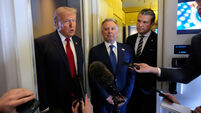
With a sceptical Mexican President Vicente Fox by his side, Bush repeated that the United States would lead a coalition against Iraq if the United Nations failed to act to ensure Saddam did not possess chemical, biological or nuclear weapons.
"If the U N won't act, if Saddam Hussein won't disarm, we will lead a coalition to disarm him," Bush said.
Secretary of State Colin Powell, also in the Mexican beach resort Los Cabos for the Asia Pacific Economic Cooperation summit, said key decisions had to be made in the next few days.
"We have reached the point where we have to make a few fundamental decisions in the early part of next week and go forward," he said.
The U S, with British support, has been pressing for six weeks for the 15-nation U N Security Council to approve a resolution intended to force Iraq to give up any weapons of mass destruction or face dire consequences.
But France and Russia have resisted, floating rival draft resolutions that eliminate some of the tough U S language. All five permanent Council members - Britain, China, France, Russia and the United States - have a veto.
The U S . resolution would give U N . arms inspectors broad powers to uncover any weapons of mass destruction programmes.
CONNECT WITH US TODAY



Be the first to know the latest news and updates