McAnallen family appeal to GAA for SADS screening unit
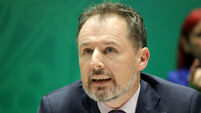
Reacting to the tragic death of 10-year-old Patrick Breen, from Tyrone, who died training for his under-13 team on Tuesday night, Cormac’s brother Donal McAnallen said that more needs to be done to prevent so many sudden cardiac deaths.
“The GAA has made progress and are better in this regard than many other sporting organisations. But we would prefer, as a family, if screening for players was more comprehensive. We would like to see a mobile unit. Because, at the end of the day, screening does reduce death by a considerable number.”
A similar plea was made by the former Armagh captain, Jarlath Burns last month, who said the screening unit cost of €1 million would be feasible given the finance generated by the GAA.
He criticised the “silence coming from Croke Park” on the issue and said the medical, scientific and welfare committee established in April to advise the GAA on such matters had not met in the first five months of its existence.
The Government taskforce on SADS recommended more than four years ago that all inter-county GAA players be screened. This would amount to around 2,000 people but the GAA has only committed to screening 400.
Mr McAnallen said the taskforce recommendations are taking a long time to implement: “On one level, a lot is being done to implement the recommendations, but probably not at the speed we would like.
“The emergency response times are very slow compared to other countries, we sometimes here there are waits of 20 minutes. A lot more needs to be done.
“Because this involves young people, there is a tendency to think it is just a tragic incident. It has to be taken more seriously.”
The death of young Patrick Breen came on the same day that Paraic Duffy — the GAA player welfare manager — wrote to county boards and inter-county players urging them to take action which would prevent sudden death from cardiac arrest.
He said: “We took a decision earlier this year that every county ground must have a defibrillator on site, plus of course, people who are able to use them.”
Co Tyrone has been leading the way with providing defibrillators.
This has been the main objective of the Cormac trust, set up by the McAnallen family.
Donal McAnallen said the death of young Patrick Breen brought back tragic memories for his own family of losing Cormac at the age of 24 when he died in the family home.
DR DAVE MULCAHY is the director of the centre for cardiovascular risks in younger persons, which has screened 100 high-risk people at a clinic Tallaght Hospital in Dublin.
What happens when a person dies from sudden adult death syndrome? The likely explanation is that they ultimately die due to a sudden abnormal rhythm of their heart which is not sustainable with life.
But sometimes we don’t know what happens, sometimes the heart thickens, sometimes it is thinned or infected with a virus.
Sometimes, when we find no cause, it is due to rare electrical occurrences in the heart.
Are those who play sport more at risk? Severe physical activity might act as a trigger in somebody who is already very prone.
But the majority of deaths happen at night time or when the person is engaged in very sedentary activity.
Should parents be worried if their child is sporty? Deaths of sports people during sports events are highlighted more. It does happen to people in all activities. There are very few deaths of young people compared to the number of man-hours put into sports.
You have to look at all the benefits of a young person playing sports.
If a child is living a normal healthy life and playing sport, you have to accept that. But also look out for symptoms.
Is there a genetic link in these deaths? There is often a genetic component and to date we tend to see those whose other family members have suffered. If there is an incident in the family, it is important other members have a follow up.
It seems these deaths are happening quite regularly, does Ireland have a higher rate of sudden adult death syndrome compared to other countries? We don’t have any real statistics to compare it to, and the ones we are using are based on the US and Britain.
There are about 60-80 deaths here a year and there is no reason to believe that this is any higher than other countries.
We now have a situation where there has been two cases in two days but there hasn’t been any cases in a number of weeks. We are a small country and it is very well reported here.
What age group are most at risk? You can have cardiac deaths in children as young as eight, but that is extremely rare.
For cases of those under the age of 35, the vast majority are between 16 and 20.
CONNECT WITH US TODAY



Be the first to know the latest news and updates