Michael Moynihan: Amazing map project sheds new light on where Cork has come from
'A resource like this is invaluable on many different levels. In and of itself it stands as a repository of information and heritage for the entire city, and the presence of that knowledge helps to reinforce Cork’s sense of itself.'

You may remember reading here about the Digital Atlas of Cork, a free online interactive map that launched late last year.
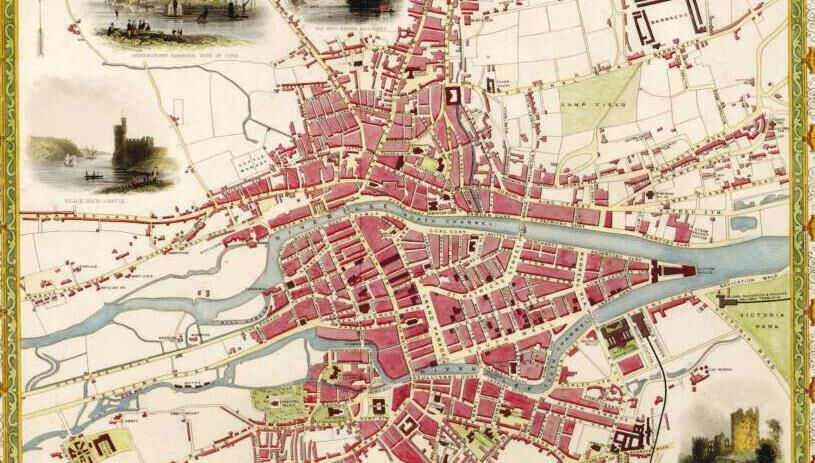
It’s an impressive resource, showcasing Cork city’s history from AD 623 through to 1900. A big plus is the ease with which it can be used — you can browse the digital atlas or search for a specific site in the city.
It was based on what I described then as “the forthcoming Irish Historic Towns Atlas no. 31, Cork/Corcaigh by Howard Clarke and Máire Ní Laoi”.
Forthcoming no more, however. It was launched a couple of weeks back in City Hall, so I picked up the phone to Howard to learn more about the project.
“We concentrate on what we call a study area, the city core,” he told me.
HISTORY HUB
If you are interested in this article then no doubt you will enjoy exploring the various history collections and content in our history hub. Check it out HERE and happy reading
“We don’t do what are now the modern suburbs. We don’t go into detail after the year 1900 — we do say something about that period, but for practical reasons we don’t really go beyond that point.
“But people can take a lot of different things out of it. They can see, for example, industries in the nineteenth century and the people who were making things in the city were generally named in the street directories, so there’s a certain amount of family history to be seen in that aspect of it even if we don’t really focus on genealogy.”
If the atlas goes back to the seventh century the obvious question is this: what sources did they use?
“We basically use information in print, we don’t generally use information in manuscript that’s not printed, though we make some exemptions to that rule.
“So we use printed sources, primary sources, as well as secondary sources such as books, articles, and journals. We also use lots of maps — Ordnance Survey maps of the nineteenth century, and all the earlier maps. We’re using a combination of printed material and maps.
“We also use archaeological evidence where appropriate — we’ve used quite a lot of that evidence in this atlas.”
How plentiful are those sources? The further back you go the slimmer they get.
“In general the sources for history are fuller and more detailed for what we’d call the modern period, the 18th to 20th centuries. That’s what you’d expect.
“Earlier than that the sources are not so detailed, and they vary a good deal as well, depending on what you’re looking for. In general the medieval period is not documented as well so we have to rely on archaeological evidence.
“How far back? It goes back to St Finbarr in the seventh century AD, but the existence of St Finbarr is itself a controversial subject — I won’t go into all the details of that — but he was associated with Cork by the eighth century, say, and thereafter he’s regarded as the local saint related to the city.
“So you can go back that far, but at that point you’re really relying on annalistic evidence for the most part.”
Mind you, they made some interesting discoveries along the way. Take the map that was missing for over 300 years.
“The most important new discovery was a map of the city of Cork dating from 1690, the year the city was besieged by the Williamite forces.
“Three years ago we discovered that map for sale in London — it had been made by a Dutch military engineer at that time, and was completely unknown to everyone. We’ve acquired a copy of that map and the Boole Library in UCC now has it.
“It’s a map of the siege works around the suburbs of the city to defend the city against the Williamite forces, and it’s in perfect condition, beautifully drawn.
“We don’t know the full history of the map, but we believe the man who drew it, Wolfgang Romer, took it back to the Netherlands with him — he was Dutch and the key to the map is all in Dutch — and that it was kept in storage, probably in a safe place. It’s not marked in any way and appears to have been folded once, that’s all.
“It’s a wonderful discovery. Two of the borders of the map have beautiful drawings of the siege works themselves — banks, ditches, gates, fences and so on.”
Clarke is quick to give credit to others for their help with the atlas. “We’ve been working on this for the better part of twenty years. My wife is my co-author — she’s using her original name, Máire Ní Laoi, and she did roughly five years work on her own in the library of the Royal Irish Academy.
“She established a basic outline of the topographical information — the basic information we use — and at that point we could see that it needed a lot more work, so I joined with her as a co-author. I’ve been working on these atlases for thirty years or so, so I had the experience in how to set it out.
“We’ve also tried hard to relate to other people in the city. My wife is from Cork so I think we’ve had a successful connection with the librarians, archivists, and archaeologists in the city.
“And with Cork City Council. Máire and I made an appointment to see the chief executive of the Council, Ann Doherty, some time ago and she was very receptive. Cork City Council also provided us with some very valuable funding for the printing of the Atlas.”
Yours truly didn’t make the launch itself but the praise from Lord Mayor Kieran McCarthy, himself a keen local historian, was noteworthy (“... a tremendous publication which will no doubt deepen our understanding of the built heritage of our historic port city. The accompanying maps, produced in large scale, are a unique and important resource for those interested in the physical development of the city”).
He’s correct — about the maps being large enough to read, about the greater understanding of the city which this atlas drives, about the physical development of Cork.
A resource like this is invaluable on many different levels. In and of itself it stands as a repository of information and heritage for the entire city, and the presence of that knowledge helps to reinforce Cork’s sense of itself.
There are no doubt plenty of people keen to point out that Cork already has a robust sense of itself — most of them far from Leeside — but this is hard evidence of the city’s deep roots. Hundreds of years of people walking the oldest parts of Cork, of the city’s limits pushing down towards the seat to the east, up the slopes to the north, westwards along the banks of the river. We hear a lot about where the city is going, but this atlas does a great job of explaining where Cork has come from.
Cork/Corcaigh is available from bookshops nationwide or can be ordered from ria.ie/cork
CONNECT WITH US TODAY



Be the first to know the latest news and updates