Sam Boland: Trans healthcare and the age of contested knowledge
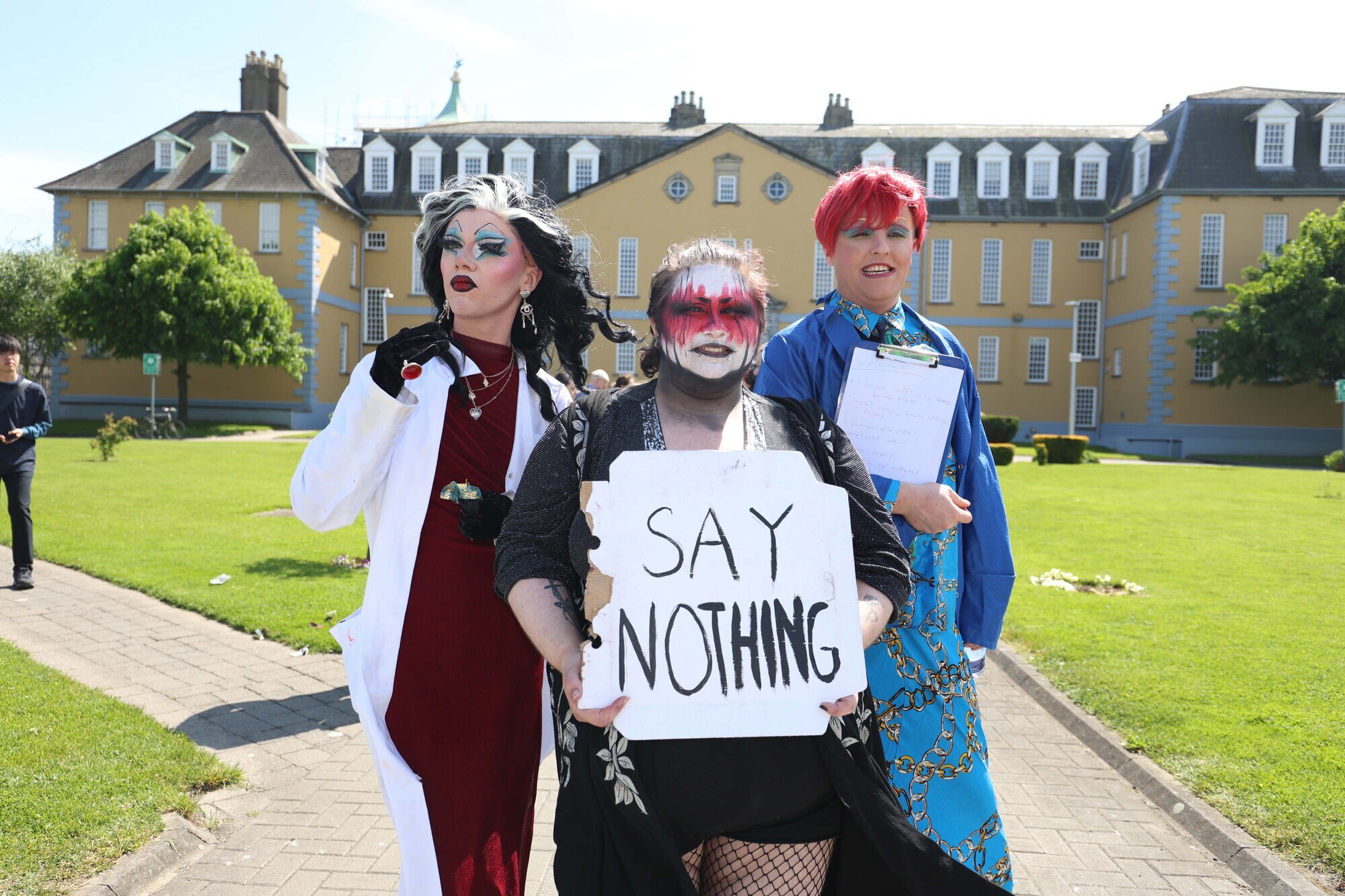
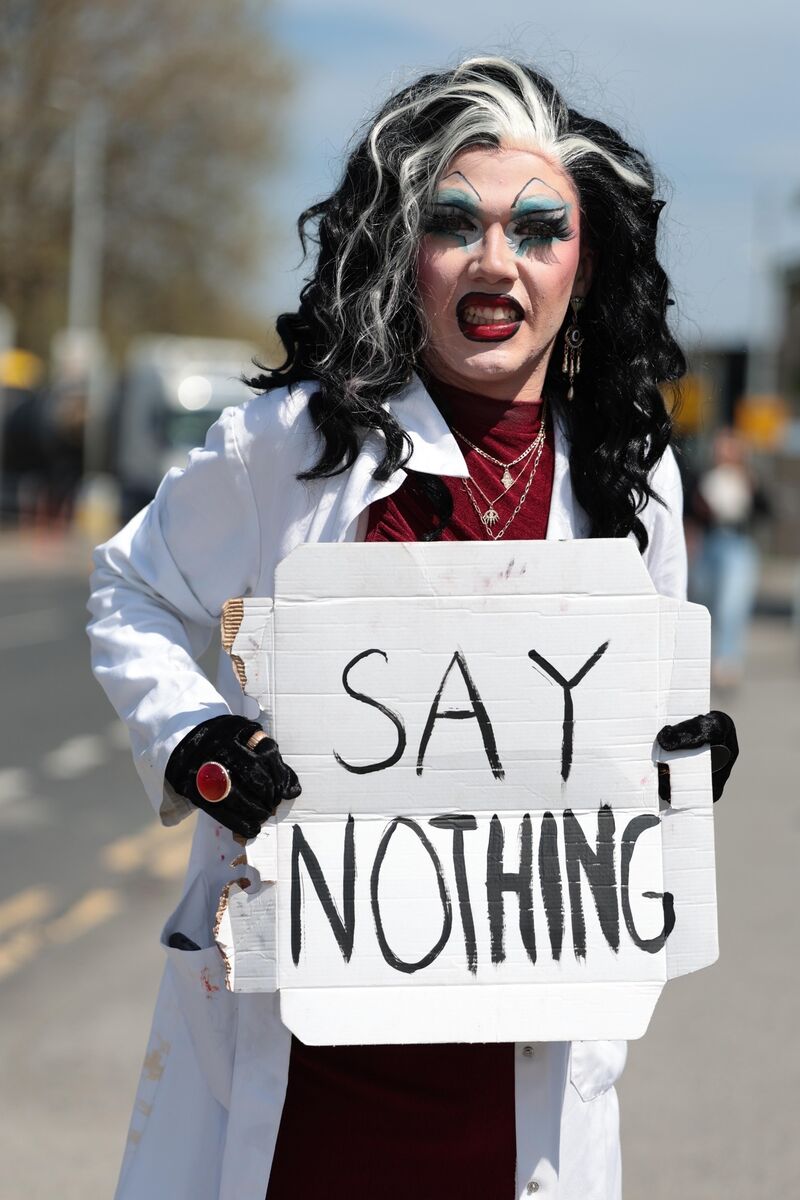
Shasa Shame, Shadow Frost, and Niall Keane, all from Dublin, at a protest earlier this month calling for better healthcare for trans people. Pictures: RollingNews.ie
We are living through an unprecedented age of contested knowledge, so much so we have to have not one but two words for such contested knowledge — misinformation and disinformation.
The American Psychology Association defines the terms thusly: "Misinformation is false or inaccurate information — getting the facts wrong. Disinformation is false information which is deliberately intended to mislead — intentionally misstating the facts."
Some of this contested knowledge is relatively harmless — if someone believes the world is flat and claims to the contrary are a conspiracy by Big Globe, it doesn't impact our lives much. In other cases, it's incredibly harmful. The idea our planet isn't burning to the ground, and that we don't have to radically change our behaviour, spells disaster.
A popular response to conspiracy theories is to 'follow the science'. You can't go wrong when you Follow the Science. It's the rational position, upholding the finest traditions of the Enlightenment, upon which our modern world is built. Science doesn't care if you think the moon landings were faked or that Tupac is still alive. Science is true, objective, without agenda.
Except it's not.
Any human endeavour carries the risk of human bias. The best journalists, for example, are not those who claim to be objective (in itself this is an a priori claim that your views carry more weight than others) but rather those who acknowledge their subjectivity and take steps to mitigate it.
The best newsrooms are pluralistic — the is staffed by farmers' daughters and printers' sons, Corkonians and Dubs, the privately educated and graduates of St Brendan's of the Perpetual Thump on the Ear. This diversity of views, or of biases if you will, gives readers the most rounded view of the world around them — a view they won't always agree with.
So it is with science.
Celebrity astrophysicist Neil deGrasse Tyson has a famous line beloved by Follow the Science adherents: "The good thing about science is that it's true whether or not you believe in it."
It's a good line. It has neat, incontrovertible interior logic. It fits equally well in a tweet or on a t-shirt. But it's misinformation. It's the last line of a much longer quote in which Tyson says science must be rigorously contested, not 'followed':
Imagine a world in which science was never challenged, if it was just 'followed'. We'd still be blood-letting with leeches. Cigarettes would still be deemed good for you. Women would not be allowed on trains for fear their wombs would fly out of their bodies above speeds of 50mph.
And that's just the fun, 'gosh, our ancestors were dumb' science. Science also underpinned Belgium's atrocities in the Congo in the 19th century and the Holocaust in the last century, and while these horrors are disappearing into the past, it was in 1998 that Andrew Wakefield's notorious study erroneously linking vaccines to autism did irreparable damage to public health worldwide.
It was as recently as 2007 that Nobel-winning microbiologist James Watson was using 'science' to demonstrate black people are stupider and hornier than white people, that Indians are naturally servile, and so on. A genius in his own field, but a prime example of how science is politicised and manipulated.
Science is politicised because it's a claim to truth, and being able to dictate what is 'true' is a position of power. Donald Trump will tell his supporters up is down, day is night, and he's not a thieving pervert, and they'll believe him.
So, when new science arises, the wrong thing to do is simply 'follow' it. As Tyson's contemporary, the late Carl Sagan, said: “There are many hypotheses in science that are wrong. That's perfectly alright; it's the aperture to finding out what's right. Science is a self-correcting process. To be accepted, new ideas must survive the most rigorous standards of evidence and scrutiny.”
Sagan was speaking in 1980, but his words are relevant today. Under scrutiny now in Britain is last month's Cass Review into healthcare for young trans people. Commissioned by the NHS in 2020, its findings, broadly, are that healthcare for young trans people is administered without sufficient oversight, and so should be restricted.
Sadly but predictably, the review was greeted with triumphalism by campaigners who feel the expansion of trans people's rights has strayed into over-reach. Just as predictably, it was met with dismay by trans people and their advocates. Commentators trying to thread a precarious path across the middle ground stressed it was important to follow the science, especially in such an important matter as child healthcare.
Generally, that middle ground is correct, but not if the science is brand new, because potential error and bias has not been scrutinised, and especially not if the science is not science but in fact a review of science, which adds a second layer where error and bias can creep in.
On its release, various arms of the NHS vowed to implement the review's recommendations, and it was welcomed in the British parliament by both major parties. Outside of the officialdom that commissioned it, however, the reaction was more challenging, with health organisations from Canada, Australia, New Zealand and others remarking it did not follow international best practice.
And if you follow the science, it doesn't get much better for Cass. One of its key methodologies was to disregard almost all evidence that medical interventions for trans or gender-questioning young people were safe — "no conclusions could be drawn", says the review — as they did not meet the standard of being 'double blind', the gold standard of medical testing, whereby one group receives the treatment being tested and the other receives a placebo.
This sounds like a good thing — after all, we want gold standard healthcare for children. However, double-blind studies on trans youth healthcare, in review chair Hilary Cass's own words in an interview with The Kite Trust, are "inappropriate and not possible" — inappropriate because it would be the depths of cruelty to tell test subjects they're receiving life-affirming treatments when they're in fact getting a sugar pill, and impossible because the placebo group soon notices the lack of results.
It would be like if you broke both your legs and the doctor healed one of them and expected you not to notice which was still broken.
A common methodology in scientific reviews, the Mixed Methods Appraisal Tool, recommends including 'low quality' studies in the absence of any or many 'high-quality' studies; that 'low quality', in layman's terms, is still an 9/10 where double-blind studies are 10/10. Where 10/10 is "inappropriate and not possible", do you reject 9/10 for not being 10/10?
So it seems the Cass Review spuriously rejected multiple reports that could have led to a different outcome. It also ignored reports not in English — and scientific communities outside of the Anglosphere are much more positive on medical interventions for young trans people.
On the other hand, Cass considered in its findings reports from the 1980s, YouTube videos, and studies with sample sizes as small as 24.
If you follow the science, the review does not withstand much scrutiny, even before you consider its headline recommendation, that trans healthcare should be banned up to age 25, is based on the pseudoscientific idea that the brain doesn't stop developing until you're 25.
The review also speaks favourably of other pseudosciences, social contagion and rapid-onset gender dysphoria, as well as gender exploratory therapy — conversion therapy by another name. And, addressing the Scottish parliament earlier this month, Dr Cass told politicians anti-anxiety medicine and antidepressants, which do have well-documented side-effects, and "psychological treatments" could be a more suitable treatment than puberty blockers.
Academics have questioned Cass's methodology, including in areas such as suicidal ideation and neurobiology. Trans advocates say the review team was working towards a predetermined outcome. Speaking of gold standards, the Cass Review is not peer-reviewed.
Context is important, too — culture war-riven Britain does not have a good record with government-commissioned reports on minorities, with the 2022 Sewell Report (which found there was no such thing as institutional racism and there were positives to the slave trade) laughed almost out of existence.
So where does this leave Ireland, considering calls that our trans healthcare be re-examined in light of Cass, and when our trans healthcare is ranked the worst in the EU? Well, where Britain does government-commissioned reports on minorities badly, what we do well here is the committee, which considers a plurality of views to find the most reliable, robust outcome.
Take the recent Oireachtas joint committee on assisted dying. Chairman Michael Healy-Rae made no secret of his opposition to assisted dying, yet steered the assembly to a conclusion largely in favour of it, notwithstanding objections that will also inform legislation.
The Citizens Assembly on abortion is another example of the best of plurality when, in consultation with 100 different views, it found the Irish public was ready to lift the ban on abortion.
Waiting lists for trans healthcare in Ireland are up to 10 years long, effectively meaning there is no trans healthcare here. Just as it was with abortion, this ban means people will either travel for it or access the black market.
Yes, trans healthcare needs to change in Ireland, but it is far too important to blindly follow the misinformed, unrigorous Cass.
CONNECT WITH US TODAY



Be the first to know the latest news and updates