Mick Clifford: Jim O’Callaghan’s political ambitions are distracting from Ireland’s justice crisis
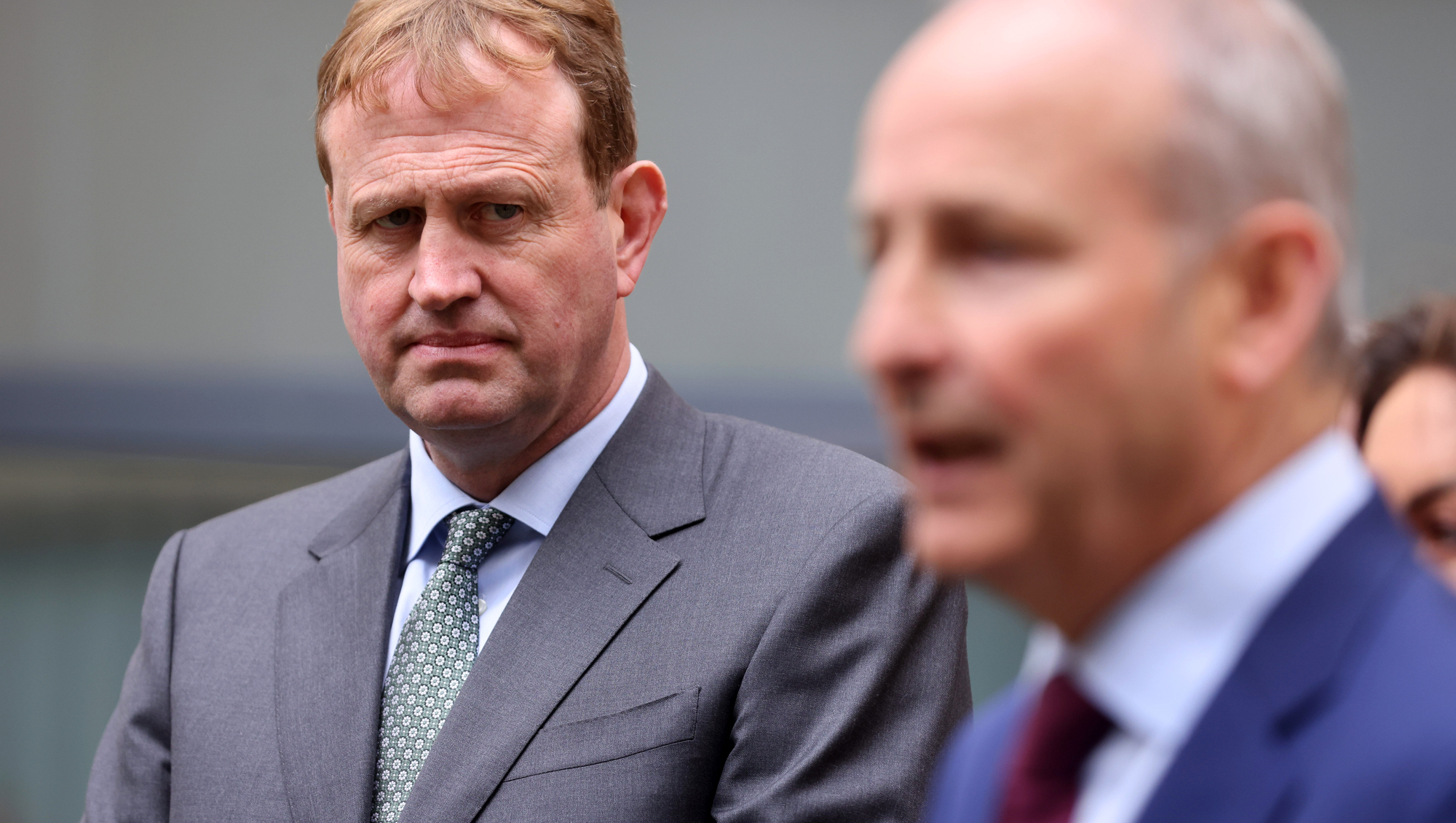
Justice minister Jim O'Callaghan and Taoiseach Micheál Martin: When Ireland's EU presidency ends, the race to succeed Martin begins. Picture: Eamonn Farrell/ RollingNews.ie
Jim O’Callaghan is a man in a hurry. There are just 90 more sleeps before the curtain comes down on Ireland’s EU presidency. At that point, the race to succeed Micheál Martin begins. It may not happen quickly but the current Taoiseach’s departure could be sudden.
Any controversy, bad opinion poll or row will be amplified because everybody knows the Cork man will be on the bend for home. Big Jim needs to be ready.
As a result, he is treading warily around any mines currently littering the political landscape. The smart money says unless something blows up in his face, he will be slipping into the shoes of the leader once the calling arrives. All of that is politics and deploying common sense at a time when a new peak is materialising on the horizon.
The only problem is such a strategy means the minister for justice is abandoning the bread and butter of politics — effecting positive change — just when his hand is required. There will be a cost for that, even if it doesn’t accrue until long after O’Callaghan departs his current portfolio.
Right now, the criminal courts are operating at a trickle. Solicitors have withdrawn their services in protest at a new payment model for legal aid brought in by the department. This is impacting on the pain of victims and the rights of defendants, to the inconvenience of witnesses and the frustration of judges.
In July 2026, about 700 legal aid certificates were issued in cases. For the same month last year, the figure was in the region of 10,000.
Read More
The new model involves paying a flat fee of €520 per client, irrespective of the number of charges or court appearances. O’Callaghan says the old model was being abused, that solicitors were seeking adjournments to make a few extra euro. There is scant evidence of this.
He cites a survey that shows cases where the defendant was paying their own costs moved quicker through the system. What he omitted is that such defendants represent a small minority in the courts, that their cases — such as criminal offences with drink driving — are straightforward and they also tend to be drawn from a middle class-background that is largely insulated from the criminal justice system.
Comparing apples to oranges may work as spin, but it does not reflect reality.
In fact, all the evidence is that the bulk of adjournments are due to the State.
This was reflected in a piece by Professor Marie Keenan of UCD in this newspaper last Wednesday. She pointed out a study of the system showed “under-resourcing across the criminal justice system emerged as the top offender as the cause of delays”.
She went on: “This included under-resourcing across the entire system; An Garda Síochána, medical and forensic services, Sexual Assault Treatment Units (SATUs), a shortage of judges, of courts service staff, of court rooms, the brevity of the court day and the court calendar, poor data processing systems, and the shortage of suitably qualified psychiatrists who can be instructed for the purpose of certain types of trials.
“Further blockages in the court system, such as the availability of interpreters or special provisions for vulnerable parties, compounded the problem. These factors are well known.”
Yet the minister is putting it all down to solicitors on the make. The new system effectively demands some solicitors work without pay, and the outcome will inevitably impact on the quality of defence. These things are supposed to matter in a functioning democracy.
Still, Jim is not for turning. His political persona right now needs to project the image of a strong leader, who will stand up to vested interests. In reality, he is stepping around the real vested interests in the legal business where access to justice is largely denied in the civil courts due to cost.
This week he was “unavailable” for an Oireachtas Justice Committee meeting on the legal aid impasse. Here was a chance to once more deploy his own advocacy skills to argue he is acting in the best interests of the public. Committee chair Matt Carthy pointed out the committee had told the minister it would facilitate him in terms of timing and his diary. No luck.
Rather than viewing the occasion as an obligation to defend and promote his policy, he ran from it as if it was a landmine. The committee heard the criminal courts could be facing a “shutdown” if the impasse isn’t resolved by next month.
Another landmine O’Callaghan wants to step around is Garda whistleblowers. This issue is back in the news through a programme on last week, although the bulk of the problems had already been reported on in this newspaper and other media outlets over the last year.
There has now been calls for an inquiry into why nothing appears to have changed since the days of the hounding of Maurice McCabe.
This week the minister was deploying his inner Michael Flatley to skip lightly around the issue. He did not think “just because RTÉ publishes a programme or broadcasts a programme, which is now taken down from its player, that I have to respond by having an inquiry in respect of it”.
He went on to say he “can’t just be swayed by one programme that’s broadcast by RTÉ”. He is entirely correct in such a summation. Except this didn’t start with a programme on RTÉ last week. Apart from reports in the and others over the last year, the matter has been repeatedly raised in the Oireachtas.
Former government ministers Alan Kelly and Michael McDowell have been, for some inexplicable reasons, lone voices in constantly exploring this issue of vital national importance in the Dáil and Seanad respectively.
Kelly is on record as saying he approached the minister to brief him privately. McDowell is a former attorney general who knows precisely what he is talking about. And yet, nothing was done and we are being asked to believe this just arrived out of the blue last week.
O’Callaghan knows predecessors of his ended up being swallowed into the vortex of an element of Garda culture that has gone unresolved for decades. He is determined that won’t be his fate.
Yet without proper examination and genuine reform, the past is condemned to repeat itself and in the area of policing that will have devastating consequences for some citizens and members of the force.
But of all that will be somebody else’s headache in a future as yet unwritten. For now, long-standing problems that require thoughtful and forensic focus are going to fester, simply because the man in charge is intent on stepping around mines, his eyes cast high on the next peak of his career.
CONNECT WITH US TODAY



Be the first to know the latest news and updates