Andy Burnham is now Britain — and Europe's — last defence from Nigel Farage

British Labour Party leader Keir Starmer, left, could face a leadership challenge from Andy Burnham depending on the outcome of the Makerfield by-election on Thursday. File picture: PA

Something historic is going to happen in the UK in the next couple of days. Or else the United Kingdom, the mother of all democracies, is going to look like a bad episode of the .
If they get it wrong, British politics is going to be utterly farcical for months, and its reputation, at home and abroad, will be in tatters.
There is an existential crisis facing its government party now, and if it fails to get its act together this week, that could be terminal.
We’re kind of used to seeing this over there. The gross mismanagement of the Brexit referendum, whose 10th anniversary is in just over a week, led to the immediate collapse of David Cameron.
He was replaced by the honest but hapless Theresa May. The vultures, led by Boris Johnson, were circling around her from the moment she was elected.
Read More
Johnson replaced her after three years and then spent the next three years disgracing himself.
If you consider his management of the covid pandemic alone, he was almost certainly the most immoral prime minister the country has ever seen.
In his turn he was replaced by the wildly incompetent Liz Truss, who lasted 45 days before being turfed out by her party.
She probably did more damage to her country in those 45 days than the worst prime ministers before her managed in a full term.
She was then replaced by the now almost forgotten, and entirely inconsequential, Rishi Sunak.
It’s actually hard to count the number of prime ministers the UK has eaten up in a decade.
So what greeted Keir Starmer when he led his party into a general election less than two years ago may not have been excitement, but was certainly an enormous national sigh of relief.
There was a grown-up in the room. Someone competent, trustworthy, decisive, and clued in.
It was obvious from the beginning of the campaign that he was going to win, and in the end he secured a massive majority under Britain’s weird first past the post system.
Some of us who study these things closely found a few things to worry about.
First of all he seemed to be pretty regimented. It wasn’t so much that he didn’t have anything original or imaginative to say.
You’d forgive him for that, because nobody wanted him to take wild risks during that campaign.
But he actually seemed to have memorised a half-dozen mantras, and trotted them out, to the exclusion of anything else, no matter what the occasion was or what question he was asked.
More to the point he was clearly following a strategy that refused to allow any consideration of meaningful new sources of revenue, despite the dire state of the British economy and its public services.
I wrote here at the time that was both unnecessary and risky. And it emerged after the election that the prime consideration for Starmer and his people was not winning a majority but winning an enormous majority.
Maybe that ought to have told us right there who we were dealing with. But I’ve often expressed the view, and it’s something I believe, that every political leader either grows or shrinks in the job.
They never stay the same, and history is full of examples that prove the point.
And Keir Starmer is a textbook case. In a modern democracy, no prime minister can survive when his long-time, utterly loyal, defence secretary resigns and says he has made the country less safe.
From the day he was elected, Starmer has talked the talk but consistently failed to walk the walk. His key characteristic, it has emerged, is indecisiveness.
He seems to believe in working endlessly to build consensus among the people around him. And then he squanders it by a complete failure to follow through.
For example, even this past weekend he has announced, apparently, a set of radical measures (which may or may not be enacted) to protect young people on social media.
That’s precisely the measure that led to the resignation of a minister he appointed to do that job, Jess Phillips, who said in her resignation letter a month ago that Keir Starmer agreed with her but couldn’t bring himself to act.
In the entire history of the British Labour Party, the tradition has been loyalty to the leader. Unlike the Tories, they don’t do palace coups.
Even Jeremy Corbyn, despised by a substantial majority of his parliamentary colleagues, never faced a no-confidence vote. But it’s coming for Keir Starmer.
It all hangs now on a by-election in the north of England, in a place called Makerfield.
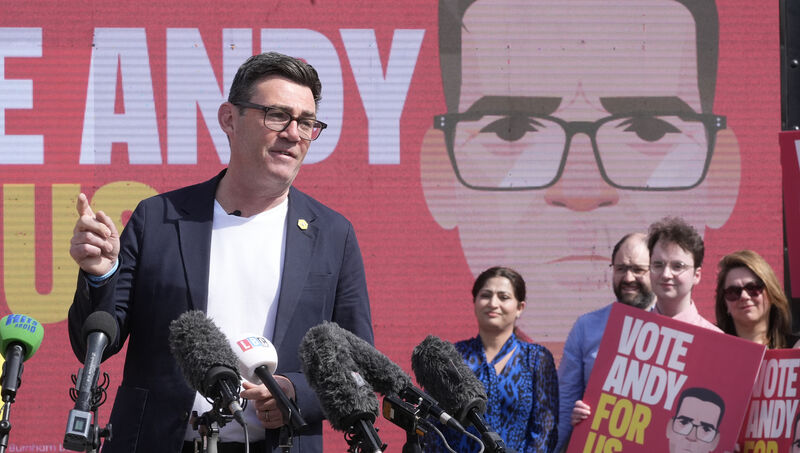
A man called Andy Burnham is the Labour Party’s candidate and he’s running in a constituency where Nigel Farage’s Reform UK party won every available seat in the recent local elections.
A couple of months ago, you’d have said Burnham had no chance. Now, both the opinion polls and the bookies are saying he’s going to win.
If he does, and beats Farage’s candidate, he will go into Labour legend. For now. The king of the north, they’re calling him. A relatable version of a great Labour leader.
Although Starmer is vowing to fight on no matter what, everyone believes that if Andy Burnham arrives in Westminster, his current boss won’t be party leader and prime minister for long.
For those who have always understood that politics is a cruel trade, Keir Starmer, an honest and decent man who couldn’t cut it at the top, will be done for.
Loads of ability, no command. No vision. No authority.
But there still remain two possibilities. What if, after all the hype and expectation, Burnham doesn’t win Makerfield?
Not only will that legend dissipate overnight and forever, but the entire Labour Party will become a bit of a laughing stock.
They’ll be stuck with a leader that virtually no-one wants.
The only alternative would be a leadership contest in which Starmer will be a candidate, where nobody capable of really galvanising the troops will win.
And what of the other possibility? Burnham wins the by-election, wins the party leadership by acclamation, and becomes prime minister in jig time.
And then shows the world that he too is bereft of ideas, that he too lacks the character to make a real difference? What then?
I’ll tell you what then. The UK this week is on the brink of getting it right at last. Or it’s on the brink of going down a very dark road, where the politics of blame and hate could begin to come into their own.
Like them or not, the fact is that the British Labour Party may be the last defence between all of us — not just the British but all of us — and a rapid slide under the likes of Nigel Farage into an era of authoritarianism across all of Europe.
So, as unlikely as it seems, there’s an awful lot riding on a man called Andy Burnham and a place called Makerfield. You can be absolutely certain this is a space worth watching.
CONNECT WITH US TODAY



Be the first to know the latest news and updates