What it was like at Augusta National to witness Rory McIlroy etch his latest masterpiece
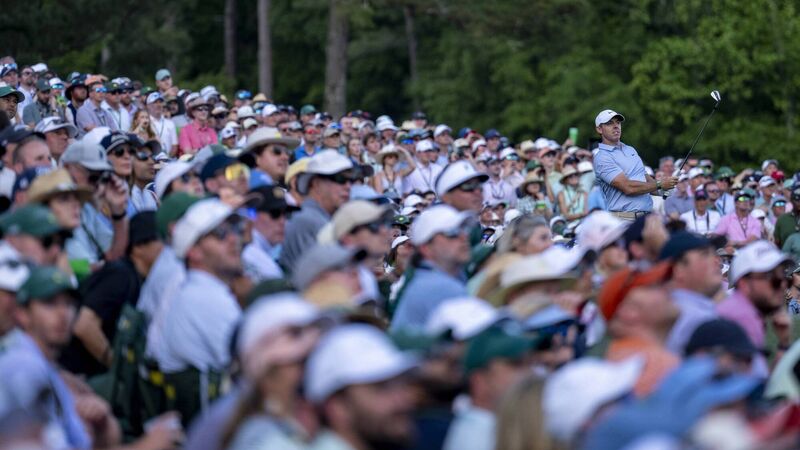
One of the curiosities of Augusta National is how quickly you become accustomed to assessing noise levels and decoding the delayed updates of its manual scoreboards. If the special attraction is the sights, the added delight is the sounds.
That ranges from the ethereal bird song echoing around the course (yes, we did see plenty of real birdies about the place) to the mechanical whirr of old-school disposable cameras during practice days, culminating in the cavernous roars during the tournament.
The sonic peak of the week occurred on the sixth tee when Shane Lowry stitched home a hole-in-one. Come Sunday, the atmosphere at the exact same spot was one of utter shock.
Rory McIlroy’s birdie chip looked promising until a late wobble on the par-three fourth. No matter. Settle for par and move on. A sizeable crowd began to skip ahead to where Lowry was playing with Sam Burns in the penultimate group.
Read More
A sharp, collective intake of breath should have signalled calamity, but it still required the intricate system that updates the white bulletins for patrons to comprehend the scale of the problem. McIlroy: 12 – 10. WUT? No, wait, what? He dropped two shots? The posted number disappeared momentarily and the fretful masses breathed a sigh of relief. Surely some mistake. Then it reappeared while an absolute thunderclap of a roar cannoned over from further afield.
That is when the auditory detective work begins. That sounded like the seventh? Is world number one Scottie Scheffler continuing to make a run? Was that a birdie-level exultation or an eagle? Each salvo of cheering has a particular cadence, and here you have to get good at recognising them. The prohibition of mobile phones actually compels people to come together in hushed consultation and fevered debate.
The only certainty at this critical juncture was this: Something big was happening. “We have ourselves a Sunday boys,” was the verdict of one patron on the sixth.
The Irish challenge hit trouble early when McIlroy double-bogeyed there within minutes of Shane Lowry dropping two shots on the fifth. In the acclaimed documentary about his 2025-triumph, McIlroy spoke about how your physiology can affect your psychology.
At this point, the body language of both was concerning. Lowry slumped over and buried his face in his elbow when his putt rolled past the hole, the putter serving like a crutch preventing him from completely tipping forward. The Rory bounce was conspicuously absent, too. It looked decidedly terminal.
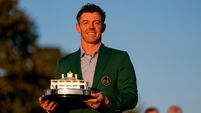
It is worth remembering this fragile equilibrium given what came afterwards. It took a stunning sequence of defiance for McIlroy to head to the last tee looking, dare we say it, comfortable. All he needed at that point was to avoid a double-bogey and the immortality of history would follow. The first back-to-back Masters winner since Tiger Woods in 2002. Just the fourth ever player to replicate the feat. The prospect of squandering a record 36-hole lead avoided. He was in the ascendancy.
So, naturally, he produced the most stressful moment of his round and pummelled the ball into the trees. A media member standing on the left side of the fairway assured us he was fine because he had executed the exact same shot when he won the media lottery to play the course last year. Imagine, the best European golfer of all time and an amateur-hack produced identical efforts.
This is the quintessence of the McIlroy experience. It is why recent suggestions that this was an un-Rory like success ignore the more overarching reality. Sure, it was a different style of golf. That young Holywood hotshot who bombed the ball off the tee and executing towering iron shots was replaced by a wily old veteran. Afterwards, McIlroy was asked to grade all his game over the course of the four days. Driving? B-. Iron play? B. Short game and putting? A+.
“That is what won me the tournament this week.” But he remains, in the most endearing and entertaining way, an absolute madman. Just look at how he diced with disaster on the 15th. That par-5 is absolutely glorious in its risk/reward balance. It is where he produced that majestic fairway effort during 2025’s remarkable finale. Sunday’s pin position meant that sort of heroism wasn’t possible so he found a unique way to introduce some drama into proceedings.
A drive into the trees ensured McIlroy had to lay up to the downhill slope where he needed a delicate approach to the teetering green. As soon as he swung, the hands rose in a desperate plea: please don’t spin back. Talk about heart-in-mouth theatre. It felt like the corner grandstand, one of the peerless viewing locations in all of sport with the par-3 16th tee also visible to the flank, was about to topple backwards such was the collective shudder at that thinned shot. It clung on, precariously.
Video report from the Masters 🏆
— Maurice Brosnan (@m_brosnan) April 13, 2026
The lunatic that is Rory McIlroy pic.twitter.com/1aZRdFIAfS
And on and on it went. A yanked iron on the next was followed with a truly sensational putt down the slope.
“Once I got that ball up-and-down from the back of 16, I just said to myself on 17th tee, I just need four more good swings,” he revealed afterwards.
“I made one. But somehow I got it done.” Classic.
A sizeable Irish contingent was exhausted but content at the finish. A few hesitant souls waited until this very last moment to make their way to one of the smaller merchandise shops to procure a 2026 flag. Such venerated traditions are sacrosanct in these parts, yet so much emotional equity hinges on victory. Patrons and players alike are resolute on what they will do but agonisingly uncertain if they will do it.
Nearby, beside the recently developed Augusta National municipal course known as the Patch, is a regional airport which includes a private airstrip. Locals flock there on Sunday nights with fold-out chairs and coolers full of beers to watch the sun set and the private jets take off. Who occupies those planes is entirely dependent on the hours of blockbuster entertainment nearby.
McIlroy’s reward was another night in Augusta with his daughter, wife and parents all by his side. Even after shooting an 80, Shane Lowry waited to congratulate his best friend. The conversation quickly turned to McIlroy’s place in the European pantheon and what will come next for this mercurial champion. He helped fuel that conversation.
“That debate is going to be hard,” he said afterwards. “But it is a cool conversation to be a part of.
“Again, it took me 10 years to win my fifth major, and then my sixth one has come pretty soon after it. I am not putting a number on it, but I certainly don't want to stop here.”
Even so, a decisive factor in what he can go on to achieve is the liberating freedom wrought from his deeds over the past twelve months. Talk of future possibilities is now protected by a cemented legacy. Where he was once haunted now looks like a home course.
Talk of generational potential has become a tribute to realised talent. As for outside unfair advantages regarding his ability to practice at Augusta in the preceding months, that can be dismissed as the transparent manure that it is.
They did talk about the esteemed figures over the seven days. They talked of Tiger Woods and the profound sadness that clings to a fading star enduring obvious suffering. They talked of the legend that is Jack Nicklaus, his charming appearance at the honorary start and his weathered wisdom on the tournament, sport and life.
They talked about Nick Faldo’s feats and a challenger to crown as best European. Nick Faldo did a lot of talking too.
Looming above all of that, all week long, the talk of the town was one syllable: Rory. Where is he, when will he come through, what did he just do. No matter what happens next, his name will now reverberate around these pines. Forever.
CONNECT WITH US TODAY



Be the first to know the latest news and updates