Letter from Augusta National: Don’t sweat the small stuff. It decides everything

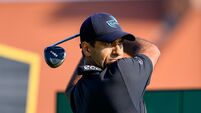
Tom McKibbin's second round at the Masters started with a bogey and finished with him carding a 76. Pic: Hector Vivas/Getty Images
At the start of the second round of his debut at the Masters, Tom McKibbin navigated the first nearly flawlessly. In the approximation-adversary that is Augusta National, nearly isn’t enough.
That opening tee at the par 4 Tea Olive is a stern examination. Not exactly a brute, but a conundrum designed to unsettle. The fairway runs out to the left, has a trap bunker on the right and ensures a blind second shot if you land short. McKibbin found the fairway with a 287 yard drive, was within 28 feet of the pin with his approach and lag-putted to within four from there.
Then, he tapped a putt a degree too far left on a fast green. The ball lipped agonisingly around the cup and spun out. He started with a bogey and spiralled to a 76.
Read More
Every elite sport is defined by microscopic margins, but golf is a pathology beyond that. The extent to which this club obsesses about every single detail is almost-manic. Every single shot is recorded and analysed from the course. Occasionally, you see tripod devices that resemble surveyors although the precise material that each one tracks is clouded in the house’s habitual omertà: “The only thing I am at liberty to tell you is that we are recording data for Augusta National.” At each crossing, a steward calls the upcoming players’ handedness. That way, if it’s a leftie, the message can be conveyed to marshals on the opposite side of the fairway to usher any potential bobblehead out of their line of vision.
A detailed weather report is posted in the clubhouse every morning with the precise mile per hour and direction of the wind as well as the relative humidity percentage. The greens are cut to one-eighth of an inch and the fairways to three-eighths of an inch. A spectator guide book spans 68 pages. The media guide is 467.
This citadel that was made in the 1930s for industrialists in the Northeast to have a place to play golf in better weather has become a behemoth of precision. All that said, it simply reflects the neurosis of the game it hosts.
Bob Rotella’s gospel, the audio book that Rory McIlroy loaded up to steady himself before the ultimate success last year, espouses a simple idea: Golf is not a game of perfect. One of his tenets is that before taking any shot, a golfer must pick the smallest possible target. In 1992, Fred Couples famously survived disaster at the 12th hole when his ball miraculously stayed out of Rae’s Creek. Rotella explains that he had picked his target but was distracted by a fluttering flag on the other side.
Yes, that is right. Catching sight of a fluttering fabric that marks the spot you are supposed to finish can be the difference between clinching a Major and letting it slip. A blade of grass offering enough resistance to stop a ball getting wet can define a legacy.
Look at the shot that ignited McIlroy’s opening day scorcher. This genius, whose drive was all over the place to start, found a moment of clarity. On his way to a birdie on the par-5 eighth, he reached for the 3-wood and drilled a bullet onto the green.
“It was probably a perfect 5-wood number, but out of that first cut, the ball usually spins a little more with the fairway woods,” he said afterwards.
Basically, the pin position was back right, so he choked down on the club, came out short and watched it chase forward towards the flag. Think about this for a moment: he calculated how a ball would spin out of that specific cut of grass to find a slope at the right speed so that it would trickle towards a punchbowl-like green. Goddamn.
Here is the paradox at the heart of it all. How do you excel in a sport that obsesses over every decimal while pretending they don’t actually matter? Don’t sweat the small stuff in a landscape that is all about the small stuff.
They build their entire strategy around that. On his 37th Masters start, legendary Spaniard José María Olazábal did whatever it took to extricate his short game. So on the 11th, he comically sent his wood shot way right rather than daring to drive to the flag. The logic is simple: Get it down there and then produce an absolute clinic around the greens. This is how you make the most of an organic strength and mask a driving deficiency.
Golf is not a game of perfect? Explain Tiger’s call as he hit that iconic slinging draw on the sixth in 2011: “Be perfect!” He knew it had to be.
All the stakeholders are aware of this. Sure, it is why they consider every vantage. McIlroy raced behind Cam Young after his eagle putt attempt on 15 for a reason. The defending champion was striving to get a read on his putt line. That information can prove critical. Minutes later, he made his own birdie putt.
The best players in the world are constantly in a battle against blazing elements and the immaculate horticulture and a stacked field.
“Even on the easiest day here you are playing, you're still playing on the razor's edge,” said Max Homa. “I watched in my group one of the guys got off to not a great start, and you start to trying to press on a hole like three. If you got a great shot, you have a kick-in. If you don't, it's hard to make par or bogey at times.
“That's this whole place. I think that's why you see when someone wins, they hit a legendary golf shot, but someone that day also tried that and (it) blew up in their face. It's the golf course, man. Everything is so fine.”
Look at what it does to the contenders. Xander Schauffele's tee shot on the eighth goes a few inches too far right and ends up in a patron’s shopping bag. He still recovered to make par. Bryson DeChambeau, a two-time major winner, hauls around a bag that contains irons all cut the same length as well as a 5-iron that he fabricated himself with a 3D printer. He signed for a 76 and hit nearly 200 balls on the range that night in a search for some lost alchemy.
It reduces world-class talents to punch lines. Bob MacIntyre, who scored four Ryder Cup points across two victories, is so frayed that he reaches for a symbolic swear after an erratic strike into Amen’s Corner: “Jesus, f*ck.”
That’s why you have to be a little mad to succeed in this sport and a touch perverse to enjoy watching players oscillate between the two. And look, that’s what it’s all about. You try to be perfect in an imperfect world. You be imperfect in a perfect one. Rotella could have been writing about more than just golf.
CONNECT WITH US TODAY



Be the first to know the latest news and updates