From Blackthorn to Nike in every colour: the evolution of GAA boots in the modern era
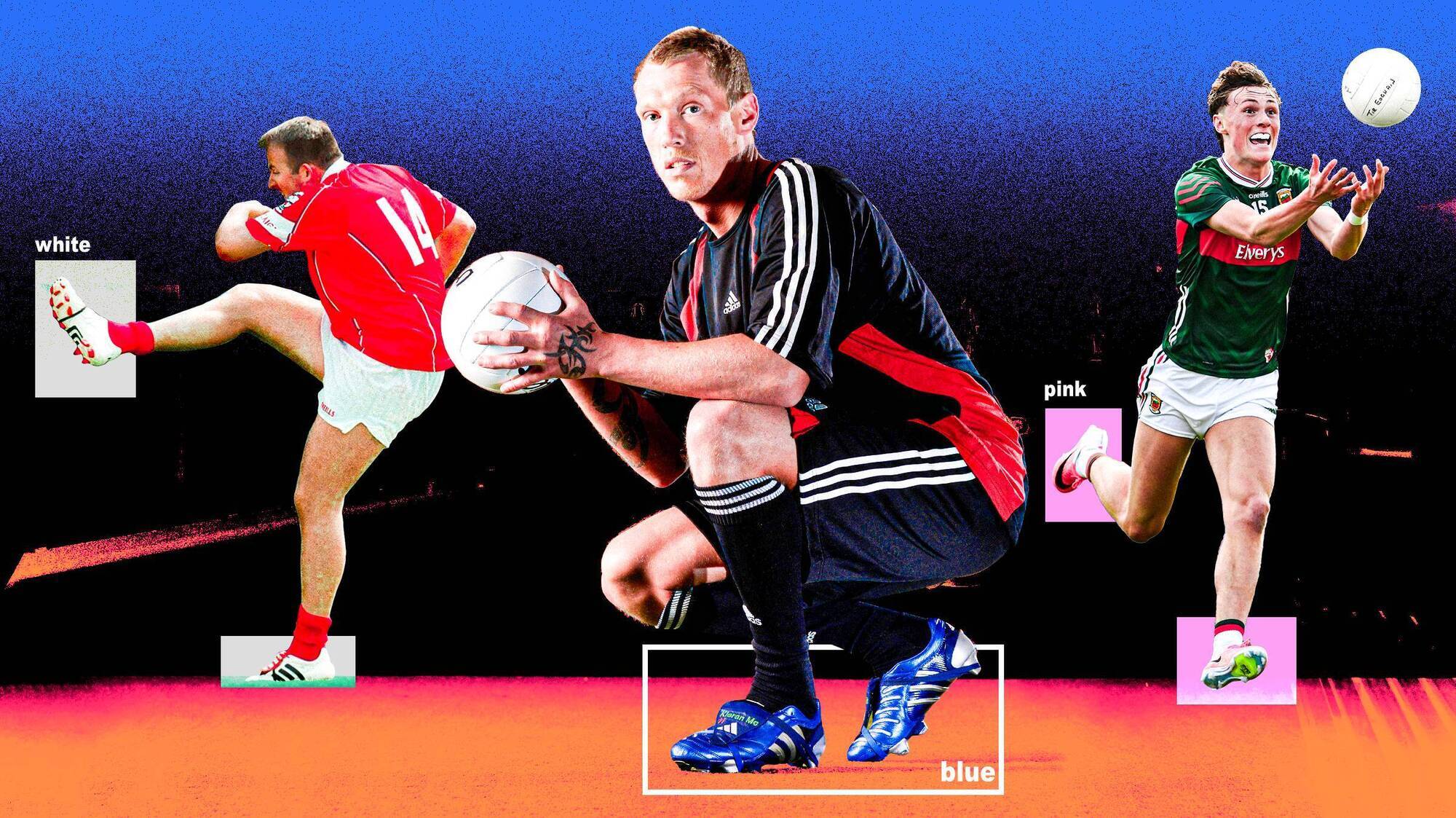
Have boots, will travel, will stand out. From left, Cork's Colin Corkery, Mayo legend Ciarán McDonald and his son, (right) Kobe. Graphic: Adam Moynihan
During RTÉ’s coverage of Tyrone v Mayo in the football championship a couple of weeks ago, ex-Tyrone player Seán Cavanagh commented on Mayo youngster Kobe McDonald’s choice of footwear.
“He’s a brave man coming to Omagh with a pair of pink boots… He’s gonna have to back it up.”
His words were meant, partly at least, in jest but the fact that Kobe’s colourful Nikes even got a mention is instructive. Traditionally there was an unwritten rule that GAA players should only wear plain black boots. Those who didn’t, like Kobe’s own father Ciarán before him, were often branded as flashy attention seekers – or worse.
Perhaps Cavanagh speaks for dyed in the wool GAA traditionalists who still can’t wrap their heads around loud colours, but a glance around the Healy Park pitch would have revealed that most modern players no longer see the world in black and white.
Read More
Although it was Kobe’s Nike Mercurial Vapors that caught the eye, he wasn’t the only one in pink. Conn Kilpatrick, Peter Teague and Mattie Donnelly of Tyrone sported similar styles during their side’s narrow one-point win.
Soccer fans may also have noticed that a high number of players at the World Cup are opting for pink. A senior figure at Nike, Odinga Nimako, told The Athletic that bolder colours are in high demand, which is what led the company to “go pink” this summer.
“What we’ve been hearing consistently from the athlete and the consumer, especially when it comes to big moments, is that bright colours give them confidence.” Nimako also said that wearing pink motivates players to perform to a higher level because, as Cavanagh implied, you need to be good to justify wearing something so loud.
While international soccer players broadly have to put on whatever boots their sponsors give them, Gaelic footballers have no such obligations. Yet the majority of them decide to go with bolder colours anyway. In fact, in this year’s Munster, Leinster, Ulster and Connacht football finals, only 30 of the 120 starters wore black boots, with the majority (75%) stepping out in various shades of red, blue, white, green, yellow, orange, purple, silver, gold and – yes – even pink.
Kobe and Mayo weren’t involved in the Connacht final but Galway’s Shane Walsh sported pink David Beckham branded Adidas Predators. His teammate Rob Finnerty wore orange Vapors bearing the initials of French soccer star Kylian Mbappé. Meanwhile, only one member of Roscommon’s starting 15 opted for black.
In fact, the scene has actually flipped to the extent that choosing retro-style black boots has become a fashion statement in itself.
Of course, it’s a far cry from the old days when there was scarcely a dash of colour to be seen. For comparison, every player who lined out in the 1986 provincial deciders had black boots on, and they were almost all made by German companies Adidas and Puma.
Endorsed by international stars like Franz Beckenbauer, Zico and Gary Lineker, the Adidas World Cups (for soft ground) and Copa Mundials (for hard ground) quickly became soccer staples following their release in 1978 and 1979 respectively. By ‘86 they were also the boot of choice for many of the leading Gaelic footballers. Every member of the Kerry team and most of the Cork team wore them or other similar Adidas models in that year’s Munster final.
The Kingdom had a close and controversial relationship with Three Stripe International, the Irish wing of Adidas, for around 30 years.
Although the forbidden jerseys of the eighties gained all the notoriety, the arrangement actually began in 1972 as a boot deal. Three Stripe boss Michael O’Connell had the idea to give free footwear to the Kerry panel as a means of promoting his merchandise on the national stage.
Blackthorns, manufactured in Dundalk under the brilliant tagline ‘The Boot That Boots The Ball’, were still the most popular GAA boot at the time, though certain players had been wearing foreign brands on their feet for a number of years.
“I distinctly remember the difference,” Kerry’s goalkeeper in ‘72, Eamonn Fitzgerald, once told this writer. “The Adidas boot fitted like a slipper and was far more flexible and much lighter. You could never go back. Up to then, Adidas was for cross-channel soccer players; that was the official party line by the GAA. We got the boots but there was no publicity about it.”
Cork native O’Connell also provided gear to players from his native county during this period.
Puma were the other main footwear company in Gaelic games in the eighties. Most of the Meath and Dublin players in the 1986 Leinster final wore Puma Kings (or similar), a model made famous by Eusébio, Pelé, Johan Cruyff and Diego Maradona. Just weeks earlier, the Argentinean superstar had excelled in the legendary Puma boots as he led his country to victory at the World Cup in Mexico.
Goalkeeper John O’Leary was a notable exception in the Puma-dominated Dublin dressing room. He preferred an ankle-high rugby boot with a reinforced toe box, which supposedly added distance to his kickouts.
Sporting non-black boots wouldn’t become commonplace in Gaelic games for a few decades yet but Galway hurler Gerry McInerney is often credited with being the first player to do it. In the late eighties he wore flashy white Nike “cleats” he had purchased while living in the United States.
“They didn’t look too bright over there with the weather and everything,” McInerney told RTÉ in 2015. “But when I brought them back here, they got a bit of attention. It wasn’t much until we got to Croke Park – there was a bit of slagging after that then… I was just being myself.”
Galway teammate and fellow emigrant to the US, Pat Finnerty, wasn’t impressed. “I begged him. I begged him not to wear those boots,” he said in the Irish Independent in 2018. “Mac was a little bit ahead of his time...”
You can say that again. Even 20 years later, though colourful footwear had started to gain traction in soccer, black was still very much the shade of choice for your average Gael. The vast majority of starters in the 2006 provincial football finals took to the field in traditional black boots (110 out of 120 players, roughly 92%). Half the teams – namely Cork, Kerry, Galway and Armagh – wore black and nothing else.
Five of the nine bold fashionistas who went for something a bit different colour-wise were on the Mayo 15 that lined out in the Connacht final. Among them was Kobe’s dad Ciarán who wore white Adidas Predators. With his bright boots and bleach blonde hair, McDonald Senior’s aesthetic was iconic – and he invariably put in the performances to match.
Incidentally, the touch of flamboyance did Mayo no harm at all on the day as they beat Galway by 0-12 to 1-8.
In Leinster, Dublin’s Alan Brogan wore blue Predators while John Reynolds of Offaly went with white and black Adidas F50s. Donegal pair Karl Lacey (white and black F50s) and Neil McGee (navy and silver Umbros) were the only Ulster final starters who didn’t wear predominantly black boots that year.
He wasn’t still playing county in ‘06 but in the early part of that decade Cork forward Colin Corkery was something of a trailblazer with his bold red and white Predator Manias.
“I had first worn a white pair when we drew with Tipperary in the 2002 Munster final and got a bit of stick,” Corkery later told the Irish Examiner. “The first coloured boots I played with were in the All-Ireland semi-final later that year against Kerry, red ones. They didn’t go down well with some people who didn’t want me wearing anything but black but the colour made no difference to me, and we sold the boots off for charity afterwards.
“I suppose when you’re not playing well fans would have a case to go at you but when things fall right, they don’t, and thankfully they did for me in the 2003 club final and in a couple of games before that.”
Helped by the massive success of the Predator range, which was first launched in 1994, the brand with the three stripes retained their majority share in Gaelic football in 2006. Their boots were worn by 51% of players in that summer’s provincial finals.
The World Cups/Copa Mundials hadn’t changed in terms of design since their inception but they remained hugely popular.
Puma Kings were still in style too. Around 28% of provincial final players in ‘06 wore Puma with their spot in second place challenged only by Umbro. (The most random boots belonged to Kerry’s Kieran Donaghy who opted for the little-known Australian brand Nomis. They served him well as he ended up being named Footballer of the Year.)
Despite being one of the biggest names in the world of soccer Nike had not made any huge inroads into the GAA by 2006. Only three provincial final players sported swooshes that year and they all played for Mayo (Billy Joe Padden, John Healy and a young Andy Moran).
A number of top GAA players penned individual deals with brands around this period. In 2003, Kieran McGeeney, Dara Ó Cinnéide, Michael Donnellan, Trevor Giles and DJ Carey were reportedly paid €2,000 each to wear Puma. By 2005, the Puma stable had expanded to incorporate over 20 footballers and hurlers. Among them were Henry Shefflin, John Mullane, Ciarán Whelan, Oisín McConville and Tomás Ó Sé.
Adidas got in on the act in 2005, recruiting 11 stars including McDonald, Seán Óg Ó hAilpín, Paul Galvin, Alan Brogan and Ken McGrath.
Tyrone’s Owen Mulligan was an Adidas man as well. The Predator Manias he wore when he scored his amazing solo goal against Dublin in the All-Ireland quarter-final in 2005 were subsequently sold at auction for €30,000. As he later explained to John Fogarty of this parish, he switched boots for the final against Kerry after he and a number of teammates, including Philly Jordan and Peter Canavan, were tapped up by Nike.
Fast forward to the present day and Adidas’ traditional dominance in Gaelic games could be under threat. The number of Nike wearers in the provincial finals shot up from three in 2006 (less than 1%) to 55 in 2026 (46%). The Americans have almost completely swallowed up Puma and Umbro’s GAA base. This year just four players wore Puma across the four finals, while none at all wore Umbro.
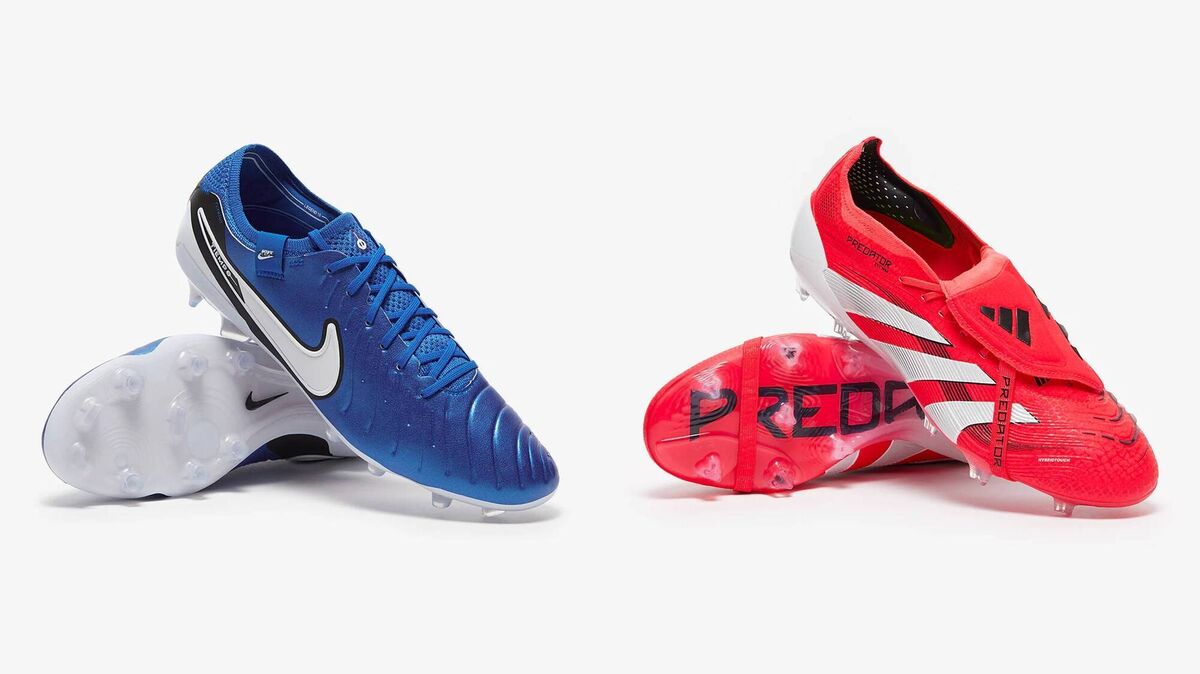
Nike fell just short of Adidas’ total of 56 players but they have a solid claim for Gaelic football’s current favourite model (or ‘silo’ as they say in the industry). The Nike Tiempo Legend is favoured by 30% of the footballers who started the provincial finals, including over half the Armagh team in their Ulster win over Monaghan. Conor Turbitt, Andrew Murnin and Cian McConville all wore Legends, albeit in different colourways, as did Galway’s Paul Conroy, Cork’s Brian O’Driscoll and Monaghan’s Micheál Bannigan.
The trusty Predator now ranks as the second most popular boot (24%). Adidas’ F50s and Copas (modern variants of the now rarely spotted Copa Mundials) and Nike’s Tiempo Maestros and Mercurial Vapors are competing for third.
Now that everyone is doing it, it’s harder to stand out from the crowd with a splash of colour, but some players are still managing to elevate their looks by sporting unique models not worn by anyone else.
Walsh’s ‘Beckham’ boots are a good example, as are the Predators worn by Cormac Costello (grey with the famous red tongue) and Paudie Clifford (white ‘94 Reverse’).
Paudie’s brother David currently wears dark-coloured Nikes; he was one of seven players to step out in Tiempo Maestros in the provincial finals. One would imagine the GAA’s biggest star would be a prime target for big brands if those boot deals from the Celtic Tiger era were still a thing, but he’s not tied down by anyone at the moment. He has actually alternated between Nike and Adidas throughout his career, a habit which would be impossible for his contemporaries in the professional ranks of other sports.
Reigning Hurler of the Year John McGrath of Tipperary favours Predators. His brother Noel is sticking with the tried and tested: he still sports the classic Copa Mundials he has worn for much of his 17-year inter-county career.
In line with the GAA/GPA Players’ Charter, male footballers and hurlers now receive an annual boot allowance of €375, which they can spend on whatever footwear they like. (Despite the pending amalgamation of the GAA, the LGFA and Camogie Association, female players are still not in receipt of this helpful stipend.) Cheaper versions of the most popular silos are available to mere mortals, but elite players prefer ‘elite’ options, which range in price from around €220-300. In some cases, individual county boards may assist with footwear as the need arises.
When they purchase for themselves, many county GAA players opt for independent Irish websites like PM Boots or All-Star Boots. Meanwhile, Cork’s footballers and hurlers get their boots free of charge courtesy of their main sponsor, Sports Direct.
From Blackthorns to Puma Kings to Predators to Tiempos, and from black to pink and every other colour in the rainbow, GAA footwear has evolved a lot. One wonders what the next step will be. Could a native brand like O’Neills take over with a GAA-specific boot, or will big international companies like Adidas and Nike continue to reign supreme?
Will bright colours fall back out of style with traditional designs finding favour again?
And, ultimately, does it even matter? The boots won’t put the ball over the bar for you. The more fashion conscious might counter with a mantra of their own: Look good. Feel good. Play good.
CONNECT WITH US TODAY



Be the first to know the latest news and updates