'I couldn’t find the mojo': Dara Ó Cinnéide on 2005, Tyrone and life after Kerry
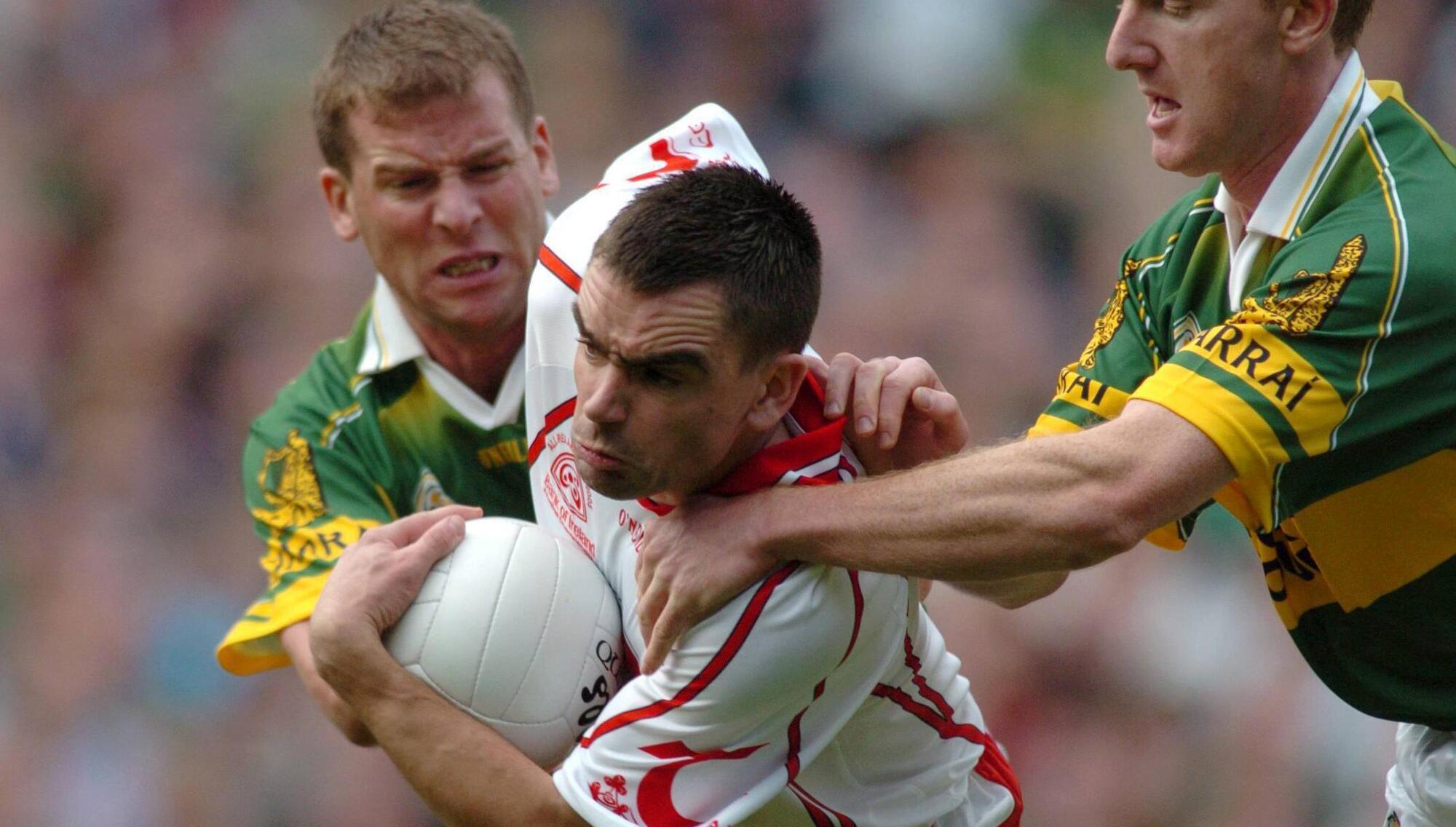
Ryan McMenamin, Tyrone, under pressure from Dara O'Cinneide and Liam Hassett in the 2005 decider. Pic: Damien Eagers/ SPORTSFILE
As this year is the 21st anniversary of him finishing his inter-county career with a goal in a Kerry-Tyrone All-Ireland final, we thought it’d be timely to check in with the man himself.
No, not Peter Canavan who everyone can still see peeling off Owen Mulligan that day to masterfully place it beyond Diarmuid Murphy’s reach.
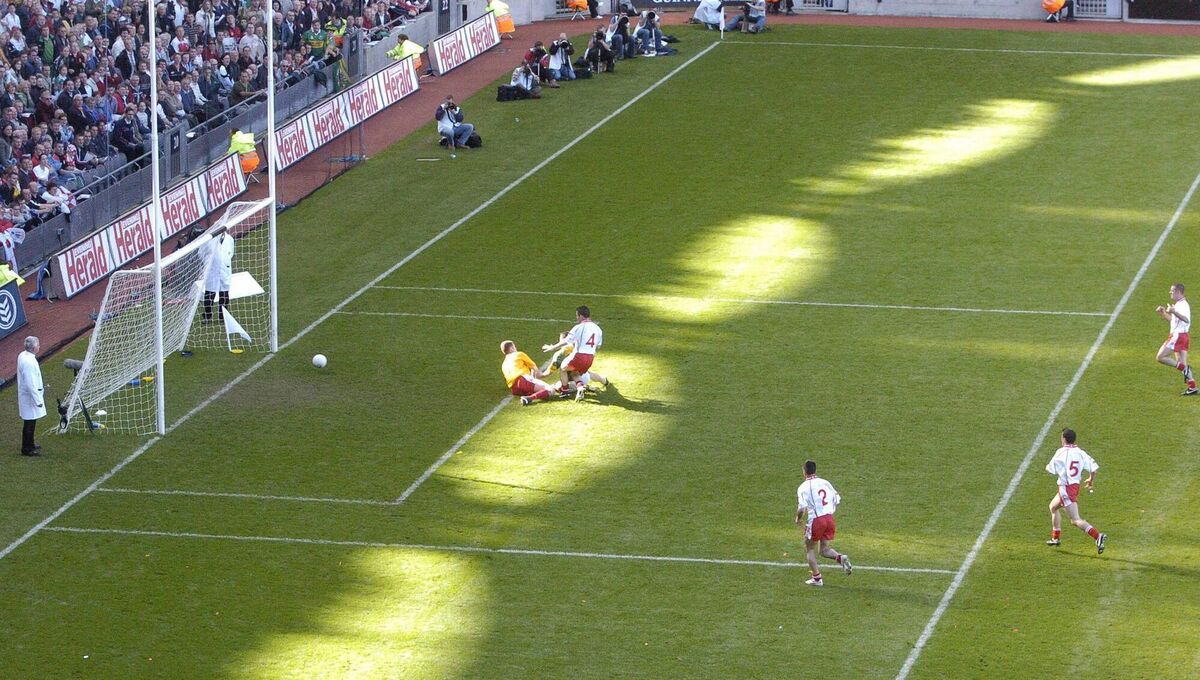
We mean that other previous All-Ireland winning captain, Dara Ó Cinnéide, who everyone seems to forget ran onto a ball from Colm Cooper in that same game to shoot past Pascal McConnell.
As it happens, he’s just off the phone from Murphy when we call.
For once they barely mentioned caid; Ó Cinnéide’s home and car insurance is expiring and his old friend from neighbouring Dingle is a branch manager of a leading insurance company.

Instead he saves the football chat for us.
“That was my last day but I didn’t know it at the time,” he says at mention of that 2005 final. “I was only 30. I went back training for 2006 but I went back too early. I was all gun-ho, we’ll avenge that loss to Tyrone and all that. But I just lost the hunger over the winter.
“An uncle died in November. And then the west Kerry final against Anascaul was postponed for a wedding. There was a lot of messing around about the re-fixture – in the end it was never played – and it just tipped me over the edge. I was over in Chicago visiting my brother with my now wife and I just had this feeling of 'Feck football, feck everything'. We were in a cinema over there when I had this realisation, ‘I’m not going back with Kerry.’ And soon after that I called Jack O’Connor.
“I knew what I was walking away from. I said it to Jack, ‘I think Kerry are going to win this next All-Ireland.’ But I couldn’t find the mojo to be part of it. I remember Darragh Ó Sé saying, ‘Look, I think there’s a few more years in you.’ But I had a lot of mileage up by 30. I first played senior with the club when I was 15.
“A Tomás Ó Sé would be a different animal. He’s always been a great athlete, that’s how he could play with Nemo in All-Ireland finals at 40. And I wasn’t a Declan O’Sullivan or Gooch. I knew exactly where I was in the Kerry hierarchy and that I needed to be obsessed to be good. And that obsession wasn’t there anymore.”
What did that obsession look like?
“I remember Liam McHale after Mayo beat us in the 1996 All-Ireland semi-final saying they knew they were going to beat Kerry because on top of all their collective training they would all do 10 press-ups and sit-ups on their own before going to bed as that bit extra. So my thinking then was, Well, we won’t do 10, we’ll do 15 – in fact we’ll do 150, a thousand. If you beat us we had to work harder and get up earlier and stay up later and get more in the 24 hours in the day.
“It meant kicking a ridiculous amount of frees, though the advice I’d get as my career went on was that less was more. I had a 27-kick rule, something I picked up from Johnny Culloty. First practice the easy ones: go out to the 21, take three from the left, three from the middle and three from the right. Then go out a bit further: again, left, right, centre. And then go out to 35 metres and around the arc: again, left, right, middle. Don’t even bother practicing 45s. So I would do those 27 kicks. But the way I’d go about it, if I missed one, I’d start all over and keep going until I nailed all 27.
“Again, I had to be like that to be good enough to take frees for Kerry, though all that kicking probably damaged the back a bit. I had this chat with Oisín McConville in recent years about free-taking and he said he switched to taking the frees out of the hands to protect the body. I only took frees off the ground. There’s an expression in Irish: Caithfear teach a leagan chun é a thógáil arís. A house must be knocked down to build it again. I was too far gone to do that.”
And so just as Kerry moved on without him, winning that 2006 All-Ireland as he suspected, he moved on without them.
There were other projects to do. Writing a column for the being a regular pundit on finally getting married.
“We’d got engaged in 2003 and meant to marry in 2004 but then I was made captain of Kerry and thought, ‘I better put that off.’ And I kept putting it off. Still lived at home with the parents. Pure selfishness. Everything in life revolved around Kerry. The minute I finished with Kerry I moved out.”
Ó Cinnéide was of a generation of Kerry player that never beat Tyrone in championship but he’ll point out such a failure was nearly as much on Tyrone as Kerry themselves.
“Hats off to them. They beat us fair and square every time we played them. They were exceptional, especially in 2005, and they had to be because we were very good too.
“But this is something I’ll always argue with Tyrone people. Every second year or so they’d do this disappearing act. We were as constant as the northern star. My brother was living in Chicago at the time but the likes of Owen Mulligan and Seán Cavanagh spent more time out there, playing football for the summer while we were still trying to win All-Irelands.
“In those years there was definitely an animosity there and I don’t ever expect us to see eye to eye. But there is a genuine respect there between the counties. I mean, just look at that forward line they had in ’05. Canavan. Mulligan. O’Neill. Dooher. McGuigan. The only one that wasn’t a big name was Ryan Mellon and he kicked three points off Tomás who had been our best player that year.”
The first time he came across Canavan was in 1988. Four lads from west Kerry played in that year’s All-Ireland minor semi-final and it was his own An Gaeltacht clubman Micheál Ó Sé on the match commentary who pointed out that the star man for the opposition was a certain Peadar Ó Ceannubháin.
“The first time I played against him then was a league quarter-final in 1995 up in Croke Park. Tyrone beat us well and went on to reach the All-Ireland final.
“The following February then we drew with them up in Dungannon. Mick O’Connell used to go to games back then and at halftime he came onto the field to kick the ball and the crowd gave a cheer after every kick! That was the respect they had for him but Canavan’s own status by then was already that of a Matt Connor: one of the few forwards outside of Kerry that Kerry people would acknowledge was a class apart. But then in that year’s All-Ireland semi-final Meath basically kicked the lard out of him and Tyrone and ourselves started moving in different circles until the young lads like Mulligan came along.”
It's funny how one generation and icon can inspire the next. Canavan as a teenager wore out a video his dad got of Frank McGuigan kicking 11 points from play in the 1984 Ulster final. Ó Cinnéide and almost every friend, not just teammate, were reared on the video.
“In college when we’d have a few pints we’d be able to rattle off any sequence or line of from that tape. ‘And it comes up now to John Egan. John Egan up to Eoin Liston. Liston back to Egan. And now they’re really rolling.’”
The Kerry team of the 2000s would have been worthy of a DVD of their own but, says Ó Cinnéide, there was no need.
“Most of it you can get on And with and this thing now, you can still get Gooch doing Gooch things like playing Gneeveguilla and chipping the goalie. The only pity is that there’s not more Maurice [Fitzgerald] out there.”
He can see the legacy of those greats live on though. Like in that handpass Dylan Geaney gave for Joe O’Connor’s goal against Armagh last week. And of course in David Clifford.
“He’s a combination of the two. He has Maurice’s height, languid style, Gooch’s bag of tricks. I don’t know the lad himself but I know his uncles Barry and Fergus would have been in college with me and they were football obsessives which I hear David is himself.
“His father Dermot is the same. A south Kerry man from Derrynane, so I can only imagine Maurice came up regularly in their conversations. And you don’t spend six years in the Sem [St Brendan’s] like David did without studying or appreciating Gooch.
“But I keep saying this: as good as he is, David Clifford still has only two All-Ireland medals. The same as almost all the team. It’s maybe a strange way of thinking and kind of an embarrassing thing to say but I’ve often had conversations with people from other counties and they’ll say to you, ‘How many All-Irelands is it you have again? Is it four or five?’ And I go, ‘Three.’ And you’ll see them go, ‘Oh, right’ because they assume it would be more.
“Now, look, there was a time we thought we wouldn’t get any. At least I can say I played for 12 years and 25 percent of the time we were successful, that I was part of a great team. A Darragh Ó Sé then, he played for 15 years, won six.
“But as good as Darragh was, he’s not going to be winning anymore. All that matters to me now on a personal level is Brian Ó Beaglaoich going to get a third? When he’s the age I am now he’ll be in conversations where the question will be asked: How many All-Irelands is it you have? I wouldn’t want for him to say he has just the two. Now again, you can take that for Kerry arrogance but that’s just the reality here. You can’t win two All-Irelands in the one year. They’ve already left some All-Irelands behind them, so they’ll have to hoover up any All-Ireland they can get when it’s there for them.”
There’s obviously one opening up for them now. But he offers a note of caution, informed possibly by the Michael Burns experience against Donegal last month.
“All it takes is one moment of madness and for a Kerry player to be sent off and all that goes up in smoke. I don’t buy the line if David Clifford gets injured Kerry can’t win the All-Ireland. Kerry can win it without him. We won an All-Ireland in 2004 without Seamus Moynihan and Darragh who were our two best players. But you cannot win an All-Ireland with 14 men the way the game is now.”
Speaking of how the game is now, would he like to be playing now with these new rules? He laughs.
“We joke down here that [Éamonn] Fitzmaurice was our Trojan horse on the FRC! But thankfully it was a very open process, thankfully they surveyed what game people wanted, and thankfully they came up with a game that reflects that. It’s sad in a way they had to introduce ways to reward kicking – but it’s great that is there now.
“I’d have loved the two-pointer. Would probably have been guilty of trying it out too much! I remember watching Fionán Murray playing a game for Cork RTC against Mary I and he was drop-kicking everything, just for the craic! I’d probably try something like that in a club game – try dropkick a two-pointer!”
Don’t be surprised so if some day you see him doing an O’Connell. Going out at halftime all these years on for a kick and the craic. Still obsessed in a different kind of way.
CONNECT WITH US TODAY



Be the first to know the latest news and updates