Maurice Brosnan: A flawed Munster decider still had moments of class, starting with the No 1s
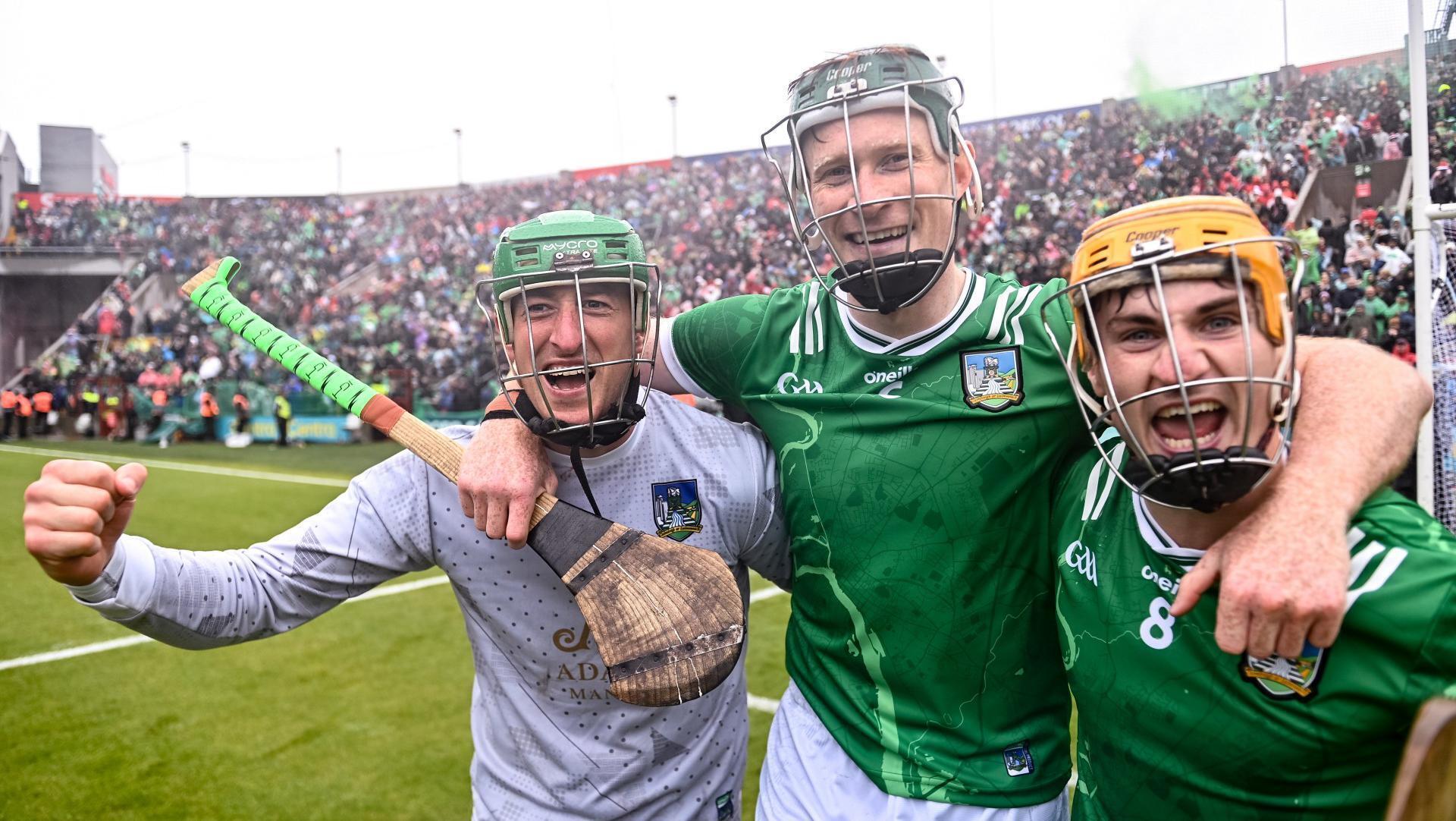
LOOKING AFTER NO 1: Limerick players, left to right, Nickie Quaid, William O'Donoghue, and Adam English. Pic: Daire Brennan/Sportsfile
It is the enduring allure of this competition that even something as imperfect as this Munster final decider could become so enthralling. The end was chaos and carnage and class, a fitting conclusion to a messy afternoon.
As a green wave swept across the immaculate surface, first a trickle from the North Stand and then a flood that engulfed midfield with deafening chants of ‘Cian-O’, Nickie Quaid made his way through various Cork players offering the usual consoling handshake. Eventually, he found his opposite number. Two men who had shaped the tie looked each other in the eye and embraced.
They both did everything possible throughout. In the end, Patrick Collins could not do enough. After a David Reidy wide and Gearóid Hegarty effort off the post squandered a chance to make the margin two, Collins strolled out from his posts with a forlorn choice. It was a long-range free against the wind with the clock deep in the red. Out of range. Out of time. Outdone by one.
If the 2025 final was bedlam on ice, this was an on-and-off slip and slide. Several Cork players and members of management gathered around referee James Owens in apparent indignation at that final whistle sounding before they could work an equaliser. Every yard has to be fought for in a contest like this.
And still, the wonder of this ferocious meeting is how both sides extract the absolute best out of the other, how they intertwine and respond to one another.
Take Barry Nash’s first-half score as a case in point. Limerick had weathered the early Rebels' storm and began to get to grips with the lay of the land. Darragh O’Donovan gathered possession in his half and looked up. In the opposite half, Robert Downey was sitting in front of their inside duo.
That meant a man had to be free somewhere. Paul Kinnerk’s ingrained philosophy would have established that. Cian Lynch came flying off his shoulder with Barry Nash in support. They manufactured a three vs two in the middle because Cork had one close to their own goal.
Such a threshold demands excellence in individual matchups too. Sean O’Donoghue beating Aaron Gillane to the ball paved the way for him to lay off to a retreating Diarmuid Healy, who ran himself into the ground. The wing-forward could angle a ball towards Brian Hayes. Tim O’Mahony came thundering down the middle and the result was a tap-over Aaron Connolly free.
One-on-one duals, taxing physicality, tactical clarity, a bit of luck, they need it all. As frustrating as the play was, it was still littered with magnificent moments. Hayes’ goal while sitting on the wet surface. Lynch bouncing the ball off the same treacherous ground during a full-pelt sprint. Diarmuid Byrne’s long-range beauty. Healy’s heart to show consistently.
Nothing illustrated that more than both number ones. It started with Quaid at full length to deny Healy ten minutes before the turnaround. In the second half, Mark Coleman opted to go low to his left instead, but the end result was the same.
How they bleed together is part of the fascination. In Ballylanders, the convoy of travelling fans found red and green flags fluttering side-by-side on the same street. The Blackrock end was undoubtedly Cork, even if a few supporters were removed for lighting flares before throw-in. Limerick made their presence known in the end with that awesome pitch invasion. Both counties have become indispensable to the other's greatness, on and off the field.
Those remarkable Quaid stops are why Cork can feel aggrieved about the defeat. The raw numbers suggest a one-sided affair. 23 shots to 42. 10 shots from play to 26. Glorious goal opportunities, marginal calls and absent personnel are as much part of the equation as raw statistics.
The fact that there is still scope for another meeting in 2026 should excite all concerned. It will drive this iconic rivalry to a higher standard. In the bowels of Páirc Uí Chaoimh, John Kiely staggered into the media room, utterly spent.
“I was nearly going to the coronary unit yesterday,” he said with a hard-earned grin. “My heart was on fire at that stage. You know what is coming.”
Every single time. That is the expectation. That is the bar. For Collins, the burden of going toe-to-toe with a master like Quaid is the double-threat. His distribution is as important as his shot-stopping.
Three times in the first half, Collins put the ball over the left sideline. From all three, Cork turned Limerick back over to score. Mark Coleman’s long sideline to the square stemmed from a Limerick sideline first.
This was because Cork made a concerted effort to avoid Kyle Hayes here. Until the final minute. Collins went long to that right wing and the number seven saw his chance. A towering leap, the sliotar broke up the wing to Lynch and a glorious opportunity to stretch the legs.
Hayes drove to the 13 metre line and popped to Hegarty. He took one look and snipped a point to level it.
How Limerick celebrated a seventh Munster crown in eight years says as much as the fact they won it. There was a race to the city end to dance in front of delirious supporters. Darragh O’Donovan planted a flag in the field.
“For us, we just want to get every last juice out of ourselves,” said Kiely afterwards.
The beauty of this rivalry is that this is what it takes.
A collection of the latest sports news, reports and analysis from Cork.
CONNECT WITH US TODAY



Be the first to know the latest news and updates