Brian Gavin: Neither Owens or Kennedy do themselves any favours in provincial deciders
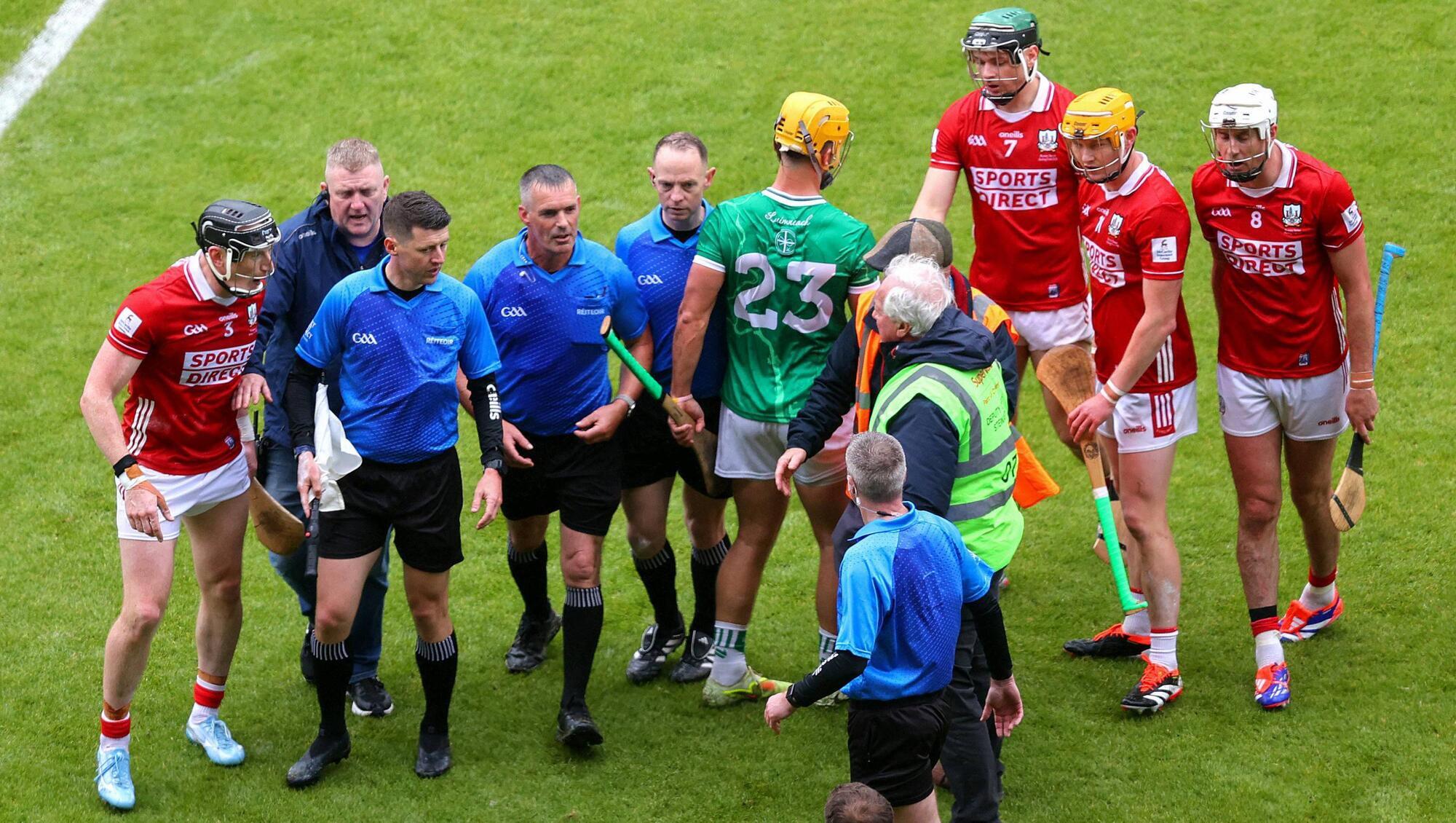
MAN IN THE MIDDLE: Referee James Owens takes the brunt of Cork's post-final whistle frustration at Pairc Ui Chaoimh. Pic: Tom O’Hanlon, Inpho
For referees, the Munster hurling final would be considered the second biggest game of the year. The occasion, the bragging rights, the venues and the need to do all of that justice culminate into the highest honour outside of an All-Ireland final.
If you forget his replacing of injured Thomas Walsh in last year’s game in Limerick, this was James Owens’ first appointment to a Munster final since 2015. And he deserved it. He had been refereeing with confidence and his handling of the Cork-Limerick game in Páirc Úí Chaoimh in April was excellent.
This was his poorest display of the championship, however. It was a battle that cried out for control without letting too much go, but Owens contributed to it being a stop-start event.
I’ve mentioned before that the players have to look at themselves too and this one was no different. How they simulated for frees was a bad look for them but they may just have taken some cues from how James was officiating the game.
There was no question that the Cork penalty was a correct call. Kyle Hayes was all over Brian Hayes for it but when he didn’t award Shane O’Brien one for a clear foul by Niall O’Leary, Limerick could feel hard done by. In that situation, Owens should have at least be seen to have a chat with his umpires.
Read More
The free count was 32 in total, which felt far too heavy for a Munster final never mind a championship game. Alan Connolly and Seán O’Donoghue could feel aggrieved for Owens to signal the other way while Barry Nash ducked to win one and Shane Barrett later bought a free at a crucial stage.
Gearóid Hegarty picked up a soft yellow card for a tackle on Diarmuid Healy when he should have been booked for a later foul on Tim O’Mahony.
In the end with Cork needing a point to force extra-time, there was confusion about the amount of time they felt they had to force a scoring chance. Patrick Collins passed it short to try and work an equaliser but after the third pass Owens called for full-time — much to the annoyance of some Cork players.
Did they have reason to be frustrated? Maybe if it hadn’t been clear what was remaining but it was two and a half minutes over the announced five minutes.
A lot of people would feel the clock/hooter would not be welcome in hurling but if it made the timekeeping more transparent then it may have to be considered. Nobody would have been in any doubt about the amount of time remaining or what Cork had to do to to send the Munster final into extra-time for the second year running.
It was a final that was in keeping with a disappointing Munster championship but it sure was a shame when the atmosphere was electric and this rivalry was promising so much.
Neither side could feel too harshly done by – they both benefited and lost as a result of calls. But the biggest loser may yet be Owens. It was a tough day to referee but we have seen Munster final referees overlooked for later appointments and this may yet be another example.
On Saturday evening, I was in Croke Park and like many others looking forward to a novel Leinster final. It was a chance for Galway and Dublin to put a new name on the Bob O’Keeffe Cup and for Michael Kennedy refereeing his first senior provincial final.
As a Tipperary man and his county being out of the championship, the door was open for him to advance his case for an All-Ireland semi-final or more.
Unfortunately for him, he didn’t grasp the opportunity and he put in a very ordinary performance in a game that wasn’t difficult to referee.
Conor Whelan received a black card for hauling down Eoghan O’Donnell inside the 20-metre line and through on goal, and it took a lot of noise for the Dublin supporters to convince him to blow for a free. It took his umpires to bail him out and acknowledge it was a black card and a penalty.
Kennedy had shown signs of slipping just before that when Whelan made an obvious foul on O’Donnell and was fortunate not to pick up a yellow card. If that had been given, would he have committed the second infraction? If he did, Galway would have been down to 14 for the remainder of the game.
However the decision that was especially poor was the blatant pullback on O’Donnell by Conor Cooney just before Kennedy awarded the penalty to Galway and issued the black card to Andrew Dunphy.
It let Galway through for the scoring chance and Aaron Niland converted a penalty from the goal.
I’m not sure how Kennedy didn’t see it. If he didn’t, then linesman Colm Lyons should have and I’m not sure how that communication broke down.
Conor McHugh’s foul on Joshua Ryan was reckless and he was extremely fortunate not to walk for it. Jason Rabbitte earlier was fouled three times before he was pinged for overcarrying. Whelan picked up a free for falling over a Dublin player and there was a blatant free for Brian Hayes that wasn’t given when Cathal Mannion fouled.
This was a golden opening for Kennedy and I know from experience you must take them when they come. He will have regrets with only five fixtures remaining in the year but at least the mistakes didn’t impact the result.
CONNECT WITH US TODAY



Be the first to know the latest news and updates