Christy O'Connor: Dublin pulled off hurling’s biggest shock in 50 years
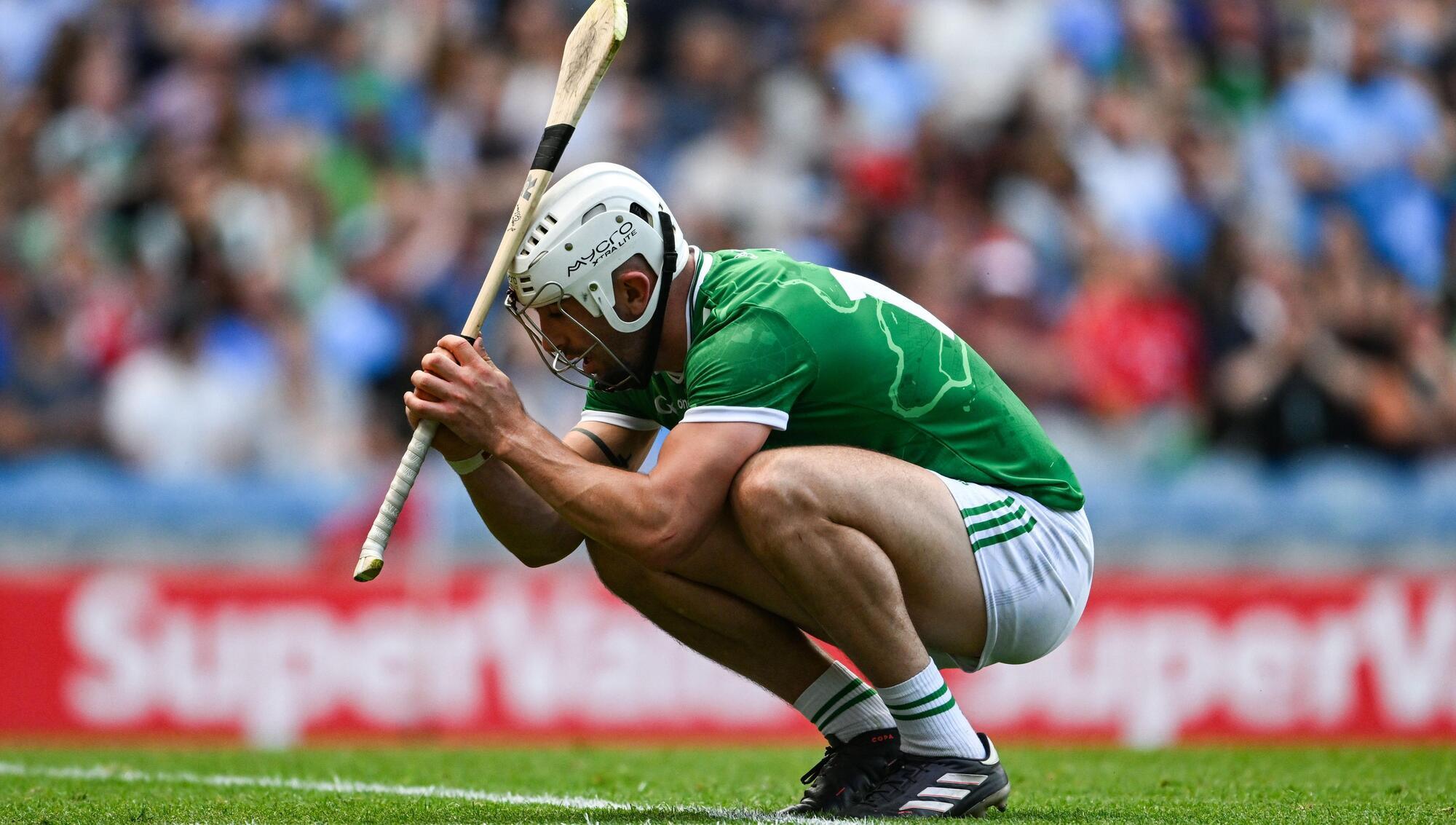
Aaron Gillane of Limerick reacts after his shot was saved by Dublin goalkeeper Sean Brennan during the GAA Hurling All-Ireland Senior Championship quarter-final match between Dublin and Limerick at Croke Park in Dublin. Photo by Daire Brennan/Sportsfile

The odds on Dublin beforehand were long but they got a whole lot longer as soon as Chris Crummey was sent off on Saturday. Just moments later, one bookmaker pushed the odds out to 66-1 on a Dublin win. Who would have taken that bet? Nobody.
Even though Dublin were four points ahead at half-time, the bookies were still giving even money on Dublin, plus nine points. When Dublin were still two points up with a few minutes to go, some bookies still had Limerick odds-on to win. Despite all that happened throughout the match, the bookmakers just couldn’t see anything else other than a Limerick victory. Outside of the Dublin camp, nobody could.
This victory was so seismic that it’s legitimate to say that it was the biggest hurling shock in the last 50 years.
What can compare? Very little.
Antrim’s win against Offaly in the 1989 All-Ireland semi-final is the only realistic comparison, but even that contains an asterisk in the context of Offaly’s status back then compared to Limerick’s elite standing and ranking now as one of the greatest teams in hurling history.
Offaly were All-Ireland champions in 1985 but that team was on the wane by 1989. Offaly were also still trying to transition through the talented young players from their All-Ireland minor winning teams of 1986 and 1987. On the other hand, Antrim were a coming team, having put together three impressive performances in their previous All-Ireland semi-final appearances against Cork, Kilkenny and Tipperary.
There have been some huge shocks in hurling in the last 50 years; Laois beating Dublin in 2019; Galway taking out Kilkenny in the 2001 and 2005 All-Ireland semi-finals; Clare beating Cork in 1993, and sacking Tipperary in 1994; Galway’s 1985 All-Ireland semi-final ambush of Cork; Offaly’s historic Leinster final breakthrough success against Kilkenny in 1980.
Still, none of those shocks were against a team, at that time, with Limerick’s dynastic provincial and All-Ireland winning status. John Kiely’s side are one of just three teams to win four All-Irelands in a row.
The only real comparison across the last five decades is Wexford’s destruction of Kilkenny in the 1976 Leinster final. Before Brian Cody honed Kilkenny’s golden generation between 2006-15, the team of 1971-75 was considered Kilkenny’s greatest side.
Only one county had previously reached five All-Ireland finals in a row — Cork 1901-5 — but they were represented by four different club teams. Although their time coincided with 80-minute All-Ireland finals, that Kilkenny side was still a scoring machine, averaging 3-19 in those five finals, with an aggregate winning margin of 31 points in their three wins. Kilkenny could have won four-in-a-row if they weren’t decimated with injuries in the 1973 All-Ireland final against Limerick.
That team lost just two championship games out of 18 in five seasons before the curtain was finally drawn down in the 1976 Leinster final. Wexford’s final winning margin of 17 points was sensational but Wexford hadn’t exactly come out of nowhere either. Kilkenny beat their neighbours in the 1975 Leinster final by six points, while they’d only scraped past Wexford by one point in the 1974 decider, which was one of the greatest games of that decade.
That Wexford side had big-day form in Croke Park but Dublin had none of that pedigree. Prior to Saturday, Dublin had been annihilated by 16 points in their previous championship trip to Croke Park, against Kilkenny in the 2024 Leinster final. They failed to emerge from Division 1B this year, losing a key game to Offaly in Croke Park in March. In Dublin’s biggest match in the Leinster round robin, Galway bossed them in Parnell Park.
Who saw Saturday’s win coming? Who in their right mind could have predicted the outcome after Dublin were reduced to 14 men so early? Outside of the Dublin camp, nobody.
Just after his fifth point in Páirc Esler yesterday, Marc Ó Sé asked a rhetorical question in his GAA+ co-commentary that had a very obvious answer. “How good has Matthew Thompson been today? Outstanding.”
He was. Ó Sé deservedly selected Thompson as his man-of-the-match after his 0-5 from play (one two-pointer) was critical to Galway’s victory over Down. Thompson also played a delightful pass to Shane Walsh for his goal in the first half, but he really showcased his maturity in the second half; from 17 possessions in that half, Thompson scored 0-2 and had direct assists for another 0-2.
He was also involved in Tomo Culhane’s goal while Thompson played another sumptuously weighted pass to Liam Silke in the 61st minute, where Silke was fouled and Walsh nailed the two-point free to put Galway ahead by five when Down were really heaping on the pressure.
“He’s gifted, absolutely gifted,” said Shane Walsh in recent OTB interview. “Like his ability is, oh my God…..to be honest, I don’t think he knows his own ceiling.”
Thompson certainly expanded that ceiling yesterday. After making his league debut against Donegal in March, last year’s U20 captain scored just 0-1 in his one start and two substitute appearances during the league, while 0-3 of the 0-4 Thompson registered in the Connacht championship came against New York.
He announced himself on the wider stage with a brilliant goal against Dublin in the round robin but yesterday was the first time that Thompson registered more than three scores from play in the championship.
A frontrunner for Young Footballer-of-the-Year, Thompson’s scoring potential has certainly added another huge weapon to Galway’s arsenal. “I’m learning every game,” he said in his GAA+ man-of-the-match interview. “I’m just taking it step by step.”
After lifting his ceiling yesterday, the higher Thompson keeps climbing, the greater chance Galway have of winning this championship.
Just as they had done seven days earlier against Derry, Dublin scrapped and slugged their way to another narrow victory on Saturday. Their display against Cork would be nowhere near good enough to win an All-Ireland but Dublin will still be relatively happy to have kicked 1-19 without Con O’Callaghan, and without their attack ever really firing like they can.
The chinks are still glaring, especially in their full-back line, but Dublin’s game-management was brilliant in the last quarter. When the pressure was at its apex, Dublin nailed seven of their last eight shots. Their big players – John Small, Brian Howard, Seán Bugler, Ciarán Kilkenny and Cormac Costello – were highly productive and effective late on, while Paddy Small was outstanding throughout, scoring 0-4 from play.
Similar to the Derry performance, Dublin’s authority on kickouts was again decisive. As well as mining 1-8 off Stephen Cluxton’s restarts, Dublin got 0-6 off the Cork kickout, 0-3 of which was sourced off Micheál Áodh Martin’s kickouts in the last quarter.
Kickouts were a constant struggle for Cork, only winning 50 per cent of their own restarts, but Cork aggressively matched up well in all the other physical battles, especially off turnovers, with Cork mining 1-7 from that source.
Cork were excellent, playing some brilliant stuff and refusing to take a backward step all afternoon, but they eventually ran out of puff and ideas, failing to score in the last seven minutes, and only getting off one shot in that timespan.
That was all the more regrettable because Cork’s shooting efficiency was 80 per cent in the second half. Accuracy has long been an issue with Cork but their overall shooting efficiency was an impressive 73 per cent. On another day, it would have been enough.
Just not on Saturday.