Irish Examiner view: Oireachtas must take urgent steps to combat climate crisis
Government’s climate action plan does not prevent reliance on fossil fuels or bring Ireland in line with pollution limits
Irish Examiner view: Oireachtas must take urgent steps to combat climate crisis

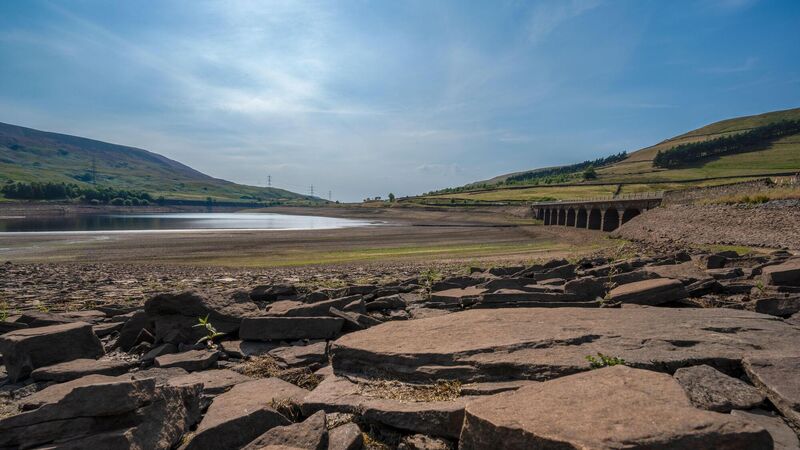
Low water levels at the UK's Woodhead Reservoir in Longdendale, Derbyshire, during a heatwave in 2022. File picture: Alamy

It is over half a century since the first Earth Day was held, on April 22, 1970, to raise awareness of environmental concerns. Lest anyone think interest in such matters is a recent phenomenon, on that first Earth Day over 20m Americans protested about pollution.

The growing awareness driven by Earth Day and other initiatives led to landmark decisions such as the establishment of the US Environmental Protection Agency, for instance, and now no-one can honestly claim to be ignorant of the scale of the environmental challenges facing our planet.

How we are facing up to that challenge? In Ireland, Friends of the Earth said the Oireachtas must respond to the climate crisis with the “urgency and commitment it deserves”. The organisation is focusing on TDs and senators on the relevant Oireachtas committees dealing with these issues, but the delay in appointing those committees suggests that not everyone shares the sense of urgency cited by Friends of the Earth.

The long-running procedural row in Dáil Éireann over speaking rights has delayed the appointment of those Oireachtas committees for months. Opposition TDs would no doubt argue that the principles at stake merited that delay, but the reality is that valuable time has been lost in addressing environmental problems.

On the Government side, it should be stated that Friends of the Earth has pointed out that the expansion in energy-hungry data centres in Ireland, as well as an “escalating reliance” on fossil fuel infrastructure, run counter to the Government’s commitment to greener energy policies.

The organisation also pointed out that the Government’s new climate action plan does not prevent reliance on fossil fuels or bring Ireland in line with binding pollution limits.

Such contradictions illustrate a basic problem with combating the climate crisis. Everyone is aware of the issue but few of us seem to show the requisite urgency in addressing it.

Firms aiming to appease Trump

US president Donald Trump’s tariff plans are being scrutinised by economists with a view to sketching out their impact in the short, medium, and long term. To judge by the recent actions and announcements of some companies in Switzerland, however, those tariffs appear to be having a significant impact already.

Swiss pharma company Roche has announced it will invest $50bn (€43.7bn) in the US over the next five years, creating more than 12,000 new jobs — almost 6,500 positions in construction and thousands more at new and expanded facilities at locations across the US, from California to New Jersey.

It is not alone in making such plans. Novartis, another Swiss pharma company, announced earlier this month that it plans on spending $23bn in the US. Companies such as Eli Lilly and Johnson & Johnson have also committed to large-scale investment in America.

These are companies which also have a significant presence in Ireland, and announcements that they are now choosing to make huge investments in America are bound to cause concern here — particularly when taken in conjunction with attacks from the Trump administration.

US secretary of commerce Howard Lutnick said last month: “They have all of our IP [intellectual property] for our great tech companies and great pharma companies. They all put it there because it’s low tax and they don’t pay us. They pay them [Ireland]. So that’s got to end.”

Those companies are responding, as can be seen above, and others have followed suit. Apple has promised to increase levels of manufacturing in the US, for instance, but there have been some unexpected consequences as a result.

Apple, which has a huge presence in Ireland, has encountered issues because its Chinese factories are simply able to produce more goods than Apple’s American factories and at a lower cost.

Roche, Novartis, and others have surely noted those issues. They appear to be appeasing the Trump administration at present but for all the bottom line is non-negotiable. The implications for Ireland, however, remain to be seen.

Obscuring truth

A recent court case involving a tax defaulter and the Irish Independent newspaper opened up a chilling vista for freedom of expression in this country.

Under relatively new anti-stalking legislation, one-time landlord Christian Carter obtained a temporary civil restraining order against reporter Amy Molloy, which meant that the court accepted Mr Carter believed there was an immediate risk to his safety and welfare.

Ms Molloy had previously written about Mr Carter’s property business, drawing attention to issues such as overcrowding and secret cameras, and won an award for her work.

At a subsequent hearing, more details were presented to the court, including Mr Carter’s defamation cases against
Independent executives, an email which offered a side deal to resolve the matter, and that Mr Carter had threatened to sue the journalist (who he alleged was stalking him) for defamation, and would “ensure she lost her job”.

The judge said he “never envisaged that this forum would be used to dilute journalistic freedom or restrict publication of certain matters” and Mr Carter had failed to satisfy the court his fear, alarm, or distress had any genuine foundation.

This legislation was introduced to help those enduring the intimidation and terror caused by stalking but is now being weaponised to halt genuine investigative journalism which serves the public good. Judge Anthony Halpin called this action what it was — an effort to “dilute journalistic freedom”.

All such efforts must be roundly resisted.

CLIMATE & SUSTAINABILITY HUB

More in this section