A model power: Why Ireland’s EU presidency must defend a values-based world
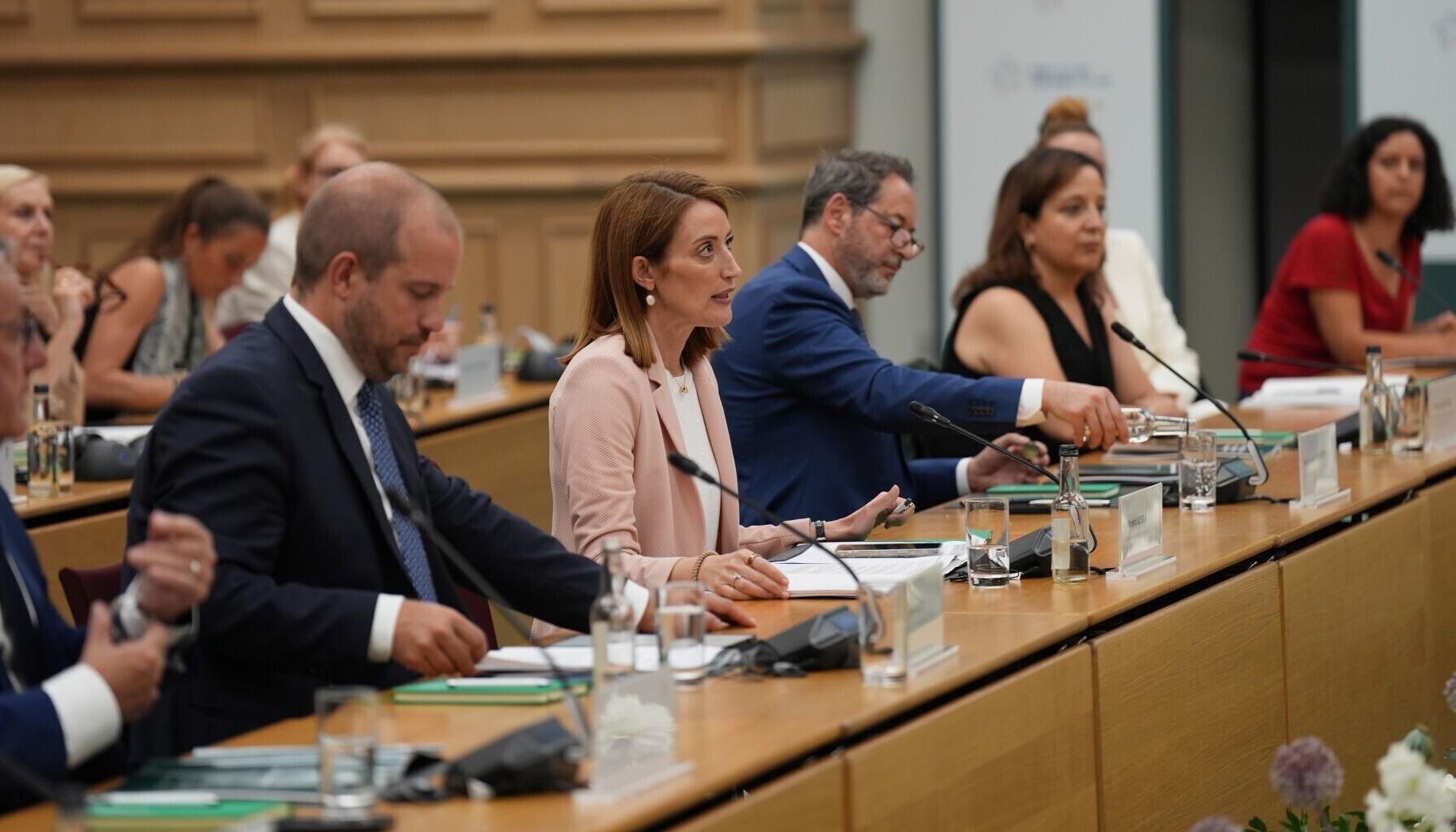
President of the European Parliament Roberta Metsola during a plenary meeting at Dublin Castle with Taoiseach Micheál Martin last week, ahead of Ireland assuming the presidency of the Council of the European Union; ‘Ireland has the experience, the values, and now the opportunity to guide the EU in the right direction,’ writes the CEO of Dóchas. Picture: Niall Carson/ PA
We are living through a period of profound geopolitical uncertainty. Conflicts are proliferating and becoming more protracted. Humanitarian needs continue to rise.
Climate change is accelerating and compounding fragility. Food insecurity is worsening. Civic space is shrinking in many parts of the world and in Europe.
At the same time, many governments are reducing aid budgets and increasingly framing development cooperation through the lenses of security, migration, and strategic competition.
This is the context in which Ireland will assume the presidency of the Council of the European Union.
Read More
During its presidency, Ireland will be called upon to act as both a strategic leader and an honest broker, helping to build consensus among member states on the European Union’s long-term priorities, which will be reflected in negotiations on the next multiannual financial framework (MFF), which is far more than a financial exercise.
It is the clearest expression of the EU’s political priorities and will determine how operationally Europe engages with the world for the rest of the decade.
Over the past week alone, we have seen significant developments on the EU external direction.
Member states have adopted the Council conclusions on the Global Gateway strategy and agreed a partial negotiating mandate on the future Global Europe Instrument as part of the negotiations on the next MFF.
The EU is actively redefining how it engages with the world. The question is whether that redefinition will strengthen or weaken the foundations of European development cooperation.
Last week Dóchas launched ‘The Future of Development Cooperation: Civil Society’s Ambition for Ireland’s EU Presidency’.
Drawing on the collective evidence and decades of experience of Ireland’s humanitarian and development organisations, we believe Ireland is uniquely positioned to act as both a strategic leader and an honest broker, steering Europe toward a future that refuses to compromise on human dignity.
We have a vision of Ireland as a ‘model power’, a country that leads through its values, strengthens international cooperation, and uses its influence to build a fairer, more resilient world.
This is an opportunity for Ireland to champion a distinctive approach within the EU.
Europe’s external action should remain rooted in poverty eradication, human rights, gender equality, international law, and genuine partnership.
It should recognise that investing in people, resilient institutions and local communities is not separate from Europe’s strategic interests, it is fundamental to them.
Development cooperation is not a luxury to be revisited in difficult times; it is an essential investment in a safer, more prosperous and more resilient world.
The Global Gateway strategy should balance Europe’s strategic interests with its longstanding commitment to Sustainable Development Goals, poverty eradication, and mutually beneficial partnerships.
Those principles are enshrined in the European Consensus on Development and Article 208 of the Treaty on the Functioning of the European Union which establish poverty eradication as the primary objective of EU development cooperation.
The recent Council conclusions on Global Gateway contain encouraging language in this direction regarding sustainability, local ownership, transparency and engagement with civil society, and partner countries.
We welcome these commitments. But they must now be translated into practice. Ireland’s presidency provides an opportunity to ensure these principles remain at the heart of implementation.
This is also an opportunity to reaffirm civil society as an indispensable partner in shaping and delivering EU external action.
The agreement reached last week on a partial negotiating mandate for the MFF is also an important step, but many critical decisions, including funding levels and spending priorities, still lie ahead.
Ireland should steer an agreement which will maintain a strong commitment to the Global Europe Instrument by allocating at least 10% of its budget to the EU external action.
The Global Europe Instrument must preserve the integrity of Official Development Assistance, maintain substantial investment in human development, safeguard support for fragile and conflict-affected contexts and provide predictable, dedicated funding for civil society organisations.
It means reinstating previously existing financial commitments with earmarked funds.
While blended finance and guarantees have an important role to play, they cannot replace grant-based funding, particularly in fragile contexts where poverty reduction, localisation, and risk-sharing require public investment.
Development finance should ultimately be judged not by the volume of capital mobilised but by whether it improves people’s lives and reduces poverty and inequality.
Ireland has consistently championed humanitarian action that is neutral, impartial and independent. That principled approach should remain central to EU external action.
But humanitarian assistance alone is not enough. Lasting peace requires long-term investment in governance, conflict prevention, resilience, social protection, and local leadership.
Ireland should use the presidency to foster greater consensus among member states and support coordinated humanitarian and diplomatic efforts in response to the crises in the Middle East, Sudan, and other conflict-affected contexts.
Today, conflict remains the primary driver of acute food insecurity and malnutrition for millions of people around the world, with famine emerging in both Gaza and Sudan in the same year.
This is unprecedented. Food and nutrition security is not simply an agricultural issue. It is fundamental to health, education, economic opportunity, peace, and stability.
Informed by our own history and strengthened through decades of partnership with communities around the world, we can elevate food security and nutrition as strategic priorities within EU external action and ensure sustained investment in resilient and equitable food systems.
Climate change is already undermining development gains across the globe, with the greatest impacts falling on those who have contributed least to the problem.
Ireland has earned international respect through its commitment to grant-based climate finance and its partnerships with vulnerable countries.
We can reinforce European leadership on adaptation, loss and damage, and just transitions, while ensuring that climate finance complements rather than displaces broader development objectives.
The Cop31 that will take place during Ireland’s presidency and the continued negotiations on the EU post 2030 climate framework will offer opportunities to defend a more inclusive approach to climate finance for fragile and conflict affected countries.
When the international community faces deep divisions, working together based on shared values is no longer just an optional choice — it is the only practical way to build lasting stability.
Ireland has the experience, the values, and now the opportunity to guide the EU in the right direction. We must make sure we use it.
Ireland’s presidency can shape an EU that remains outward-looking, principled and committed to international solidarity.
Because in a world marked by instability, conflict and growing fragmentation, principled partnership is not a luxury.
It is the foundation of Europe’s credibility, its resilience and its lasting influence in the world.
- Jane-Ann McKenna is CEO of Dóchas
CONNECT WITH US TODAY



Be the first to know the latest news and updates