Fergus Finlay: In 10 years our population may return to pre-Famine levels — I hope I'm here to see it
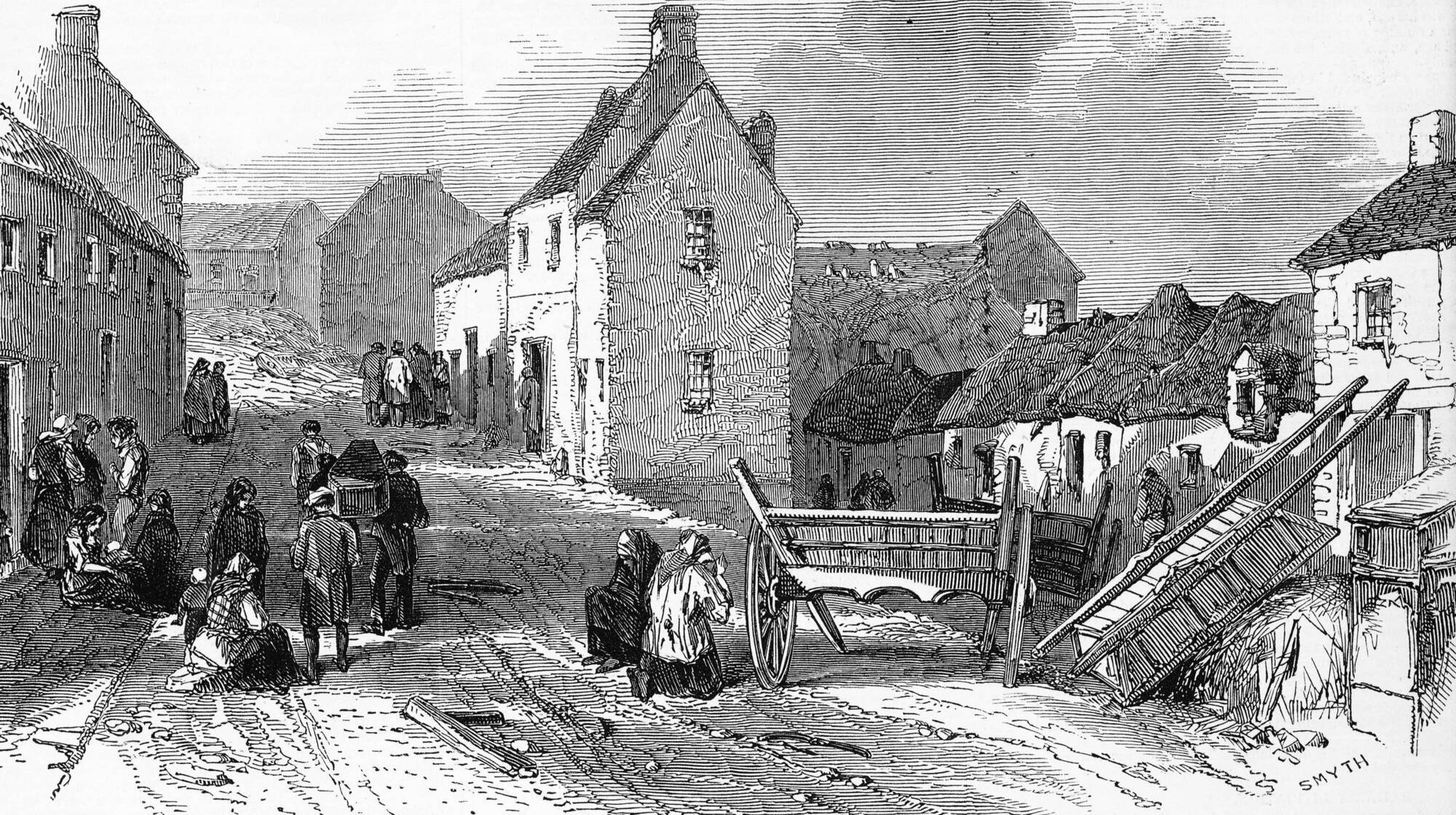
Old Chapel Lane in Skibbereen in 1847 at the height of the Famine. File image: Illustrated London News

I love history, but it doesn’t usually make me angry. Emotionally, spittingly angry. Maybe it’s taken me too long to understand what things really mean. But that’s how I left the Skibbereen Famine Centre the other day.
It was a letter on the wall that gave me an insight that I should have had but never quite got. And a silly little coincidence.
A news alert pinged on my phone telling me the Central Statistics Office had just announced another increase in Ireland’s population. Not a big deal, and It’s probably only sad people like me who are on the lookout for announcements about the CSO.
But it happened as I was standing in the middle of the Famine Exhibition in the visitor centre at the far end of Skibbereen town. The centre is a really welcoming place, with a little walkway outside that overlooks the River Ilen.
Few enough of us, I suppose, would be intimately familiar with the river and its course, at least until it became world famous as the home of our Olympic rowers the O’Donovan brothers.
HISTORY HUB
If you are interested in this article then no doubt you will enjoy exploring the various history collections and content in our history hub. Check it out HERE and happy reading
When the tide is moving, taking the river fast toward Baltimore, it becomes much easier to understand what Paul O’Donovan meant when he described his competitive philosophy as “close your eyes and pull like a dog”.
But I was inside when the phone pinged (because of course I’d forgotten to put it on silent). It was an update from the CSO saying that in April Ireland’s population (the 26 counties’ population) had reached 5,525,600 people, meaning that on the island as a whole there are now seven-and-a-half million of us.
It’s an extraordinary number, especially considering the letter on the wall of the famine centre in Skibbereen. It wasn’t clear to me whether I was looking at the original letter or a copy of the original.
That didn’t matter — it was one of those letters that once you start reading you have no choice but to finish. It was dated December 1846 and was written to the Duke of Wellington by a Justice of the Peace from Cork called Nicholas Cummins.
As brighter people than me, you may all be very familiar with the letter — I was transfixed by it. In the first “hovel” he visited he described six “famished and ghastly skeletons, to all appearance dead … huddled in a corner on some filthy straw, their sole covering what seemed a ragged horse-cloth… they were alive, they were in fever — four children, a woman, and what had once been a man.”
“I found myself grasped by a woman with an infant, just born, in her arms,” he goes on. “And the remains of a filthy sack across her loins — the sole covering of herself and babe. The same morning the police opening a house on the adjoining lands, which was observed shut for many days, and two frozen corpses were found lying upon the mud floor half devoured by the rats.”
"A mother, herself in fever, was seen the same day to drag out the corpse of her child, a girl about twelve, perfectly naked, and leave it half covered with stones. In another house, within 500 yards of the cavalry station at Skibbereen, the dispensary doctor found seven wretches lying, unable to move, under the same cloak. One had been dead for many hours, but the others were unable to move themselves or the corpse.”
What the letter told you — and I’m ashamed to say this has never really occurred to me — was not so much how many were dying, but how they were dying. We know now that the famine didn’t just cause starvation, it brought cholera, dysentery, scurvy, terrible diarrhoea.

They didn’t just slip away in the middle of the night from hunger. In the west of Ireland and the southwest particularly, tens of thousands of people died in conditions of unbelievable cruelty and appalling indignity.
If they had been deliberately tortured to death it wouldn’t have been worse. Is it possible for a mother to endure a greater torture than to hold her baby dying in agony as she is dying herself?
Historians have debated the question of accountability ever since then. I’ve changed my own view a dozen times.
But when you read the letter to Wellington (which was published in the and widely distributed); when you realise that the most senior people in the British Government knew — not just about numbers but about the suffering and pain involved — I think you can only conclude that the fully informed and considered British response was beyond shameful.
Nowadays British neglect of a dying people would correctly be seen as a war crime and a crime against humanity. And it left me, for the first time in my life, wanting revenge. Or at least to see some measure of justice done.
As a people, we were scarred by the Famine and changed forever. But somehow, we survived. We grew again. It took a long time, but we got there. At least, we’re nearly there.
After the Famine our population seemed like it would never stop going down. We all know we lost 1.5 million people in the 10 years around the Famine, and (especially in the Republic) it never seemed to stop.
Around the time I was born, our population fell to under three million, and it stayed that way for two decades. The year I was married we were still fewer than three million. And Ireland was a bleak place to live.
I can still remember the biting cold when I was a kid. My brother and I would go up the town to collect the turf for the house and push it home in an old pram. There was never enough to heat more than one room — we slept in freezing bedrooms under tiny mountains of blankets and overcoats.
And of course the country was repressed in all sorts of other ways that took years and years to change. But little by little things began to shift.
One of the least noticed but most important changes was the introduction of health care practices that drastically cut infant mortality. The introduction of free second-level education had profound effects.
Ireland’s success in attracting investment, and the gradual elimination of inequalities affecting women, made Ireland a better place to live, and a harder place to leave.
So it’s possible that in another 10 years or so our little island could get back to what I think of as the magic figure — 8,175,124. That was the total recorded in the census of 1841, the last count taken before the Famine.
I’d love to be still around when we reach that number, and still able to participate in what deserves to be an extraordinary celebration.
Because after all, recovering the way we’ve done, building a modern country that pulls its weight in the world, developing a fairer and better society and a culture that brings extraordinary gifts to the world — we did all that after an unthinkable war crime was perpetrated on us.
Maybe that, in the end, is the best revenge.
CONNECT WITH US TODAY



Be the first to know the latest news and updates