Fergus Finlay: Children are made, not born bad - which is why we need nurses in early childhood
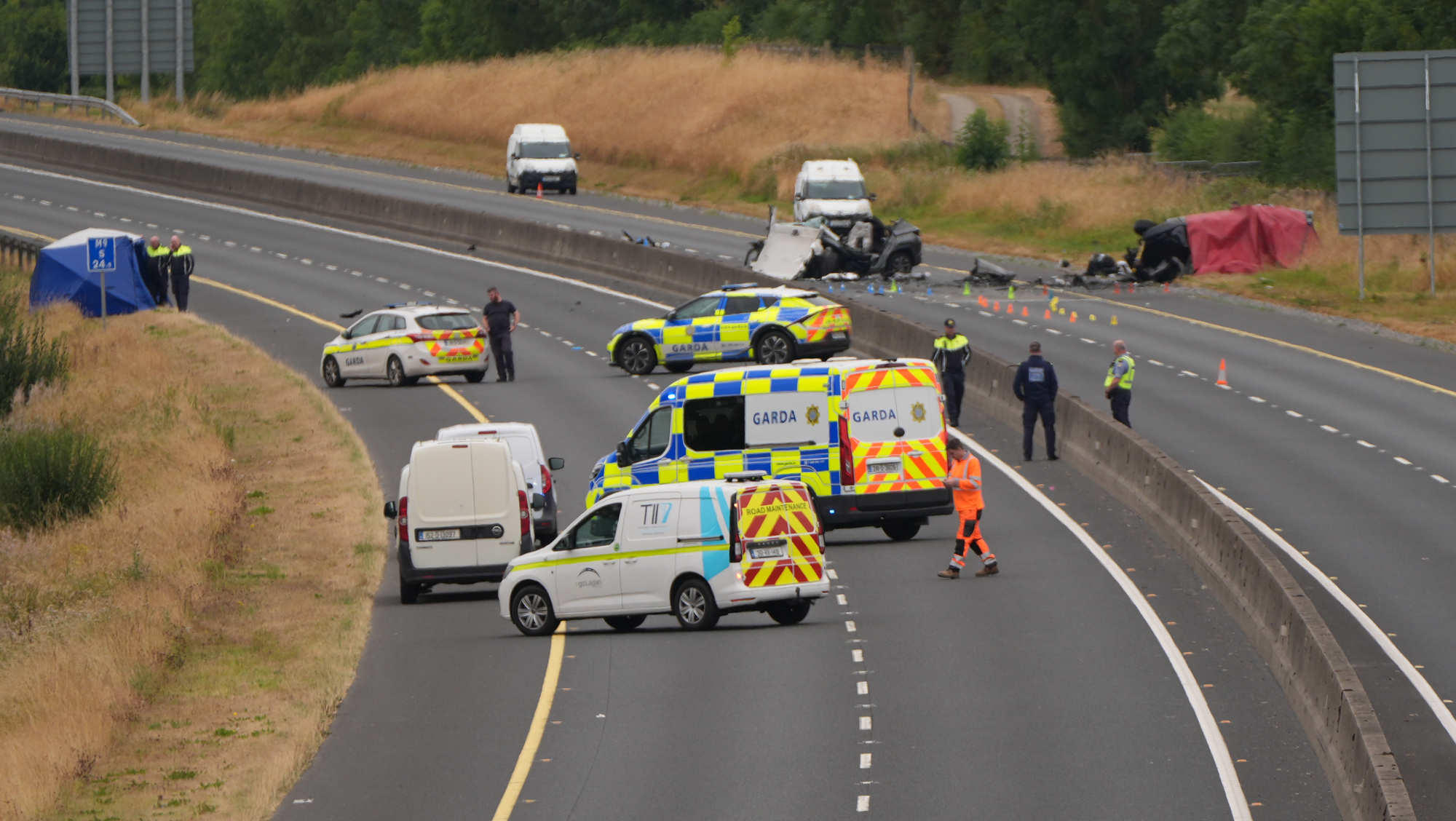
The scene on the M9 in Co Kildare last week where five teenagers lost their lives and four members of the same family were seriously injured. Picture: PA

When a child dies, surely the only appropriate human response is sorrow. I know if it was my own child I’d be broken by the pain of it, a pain I’m immensely grateful I’ve never had to suffer.
When five children die surely the sorrow is accompanied by profound shock.
And if in the act of dying they are engaged in behaviour that has caused terrible suffering to others, that sense of shock is compounded a dozen times.
In the case of the terrible crash on the M9 that caused the deaths of five youngsters, I’m guessing we all find ourselves hoping against hope that the other people involved, a family of three sisters and a seven-year old boy, all on their way to a joyous family celebration, will all make a full recovery in time.
An enormous amount of money has already been raised for them, and I hope it will help their recovery to full and happy lives.
They will never, probably, get over the feeling that life would have been much better if the crash had never happened.
The Kinsella family, all innocent victims of a terrible crash, have been surrounded by an outpouring of public support. That’s as it should be.
Read More
The children whose driving caused the crash have not. Instead they (and their families) have been surrounded by something approaching hate. And in some cases glee at their deaths. And a very strong sense of judgement based on their backgrounds.
Maybe, just maybe, there’s a different kind of judgement we should be thinking about. Could it have been different?
Could these dead kids have led different lives? Could we (all) have done something different to prevent this blight on so many lives?
I’m not going to go into all the social media aspects of this tragedy. My colleague, Mick Clifford, has done that already, and better than I could. But I do want to say this. Actually I don’t want to say it. I have to say it.
I’ve never met a child born evil or bad. I’ve never met a parent, and especially a mother, who wanted their children to grow up evil or bad.
But in a career that involved working alongside people who truly, deeply, understood how children grow, I did learn one thing. I’ve said it here before, so forgive me for repeating it now.
A child born into poverty can make it into well-rounded adulthood, but they will have a hill to climb.
If the child’s poverty is compounded by a family that isn’t functioning properly — whatever the reason — if there isn’t enough love and trust and respect, that hill will become Kilimanjaro.
If all those personal circumstances are added to by living in a deeply disadvantaged community, Kilimanjaro becomes Everest. No one can climb Everest on their own.
I used to describe my frontline colleagues in Barnardos as brave and resourceful sherpas who saw it as their job to help children climb Everest, no matter how difficult their circumstances. And those sherpas taught me an awful lot.
I’ve told the story before about meeting a little five-year-old boy who, alone among his peers, didn’t know the words of .
I learned that he lived in a house without books or reading of any kind.
He had a mother too overwhelmed by issues in her own life to ever read him a bedtime story, or even give him a cuddle before bed, and a father who only wanted his son to be tough, because that’s how he was raised himself.
Based on all their experiences, my colleagues knew what would happen next without intervention, in the boy’s life and in his relationship with his parents.
He would start school behind and stay behind. The gap would grow, to the point where he would start missing school and eventually abandon it altogether.
By age 10 he would be involved in anti-social behaviour in the neighbourhood.
There was a practice in those days of local drug dealers hiring youngsters as runners and look-outs. Do the job and you got a tenner, refuse and you got a hiding.
Whatever the route, he would have his first brush with the law at 12 or 13. By then he’d be involved in a gang, stealing cars and driving them dangerously.
His chances of a decent job, a loving and stable relationship, and kids of his own who loved and respected him, would go downhill every day.
And all because (among other things) no one ever taught him to sing .
Which is why this story always brings me back to a huge mistake we made in public policy, and one that is still not too late to be fixed.
When my children arrived in this world, we had a visit at home from the local public health nurse.
Not just one — every child in Ireland was effectively guaranteed five community nurse visits at home in the first two years of their lives. And the nurse would not just check on their development.
She could see if their mum was under stress. She could see relationships in the house and the state of the house.
If there was something to be flagged she could flag it. It was a powerful early warning system that protected thousands of children and families.
We effectively abandoned it after the bank crash. We refused to grow and sustain the community nursing workforce, even though its responsibilities had been extended into a “cradle to grave” service, and we stretched community nurses to the limit while worsening their working conditions. But we did worse than that.
Tusla was being designed and set up in those difficult years. There was a detailed report behind it, adopted by the government.
Among other things it said that Tusla had to have a universal service for children, capable of identifying problems early and providing support before families reached the point of needing specialist intervention.
In other words it was always intended that the new child and family agency would have its own dedicated group of community nurses, whose responsibilities would only include children and childhood.
But that never happened either. Tusla now carries all the responsibility for child protection, without the essential early warning and support system it was supposed to have.
All, essentially, to save money on Tusla’s startup. It has never fully recovered from that.
Now we’re dealing with unimaginable tragedy. I’m not saying that every tragedy can be prevented by better systems. But we’re debating now whether to make wrong-way driving on a motorway a serious crime, whether or not there’s a crash, and I’ve even heard it suggested that it should be treated as manslaughter.
Is there any room in the middle of all that, without in any way wanting to minimise what those kids did, for wondering if we could have done things differently? We saved some money, and vulnerable kids are growing up differently as a result.
Maybe, rather than trying to invent new crimes, we could take a long hard look at how vulnerable children can be allowed to grow into criminals, without the rest of us noticing until it’s far too late.
CONNECT WITH US TODAY



Be the first to know the latest news and updates