Terry Prone: Labour’s losses are down to the fact that they didn’t listen to voters
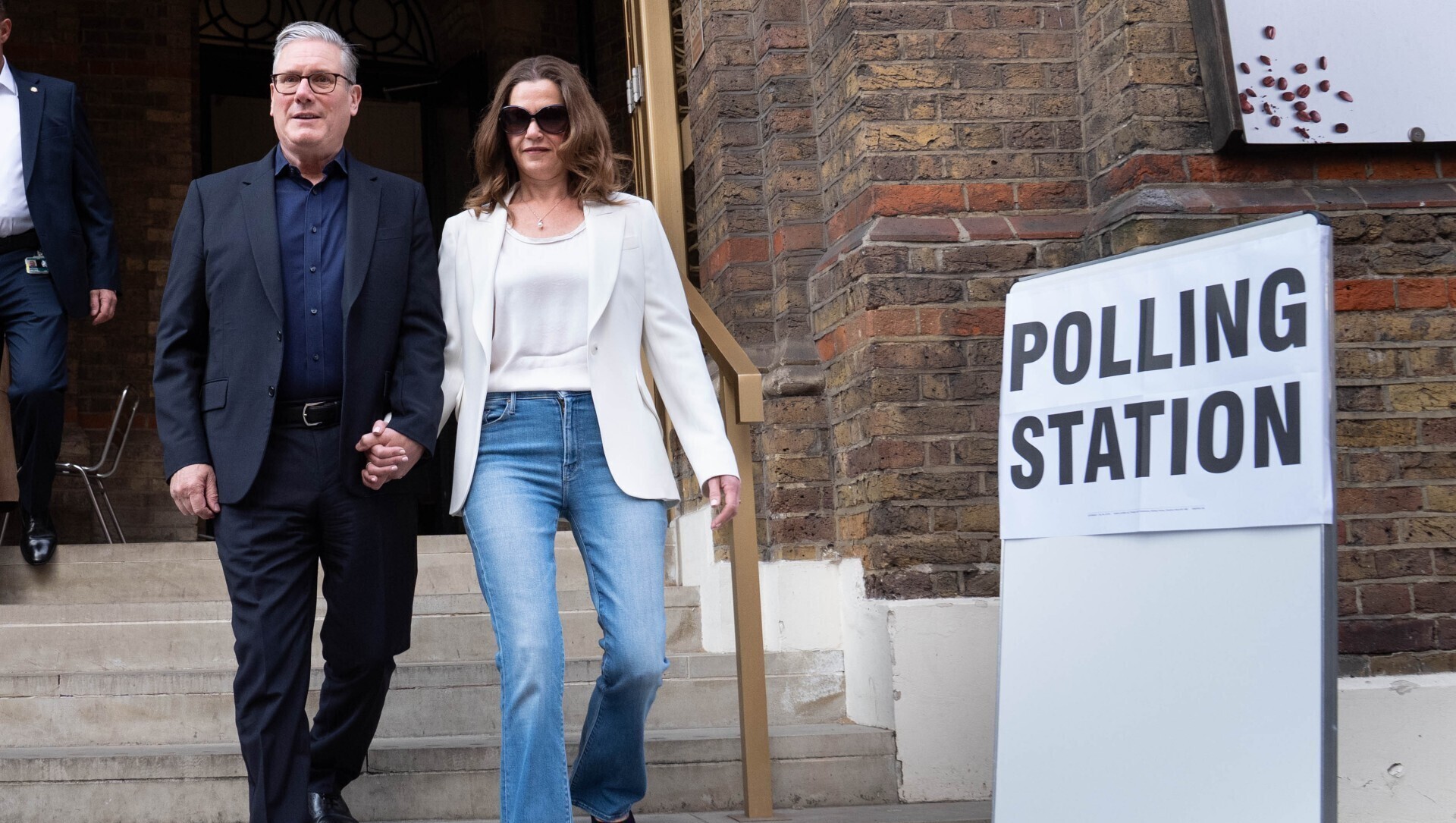
Labour leader Keir Starmer and his wife Victoria Starmer after casting their votes in the local elections at Westminster Chapel in central London last week. Picture: Stefan Rousseau/PA

Two pictures. Two pictures of British political leaders on the day England, Scotland, and Wales went to the polls. One picture striving to make its subject likeable and failing. The other succeeding without striving.
The one trying to make its subject likeable was the one showing prime minister and Labour Party leader Keir Starmer headed for the ballot box with his wife, Victoria, in jeans and white T-shirt with a white jacket, smiling. Starmer wasn’t smiling.
He had that look he frequently has, of a dutiful man fulfilling a current obligation while convinced he should be somewhere else doing something more important.
But he was holding his wife’s hand, you have to give him that, although the hand-holding, let’s be honest, is an import from American politics that never looks quite right when done by the English — or, indeed, the Irish, although in fairness to us, we rarely go there.
Read More
Now, set that aside for a moment and riddle me this. What is the foodstuff, what is the culinary accessory, that chimes with and exemplifies a sunny early summer day?
No brownie points for suggesting it’s the 99, the ice-cream cone with a Cadbury’s Flake bar stuck in the side.
That was what Nigel Farage was holding up when photographed on the same day. Beaming. He does a lot of the latter.
One of the two men looked happy and a bit of craic. The other didn’t.
While it would be ridiculous to suggest the pictures had anything to do with Starmer’s catastrophic electoral results, they did underline a missing-the-point capacity on the latter’s part which, over time, would undoubtedly have contributed to the electorate’s decision that Labour’s not currently to be voted for.
First of all, he rarely smiles. He simply doesn’t ever convey that he might be happy to be where he is.
That may be a moral decision based on him being too committed to the national good to waste time grinning at cameras. Or it may be an inborn characteristic.
One way or the other, it removes any chance that a floating voter will glance at a picture of him and decide, dammit, let’s go with the happy guy, whereas Farage pictures are congruent with such a decision.

One of the pre-election photographs of Starmer was taken when he rowed in behind his party’s candidates by taking or making calls from a Labour Party campaign call centre.
Grim? Check. Concentrated? Check. Worried? Check twice.
But then, the people talking to him on the telephone couldn’t see him, which meant his words were what counted.
Starmer, let’s never forget, is a King’s Counsel, meaning a senior barrister or “silk” who gained the prestigious title through a track record of “outstanding advocacy skills in higher courts”.
A wordsmith, in short. Except that he isn’t.
Because this assertion seems contradictory, we refer you to a message from him to voters issued last Thursday, in which he described Reform and the Greens as “not fit to meet this moment of great global instability”.
Now, here’s the thing. These were local government elections. Even if Reform and the Greens did phenomenally well, as Reform certainly did, the results were not going to put them in a place where they could stabilise global instability.
Starmer was hammering home their unfitness for a task they weren’t being elected to do.
But that wasn’t the end of it. The prime minister had more words, telling voters that “when you put your vote in the ballot box” (which does rather beg the question as to where the hell else they might choose to put it), “you face a clear choice”.
The imperative was, he said, that they vote for “progress and a better future for the community you call home, with a Labour council working with a Labour government”.
That would be a pretty dull and unmemorable proposition at any time but issuing it directly before an election that’s shaping up to be a disaster makes you wonder if Starmer has ever actually met an actual living voter and listened to how they talk.
Actual living voters rarely talk of planning to opt for “a better future for the community I call home”. They rarely do so because it’s weird.
The capacity to meet, listen to, and quote voters does not seem to fit in Starmer’s skillset. It’s probably beneath him.
Let’s never forget the high-end jeering retired taoiseach Enda Kenny experienced because of his habit of announcing that he had met a man (or woman) that week and telling listeners what that man or woman had said to him.
He would not infrequently pull a crumpled bit of paper from his breast pocket on which he had noted the man or woman’s comments.
This habit created a lot of eye-rolling: Oh, here comes Enda with the man he met last Friday. That eye-rolling and mockery missed an essential point.
Like it or not, Kenny would actually have met a real human being and had listened and noted what they said to him. Amazing, isn’t it?
It may have been unscientific — not like opinion polls which get things wrong in a satisfyingly statistical way — but it was authentic, and the sneering should perhaps have been questioned rather more rigorously, given that it demonstrated a politician doing what politicians are elected to do: Listening to voters and registering their concerns.
Listening to voters shouldn’t be that difficult for Starmer, because he hasn’t been in power that long, whereas senior members of Fianna Fáil and Fine Gael have been sitting around the Cabinet table in different positions for so long, they genuinely have a cognitive disadvantage in this regard.
Voters are chronically under-informed, so when they demand, in vox pop interviews, that money being wasted on one area go straight away to another project, experienced members of government have to stifle their desire to say “that’s not how it works”.
Voters want stuff done right now, whereas if you’ve been in government for a while, you know that a policy leading to the eventual delivery of their request is part of the programme for government.
You may even tell them that, which is not that productive, because proving someone wrong based on your superior knowledge and experience can be just a little bit unattractive.
The fact is that the longer you’re in power, the less likely you are to listen with riveted attention to points you’ve heard dozens of times.
The harder you work, the less likely you are to listen to unevidenced whinges and the more likely you are to warn against populism. As did Starmer.
Starmer will probably now announce a listening exercise to put Labour back in touch with its voters.
That’s what political parties always do when faced with a catastrophic poll result: promise to listen in a new way.
Never mind that all they had to do, to prevent the catastrophe, was to listen in the old way.
CONNECT WITH US TODAY



Be the first to know the latest news and updates