Terry Prone: Bid to scare voters against Green candidate in UK by-election backfired immensely

Newly-elected Green MP for Gorton and Denton, Hannah Spencer, eats chips in curry sauce from a takeaway near her constituency office in Manchester. Picture: Andy Kelvin/PA Wire

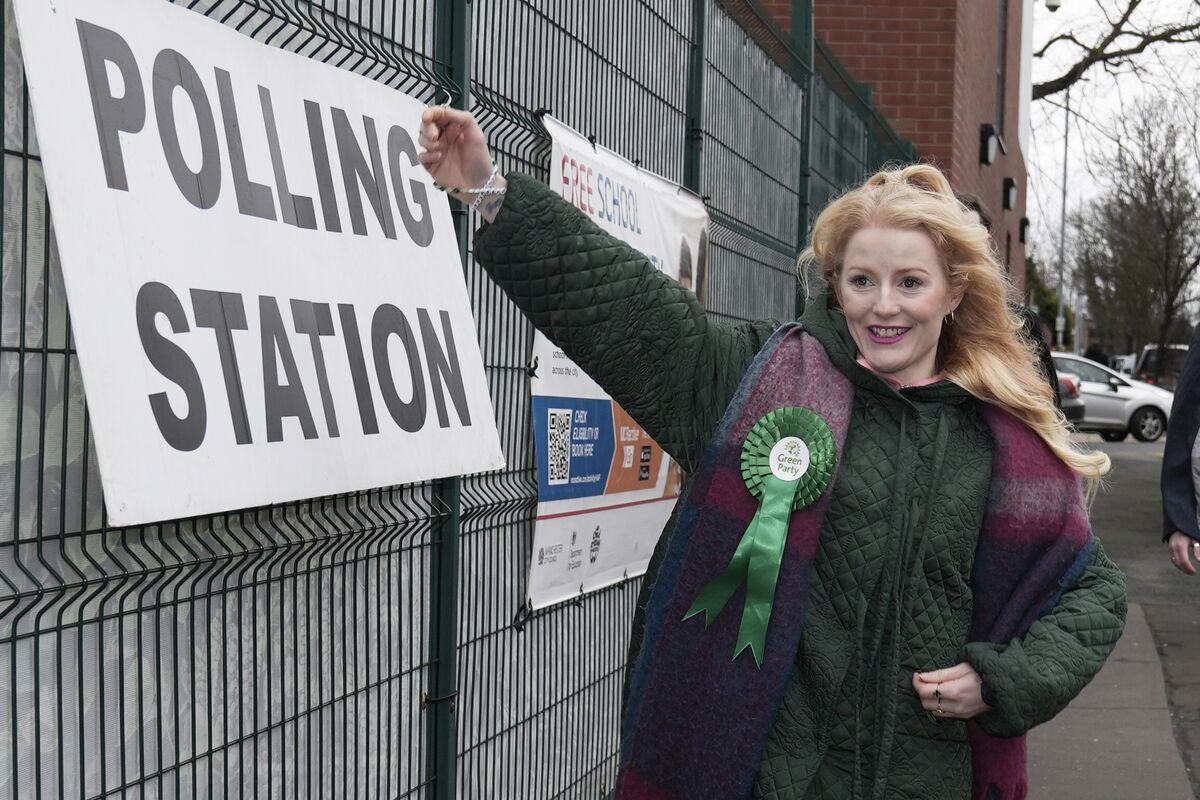
The plumber with the chips. Correction. The member of parliament with the curried chips. The picture is never going to compete with the one of Mountbatten-Windsor, pop-eyed in the back seat of a car after a day’s interrogation, but it defines a moment, nevertheless. The Green Party candidate won. Romped home, we believe is the correct description for winning almost 15,000 votes in a 21% swing.
This is even more remarkable, given that the UK doesn’t have proportional representation, which tends, in Ireland, to allow minority party candidates to sneak into a seat at the final count, although at the last general election here, even that didn’t happen. Roderic O’Gorman, our one and only Green Party TD, must be looking at Hannah Spencer and wondering what electoral lessons her victory offers him and his party.
The one lesson he should not draw from the Gorton and Denton victory is that it was achieved by Green Party policies. The reality is that it was achieved largely in spite of Green Party policies. Rumour has it that on the day before people cast their votes, vans with loud hailers trawled the constituency — sent by heaven knows which other party — to suggest to the voters that if ‘Hannah the plumber’ were elected, their kids might choose sex work (which the Greens would legalise) or drug-taking (ditto).
The rumoured van episode is fascinating, because it indicates that, despite the opinion polls, which, as is often the case, got it wrong, someone in one of the other parties saw the writing on the wall and realised that the Greens, rather than Reform, were the ones to spavin. The man with the van (in fairness, it could equally have been a woman with the van) didn’t spavin the Green candidate. But then, that’s what anyone with long experience of elections would confirm: the killer move adopted in last minute panic never works.
It sometimes appears to work: Trump’s ridiculous accusations against Hillary Clinton in the 2016 presidential election may have satisfied his strategists about their own efficacy, but Hillary was good and goosed long before that, much of the goosing her own fault.
The effort to frighten voters, in the UK by-election, overlooks a key factor often missed by political advisors who spend too much time indoors with poll statistics, and it’s this. Voters are amazingly smart. A bit like Garrison Keillor’s Lake Wobegon, where “all the children are above average,” voters can work out which side their bread is buttered on and how big is the threat from one candidate winning a by-election, which, in this case, was somewhere between slim and non-existent. Hannah, who is not only a plumber, but as of last week, also a qualified plasterer, will largely disappear. Not in the coming days. But within weeks, people will have difficulty remembering anything about her but her former profession and the picture with the chips. So threatening voters with her was just downright silly, not to mention counter-productive. People hate to be taken for fools, and the van was an investment in fool-taking.
Possibly the most interesting aspect of this by-election, however, is the question it hangs over media and social media presence as major assets, as opposed to on-the-ground canvassing. The Reform candidate, former academic Matthew Goodwin, had all of the former: TV presenter presence, huge sub-stack numbers. He didn’t do that much of the latter and was reportedly uneasy in his encounters with human beings on the ground. This latter was affirmed, as soon as the results came in, by his amazing explanation.
What he said was:
Which does rather miss the point that telling progressives how to vote doesn’t have much in the way of a track record. He went on to add that many people in the UK will look at Gorton and Denton and be appalled at what happened there. No evidence of that syndrome thus far, Matt. None.
The problem with the Reform’s man as a candidate may be a version of the Garrison Keillor comment about all the kids being above average. The technical, psychological term for this is the ‘illusory superiority bias’ where sufferers believe themselves, like Yogi, to be smarter than the average bear, even though the evidence points squarely in the opposite direction. Matt Goodwin does not connect with people and the best way to measure this is to put someone out on the stump. If voters don’t cross the street to shake the candidate’s hand, to thump them on the back, to wish them luck, the measurement is clear and the arrow points downward. That’s what happened during the Goodwin’s all-too-rare outings, pre-polling day, despite him making the idiotic claim that Manchester was the city that had made him. What, now? And remind us who gives a sugar?
At least the Labour MP for Norwich South, Chris Lewis didn’t come up with an unsustainable theory to blame someone other than his party over them coming in third. Using vivid language his party leader might occasionally borrow, Lewis described the results as “a punch in the face for the Labour Party and for Keir Starmer’s premiership.” Starmer, on the other hand, claimed to understand the voter need for change, despite being in power for only two years. Voters being “frustrated” and desperate for change is an astonishing admission to make after such a brief sojourn in Number 10.
Starmer did try to attempt to excuse the defeat on the basis that incumbent governments don’t tend to do well in by-elections, praised the positive campaign his party had run and vowed that as long as he has breath in his body he will continue the fight against extremists on the left and right.
Positioning Hannah the plumber/plasterer as a dangerous left wing extremist was never going to fly but Starmer’s capacity for missing the emotional point in any issue may be his outstanding negative trait.
Although it would compete with his poor political judgement, exemplified by blocking the mayor for greater Manchester, Andy Burnham, who had some chance of winning, from contesting the seat.
The nearest this by-election provided to fun was the Conservatives losing their deposit. Despite Labour under Starmer’s premiership falling at almost every conceivable fence, Kemi Badenoch’s party won 706 votes, which meant them losing their £500 (€570). It was the worst defeat in a by-election in British history. Yet the first response from the leader of the Tories to this catastrophic loss was to demand that Starmer should resign, a misdirection which will avail her nought.
It was amusing to hear commentators, irritated by the Green victory, demanding to know what this would change. It won’t change much. That’s not the point.
The point is that an unaffected, hard working candidate can make it into parliament.
CONNECT WITH US TODAY



Be the first to know the latest news and updates