Michael Moynihan: Bologna has made a good job of a loyalty system — why don't we try?

Are you a points guy?
I ask because of a piece I read recently online, in which the writer described some pals as points guys, or gals, because of their addiction to loyalty schemes of various types.
The writer was American, and there’s a particular American twist to the points game — the fixation on points earned as a frequent flyer, for instance, which eventually leads to free flights, or free hotel stays, if you’re adroit at converting points from one scheme to another.
Translation: if you’re a little unhinged about shaving costs and leveraging your points, in other words.
Read More
I’m a bit of a points guy myself in the sense that I find loyalty schemes hard to resist, but in a far more analogue way.
By that I mean such schemes as the common-or-garden coffee card, where buying 10 coffees in a particular shop guarantees you one free cuppa when the card is fully stamped.
It may be the case that on occasion my research assistants have complained loudly over a slight diversion because one of these cards has room for the last stamp that will earn its owner a large latte free, gratis and for nothing.
Yes, I have also accumulated several such cards for one outlet and negotiated one free coffee on the basis that the evidence to hand shows I have indeed bought 10 coffees.
However, it is a sign of common sense and thrift, not being slightly unhinged, to go to such lengths for that free coffee (many thanks here to the understanding and long-suffering staff of Salt and Cafe Gusto for indulging me).
The dangerous part of this addiction is that one begins to see the benefits of loyalty schemes everywhere.
Petrol stations and large supermarket chains, barber shops and taco joints: there doesn’t seem to be a commercial enterprise without its own card system, designed to draw you into its web.
That’s not always a great deal for us as consumers, of course. Large corporations owning your private information and contact details can be bad news for you, and for the privacy of that information.
The headlines bear this suspicion out on a regular basis.
Hence my fondness for the old-fashioned type of loyalty card, where the only way it can be linked to you is if the organisation takes a swab of your DNA from the physical cardboard you have in your hand.
(Note to self: use surgical gloves when getting that large latte in the morning.)
However, rather than involving readers in my sensible data precautions/deranged paranoia, I have a straightforward question.
Is there a gap in the market here for a city loyalty card?
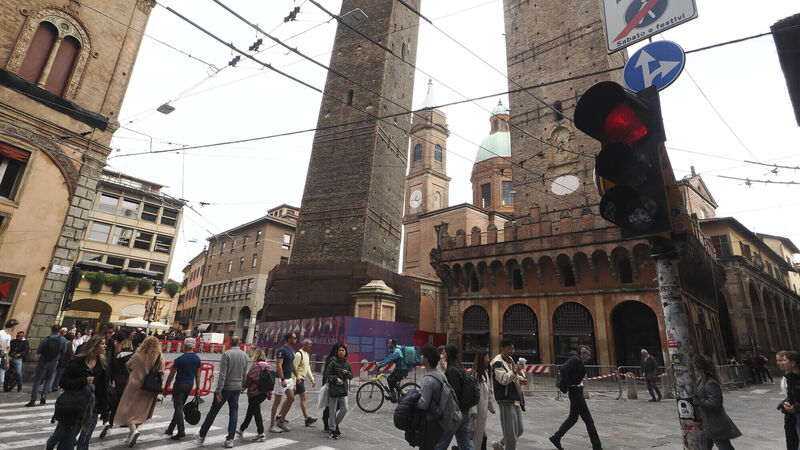
A reader was in touch to tell me about the Bella Mossa programme in Bologna, which might be a good template for us to adopt in Cork.
Some years ago the transport authority responsible for that city, RSM, was trying to come up with ways to combat traffic congestion in Bologna — stop me if this sounds familiar — and decided to try a new approach.
Rather than focusing on the negative — ie, barring cars at certain times from driving around the city — they switched to reinforcing positive behaviour through a reward system.
RSM introduced the BetterPoints Behaviour Change Management System to encourage people to change how they travelled in Bologna.
Participants could register online, download a bespoke app, and scan a barcode to earn points for walking, cycling, or using public transport.
Those points could then be used for purchases in various places in the city itself.
Bologna went all in on the scheme — the city partnered with Conad, one of Italy’s biggest supermarket chains, and international sports giant, Decathlon, but participants could also use their points at local budget chains, bike stores, opticians, independent bookshops, restaurants, and bars, which were part of the scheme as well.
So yes, Bologna was, in essence, paying people to eat and drink instead of driving their own cars (the fact that Bologna is known as ‘the stomach of Italy’ should give us all pause here, enthusiastic walkers and cyclists or not).
The scheme was a huge success when it was run in 2017 and 2018: more than 20,000 participants recorded more than one million sustainable transport journeys, totalling 3.7m km travelled in total, and saving as many as 750tonnes of CO2 emissions.
The benefits here are obvious. If people are out walking, cycling, and taking bus journeys which represent 3.7m km, then that represents thousands of car journeys which were removed from the local transport system.
The positives roll on and on from this scheme — the environment gets a boost, traffic congestion eases, and people are healthier because they’re walking and cycling, not driving.
Because of that there are more people on the streets of the city, and in the shops of the city: the master stroke by the scheme’s organisers was to pull in national and local retailers.
The ‘big shop’ was possible in the branch of a national supermarket but smaller, independent retailers also got a boost.
A couple of refinements along the way also helped. Organisers decided to streamline the operation in 2018 based on experiences in 2017.
If participants reached specific goals and targets — walking for 150 or more minutes a week, or a minimum number of days per week, or hitting recommended weekly physical activity levels — they were rewarded with bonus points.
The scheme was also marketed aggressively in the city: RSM provided branded caps, bags, and water bottles to heighten awareness, and a competitive element was introduced in the form of a corporate challenge.
The organisers didn’t stop there, spreading awareness with other ploys — they organised treasure hunts, leaderboards, achievement medals, and prize draws. Participants received personalised in-app and email messages.
In 2018 RSM also responded to specific feedback by adding elements to the scheme to pull people together as they participated.
It allowed friends, family, and colleagues to form small teams of four to 10 people to participate together, for instance: if all members of a team achieved a goal, all would be rewarded, and none would be rewarded if any team member failed to achieve the goal.
The competition between businesses and companies was also replicated at school level, with participating schools challenging each other to see how many points they could earn.
The pessimistic might grumble that we are still awaiting tap-on bus access in Cork, so an app chronicling and rewarding bike and walking journeys could be a challenge. Perhaps.
But it would be great to see some ambition along these lines — a scheme to benefit the environment, boost local businesses, and bring more people out on the streets would surely lift all boats in Cork.
Bella Mossa means ‘good job’ in Italian, by the way: could we go with ‘Obair Mhaith’ for our equivalent?
CONNECT WITH US TODAY



Be the first to know the latest news and updates