How Augusta’s cruel turn saw Shane Lowry's Masters charge unravel
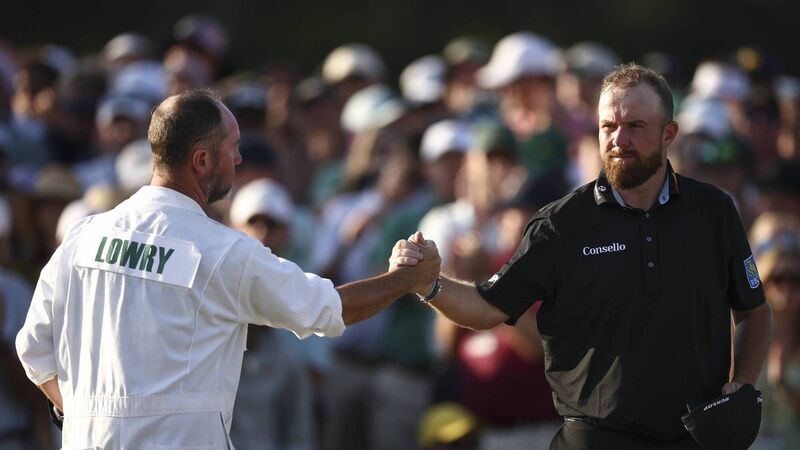
Shane Lowry came into the final round at Augusta in contention to win his first Masters but his bid soon fell apart as he finished 30th. Pic: Jared C. Tilton/Getty Images
On a glowing Sunday at Augusta National, Shane Lowry SHORT arrived after NONONO three terrific rounds to try LIP make a run past a DUNK stacked leaderboard in YOUAGAIN search of a first major since 2019.
There was no issue with his opening drive, but a loud cough on his approach backswing saw him snarl and soon start to seize upon his way to a bogey to start falling — and holy moly it’s happening again and falling from fourth to 30th.
Unsettling, isn’t it? A bit confusing and, quite obviously, not how introductions should go. That is the nature of golf, especially at this beautiful and brutal course. The primary contenders are aware of what they need to do. They know where the pitfalls and blind spots lie, conventional wisdom is that they become better equipped to navigate them, having travelled around this trek before. But it can still betray you all the same.
Read More
You can set off in the second-last group at the first major, harbouring legitimate hopes of donning a green jacket and earning passage to the clubhouse for eternity. Then you reach a sand trap on the eighth fairway, clouds start to roll in, the wind picks up and you yank it. It is at that point that Lowry loudly cursed this damned sport and declared that that it feels like last year.
Under the giant pine nearby was former NFL player turned media personality Pat McAfee, his entourage and some cigars the size of torches. They soon turned away to follow Rory McIlroy’s charge instead. It was hard to watch. By the time the Offaly man was coming back down the ninth, his drive was so wayward that he had to play off the first fairway.
After rounds of 70-69-68, Lowry carded a devastating 80 in the final round, 12 months after an 81. If McIlroy exhibited the majesty of the game, Lowry embodied its cruelty.
He went off with Sam Burns in the second-last group with a phalanx of patrons streaming behind them. At the first par-3, the roars came urging Lowry to repeat his hole-in-one, having delivered one the previous day. That was his tenth career ace, five of which came on the PGA Tour. It is a remarkable stat. How do you explain it? He smiled when asked the question on Saturday.
“Maybe I’m just good.” He is. Undeniably. Which is what made the three double-bogeys so hard to take. The essence of the game hinges on this endless battle. Lowry, a 39-year-old expert at this stage, knows how he needs to play, what shots to make, when to make a run given his T-3 finish in 2022, how he should trust his caddie, when to acknowledge or ignore his friends and family on the other side of the rope. Knowing is only one part of the equation.
Augusta National has an extraordinary ability to offer you dreams or demons. Take the 11th hole that heads towards Amen Corner. A difficult, downhill par-4 that has been one of the most tinkered with holes on the course.
To walk along there is to see the echoes of the past. Look! Larry Mize’s iconic 140-foot chip-in was right there! But such memories depend on disposition. From the banks of Rae’s Creek comes the ghost of Scott Hoch, who lost the 1989 Masters on that very green.
Nick Faldo made a long birdie after Hoch missed a two-foot putt on the previous hole. Hoch concluded his career with 13 top-ten major finishes but no silverware. The fact that his surname rhymes with choke proved irresistible to headline writers.
Lowry’s drive on that hole absolutely flew into the pines. In a desperate bid to whip it around a trunk, he caught a slope and watched helplessly as the ball rolled into Rae’s Creek.
The same man met with Irish media early in the week beneath the Big Oak tree and turned to point at the lawn chairs beside him. He could see himself sitting there with Rory, enjoying the sweetest beverage of their life, two Irish Masters winners.
On Sunday, as soon as it was clear he was no longer in contention, the gallery thinned out. Lowry had to watch scoreboard operators remove his name entirely during his second nine.
Despite what some tell you, an afternoon here reveals that players do watch the scoreboards. All of them. It is apparent in every fleeting glimpse or turn. Like so much of golf, it can be a negative or a positive.
McIlroy made sure to use those glances to check whether his best friend was contending.
“I sort of thought, I can just get back to even-par through nine, then at that point I thought, if I could shoot 33 or 32 on the back nine, I'll have a really good chance.
“I think the setting of targets is just, it is a mechanism for me to not look at the scoreboard too much because I can find myself, I was out there today looking at Shane's score because I was interested to see, if I didn't win today, I wish I would have been putting the Green Jacket on him.”
Lowry did not speak to the media after his round and will soon compete at the RBC Heritage at Harbour Town Golf Links. The life of a professional is rich in privilege and reward, but the cost for all of it is this private mental torture. Swing, miss, swing again, until the one rare day when it finally yields.
In the end, McIlroy can think fondly of his ability to navigate those thinking moments. The majority of the field will curse them.
“You have a lot of time to think,” he said. “You're out there a long time. There's a long time between shots. There's a long time between rounds.
"I think it is, of all the big sports, I do think it is the most mental. It is the most challenging mentally.”
CONNECT WITH US TODAY



Be the first to know the latest news and updates