Donal Lenihan: Why this could be Ireland’s best Six Nations never won under Andy Farrell
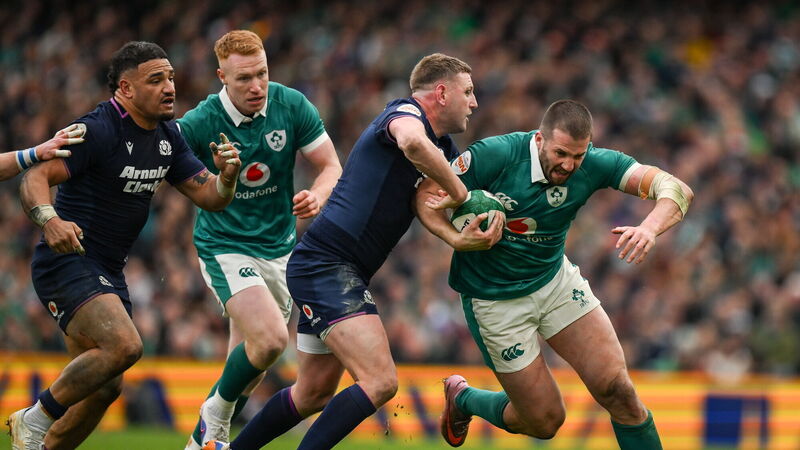
Stuart McCloskey's ball carrying, offloading and sublime passing added another dimension to Ireland’s attack during the Six Nations. Pic: Brendan Moran/Sportsfile

Park your disappointment. This may yet prove to be the best Six Nations Championship Ireland won.
Before exploring the reasons why, thoughts on a tournament that had even the most casual of followers left scratching their heads as to why they hadn’t fully tuned into the sport before now given the quality and entertainment on offer from start to finish.
Read More
I’ve never heard so many people talking about rugby or approaching me, looking to chat about the games.
And what a finish it was. Hollywood couldn’t have scripted it. There’s never been a series of games, across every round, that had fans riveted to their seats right to the final whistle.

The sheer drama and theatre on offer every weekend was incredible.
In a sport that was attracting headlines for all the wrong reasons only a few short months ago, with so many respected past players, pundits and commentators expressing their concerns over how the game has been turned into a kick fest as a result of the removal of aerial escorts, the change has been transformational.
In that respect, I think the game owes a huge debt of gratitude to French rugby, in particular Top 14 club sides like Toulouse and Bordeaux-Begles who showed that, despite recent developments, it’s still possible to play attractive, counter attacking rugby that punishes teams who kick badly.
Thankfully the French national team developed the approach adopted by their own clubs, looking to play in a similar manner.
It helps when you have a generational talent in Louis Bielle-Biarrey to showcase the benefits of playing to width or by exploiting the available space in the back field with a series of clever chips or kicks into the 15 metre tram lines.
Bielle-Biarrey is a scoring machine with an incredible 29 tries in his 27 caps to date, along with registering tries in 10 consecutive Six Nations game, a truly amazing feat.
At just 22 years of age he has the capacity to become one of the all time greats, smashing records on the way. For me he’s a pure joy to watch.
Statistics can be used to create any narrative you want these days but, in terms of highlighting just how incredible this Six Nations has been, they don’t lie.
Out of 405 matches in Six Nations history, only two have seen both teams score more than 40 points.
That occurred in France's final two games, the 50-40 defeat to Scotland and the sensational 48-46 win over England. How extraordinary is it that England managed to score seven tries at the Stade de France last Saturday but still managed to lose the game?
In total, 29 tries were scored across last Saturday’s three games, the most on a single day in the history of the championship.
What makes this tournament great is that every team goes on a journey of some sort or another over six weeks of intense scrutiny.
So where do they sit right now?
Pre tournament favorites across the board, their Grand Slam ambitions unraveled spectacularly in that 90 point extravaganza in Edinburgh. Even the prospect of securing back-to-back championships for the first time since 2006 and 2007 came down to that last minute kick by Ramos.
The best side to watch by a country mile, Fabien Galthie knows that if they are to seriously challenge South Africa at the 2027 World Cup, he must unearth a pair of explosive scrummaging tighthead props and a decent back-up to Jean-Baptiste Gros at loosehead.
In every other position he’s spoiled for choice with even more talent waiting on the wings from this years Grand Slam winning U20 side.
Having opened their campaign with a 48-7 demolition of Wales in Twickenham which extended their unbeaten run to 12 matches, England’s demise from that point forward was catastrophic.
The low point came when they lost to Italy in Rome for the first time in 33 tests on their way to losing four games in the tournament for the first time ever.
When the pressure came on, against Ireland and Scotland, they looked rudderless.
Of all the teams in the championship, Steve Borthwick’s slavish devotion to a kick and chase game was totally at odds with everyone else and badly exposed in the end.
Interestingly, once they finally abandoned that approach in the Parisian classic - by all accounts at the behest of the players - they looked an entirely different team.
That said, much to Ireland’s cost, they still lacked the composure and game management to protect a one point lead over the last two minutes of that game. England have a lot of sole searching to do before facing the Springboks in Johannesburg next July.
An all too familiar story. Capable of delivering great things as they did when becoming only team to defeat eventual champions France, they failed spectacularly when tasked with backing it up in Dublin.
Gregor Townsend has developed one of the best attacking units in world rugby but unless he can assemble a hardened and grizzled pack, Scotland have no chance in closing the gap between them and the top four sides in the game before the World Cup.
The loss of second rows Scott Cummings and Gregor Brown badly exposed their lack of depth.
Offered the chance to record three championship wins for the very first time since joining the tournament in 2000, Italy fluffed their lines badly in Cardiff last weekend.
Perhaps the physical and emotional demands required to beat England last time out took a toll on Gonzalo Quesada’s men who were way off the pace in Cardiff, trailing 31-0 on 48 minutes.
That said, they can take so much from this campaign when backing up Rassie Erasmus’s assertion that they are one of the most improved sides on the international stage.
Their achievements were even more noteworthy given the absence of key players such as Sebastian Negri, Ross Vintcent, Tomasso Allen, Ange Capuozzo and Martin Page-Relo for most of the campaign.
In Tommaso Menoncello not only had one of the best players in the tournament but also one of the best back lines. The future looks bright under Quesado.
Who ever thought that beating Italy would elicit such an emotional response from such a passionate and rugby-mad country that has enjoyed such success in this tournament. Emotions were running high, on and off the field, in the Principality Stadium on Saturday.
I was delighted for impressive head coach Steve Tandy and his players that they finally got over the line in a first tournament win since 2023.
Welsh rugby deserves more than this.
Its players, clubs and committed supporters have been served appallingly by the Welsh Rugby Union for years and the mess the professional regions find themselves which can be traced back directly to the incompetence of their union.
Hopefully the admirable progress made in such trying circumstances over the last few weeks may yet prove a catalyst for better times ahead.
It’s the least the players, who gave so much to the cause over the course of a very stressful and demanding tournament, deserve.
Andy Farrell’s capacity to deal with adversity has been the stand out take away for me from this campaign.
Not only did Ireland come into the Six Nations on the back of a disappointing autumn series, they did so without a plethora of key players in Hugo Keenan, Mack Hansen, James Lowe, Robbie Henshaw, Ryan Baird, the suspended Bundee Aki along with three loosehead props in Andrew Porter, Paddy McCarthy and Jack Boyle.
Farrell has always been a “next man up” type of coach, turning adversity into opportunity by getting firmly behind the latest incumbent. Jeremy Loughman developed into one of Ireland’s unsung heroes in the tournament.
When he was forced out due to injury, Ireland seized the moment to see if Tom O'Toole could handle the transition from tighthead prop to loosehead.
As a result, Farrell now has a rich vein of front-rows in his stable. Once the opening game was lost, Farrell took the opportunity to adjust his matchday squads to such an extent that 11 players made their Six Nations debut, in tandem with using an astonishing 35 players over the course of the five games.
The biggest strides were made in the quality of a reshaped back-three that made light of the absence of Hansen, Keenan and Lowe. At this level, as the French have shown, there’s no substitute for pace.
Tommy O'Brien and Rob Baloucoune have that and both enjoyed marvelous tournaments along with the ever-improving Jamie Osborne at full-back.
Aki’s replacement, the ever-present Stuart McCluskey, was my Irish player of the championship. He was outstanding in every game with his ball carrying, offloading and sublime passing adding another dimension to Ireland’s attack.
At the start of the season the biggest concern for Farrell, a year out from the next World Cup, was a lack of depth in a number of positions.
By grasping the nettle after that opening defeat, refusing to be constrained by the IRFU’s short-term requirement of finishing as high up the table as possible for the badly needed prize money, Farrell managed to achieve both aims in unison.
That’s why, in my estimation, this may well rank as the best Six Nations campaign Ireland won.
CONNECT WITH US TODAY



Be the first to know the latest news and updates