Running to stand still: are Schmidt's Wallabies going forward or backwards?
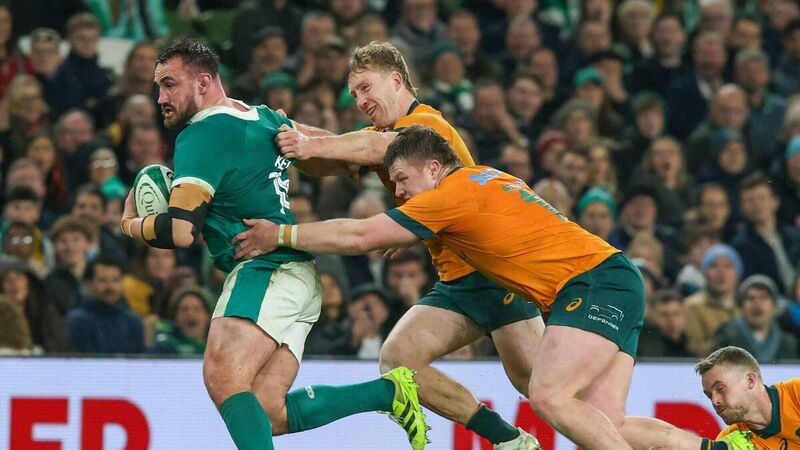
PLAYING CATCH UP: Ireland's hooker Ronan Kelleher is chased down by Australia's Harry Potter and Billy Pollard in Saturday's test match at the Aviva Stadium. The defat has punctured the bubble of positivity around Wallaby rugby. Pic: Paul Faith/ AFP
Since taking over the Wallabies in the middle of 2024 - after a disastrous Rugby World Cup - Joe Schmidt has spoken often about the fickle nature of a rebuild.
"Progress is never linear," Schmidt often says.
The line has been rolled out when the Wallabies have had a poor day and Schmidt is asking for patience. But more often it's been heard when the Wallabies have pulled it together and had a good day, and Schmidt is backfilling, and explaining how tough times help build a base for success.
But underneath all those days, good and bad, has been the basic belief and understanding that the Wallabies are progressing.
The last few weeks, and arguably even months, have cast that belief into doubt.
The Wallabies' lacklustre defeat to Ireland at the weekend, and losses to Italy and England before that, have come after performances that not only pricked the bubble of positivity around Australian rugby, but raised questions about whether the progress has stalled or even reversed, less than two years out from a Rugby World Cup on home soil.
Rewind just three few months ago and things were, comparatively, flying for the Wallabies.
After a rough start to the Schmidt era in 2024, the Australian side was tipped to be worryingly easy prey for the British and Irish Lions. Some pundits called for the Lions to head to South Africa instead.
But the Wallabies turned a positive November tour, with wins over England and Wales and a three-point loss to Ireland, into confidence and belief, and a competitive Lions series duly unfolded.
The Aussie side, who'd arguably been unlucky to not send the third Test into a decider, beat the Lions in Sydney, and then parlayed that into a first Wallaby win over the Springboks in Johannesburg in 63 years. They almost made it back-to-back wins a week later.
Though they fell short, the Wallabies' confidence levels were high and they kept climbing when they pushed, next up, for a win after the siren against Argentina, and got the job done.
But that was followed by a loss to the Pumas, and then two defeats against New Zealand. All three games had opportunities for the Wallabies to win, but a habit of falling behind early and charging home ultimately proved too tough to overcome. Discipline problems emerged.
An unconvincing win against Japan then preceded the currently winless tour of Britain and Europe, and on current form, the Wallabies will likely round out the year with a loss to France next weekend in Paris.
That would see a promising year of occasional highs end in an historically bad one for Australia, under the unforgiving lens of statistics.
A loss to France would give the Wallabies just one win from the last eight Tests, and be the first time the Wallabies have failed to win a game on tour in Europe since 1958.
And at five wins from 15 Tests, defeat in Paris would give the Wallabies a win percentage of 33.3%. That'd only be better than three years in the last decade - 2023 (22%), 2020 (17%) and 2018 (32%).
Moreover, among ever-hopeful but mostly-battered Australian rugby fans, it would raise the key question: are the Wallabies really on the right track to be a showing at their own Rugby World Cup in 2027? Were those joyous few weeks after beating the Lions and the Boks just a false dawn?
Is that progress even there any more?
Time will tell, obviously, and many in Australia are prepared to keep throwing their faith in Schmidt.
Not all though, to be fair. The results of the last few months have definitely turned up the volume of Schmidt's critics, who have grown frustrated by the Kiwi coach's opaque selections, particularly at no.10.
But Schmidt's calibre as a world-class coach is, for most, not seriously in question. And though he'd not use them as excuses, there has been a succession of injuries to key players at all the wrong times.
Having backed him all year in 2024, Schmidt lost fly-half Noah Lolesio on the eve of the Lions series, and a merry-go-round of tens followed.
And Schmidt lost key no.8 Rob Valetini for big stretches too, and only had infrequent access to La Rochelle giant Will Skelton, who'd turned the Lions series.
Star fullback Tom Wright and Tate McDermott were both sidelined for the season too.
And along with those, injury issues and illnesses to other key men rolled in, often weekly.
That all served to uncomfortably expose a key problem for the Wallabies - lack of depth - and it seems avoiding the same trouble over the next two years will mostly rest on luck.
Schmidt has tried to build some safeguards by putting experience into new players on the Spring Tour, but as seen with defeat against Italy, that ploy is a double-edged sword.
Confidence levels are now low in the Wallabies squad, and that was never more evident than when they were trounced in the aerial battle in Dublin; an area where you have to be bold.
Ireland won't party about that win, either. They left themselves in a position to lose with 15 minutes to go but were let off with a wobbly Australian lineout.
Where to next for Australia? Paris, and then home for summer holidays.
But as part of his succession plan with Les Kiss, who starts in August, Schmidt will coach the Wallabies for three more Tests in the opening games of the Nations Championship in July. They'll be against the same three sides that have ended Australia's current tour - France, Ireland and Italy.
After a break, a Super Rugby season and with some stars back from injury, it will present a perfect chance for the Wallabies to re-measure the impact of 2025. Did they stand still? Or, underneath those unflattering statistics, was there still progress?
And hope?
CONNECT WITH US TODAY



Be the first to know the latest news and updates