Coaching's quiet theft: every time we name the threat, we pickpocket tomorrow's intuition
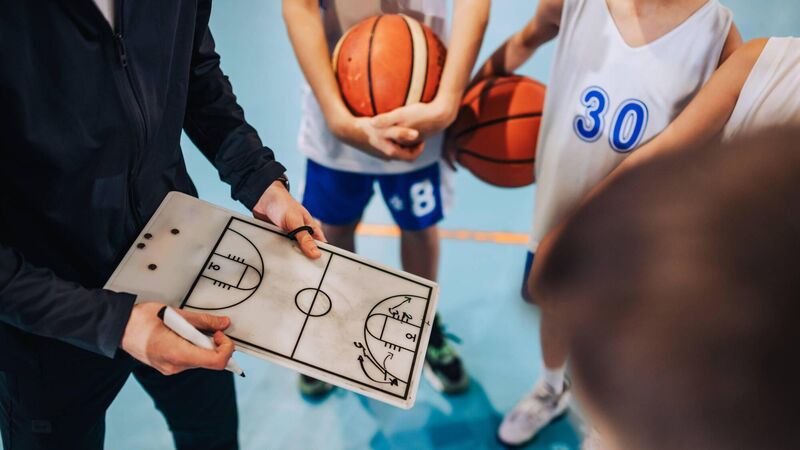
A coach working on game plan with a junior team.
— Bruce Springsteen, The River.
THE players move precisely, but never curiously. Their bodies are active but their minds are waiting. There is no tension in their decisions, no questions in their eyes, no appetite in the spaces between movements. This is failure in its politest, most well-dressed form.
Spontaneity vanishes under a system that prizes error-free performance. When structure becomes the destination rather than the entrance, the spirit of inquiry can’t get past security. The body still moves. The mind quietly stops asking. The tragedy never announces itself.
It arrives in small, forgettable moments. A midfielder checks his shoulder, not to read the game, but to confirm the pattern he memorised. A point guard hesitates because the cue — the permission — to run the set play hasn't come yet. A goalkeeper seeks eye contact on the sideline instead of scanning the field in front of him.

These tiny half-beats don't look like injuries. But they settle in the nervous system like bruises that never quite fade. Over time, they harden into habit.
The method has begun to outweigh the mind.
There's something mysterious about Roman Polanski's film Chinatown. You think Jake Gittes is chasing corruption, lies, the usual film noir techniques. But after investigation, it's something far worse. He makes the pieces fit but the full visible picture is irrelevant. It's already too late. The people responsible for the crimes made the rules. Jake stands there helplessly. The devastation was written before he even started.
The pain of Chinatown isn't the crime. It's the silence between truth and action. That awful gap where you understand exactly what went wrong, but the world has already moved past you. The damage is done. The story has closed its fist.
“Forget it, Jake. It's Chinatown.” Perfect clarity — and nowhere left to carry it.
And that same moment follows our athletes. In the video room, they become experts in hindsight. How do we break this press? Solutions identified. Patterns named. True Detectives. Theoretically, they know exactly what to do.
But the game does not arrive in neat lines and paused frames. On the pitch, the press doesn't announce itself. It arrives faster, in a different jersey, the opposition breathing down your neck. The window is a heartbeat wide, and in that heartbeat, they don't fail for a lack of knowledge — they freeze because knowledge arrived at the wrong time.
What they need is not more scripted breakdowns, more diagrams, more perfect explanation. What they need is foresight. Feeling. Timing. An embodied sense of what is about to happen before certainty feels comfortable.
And slowly - without ever meaning to - we have stolen the most important skill in sport: the ability for players to recognise reality for themselves as it unfolds.
The distance between anticipation and reaction is often no more than a second. But a second can change a season. A career. A relationship with the game itself.
This is not an intelligence problem. It is a training design problem. In our hunger for control, for clean solutions and measurable progress, we have trained obedience instead of awareness. And the game — indifferent, chaotic, alive — is already moving on to its next question.
Sometimes the coach must become an architect of uncertainty. The coach doesn't need to become Keyser Söze, or take the players on a walk around Shutter Island. Just someone brave enough to let the room feel unstable.
In a basketball training session, five players race down the court with no one defending them — it's smooth, perfect, a rehearsal in HD. They score, turn around, and head back the other way. But this time, five defenders are waiting. Now it's the real thing.
The offence tries to execute, miss or make, then those defenders turn into attackers — flowing back down the court unopposed while the original offence becomes the new defence. The cycle repeats. The coach changes the defensive coverage each time, throwing everyone off. Man-to-man becomes a zone. Zone becomes switch. A trap appears on the halfway line.
To anyone watching from the sidelines, it looks like smart progression. But inside the game, something else is happening. The possession breaks down, a perceptual stutter not because they lack skill, but because they can't yet identify the problem in real time.
And this is the critical moment. Too often, as coaches, we can't wait to instruct, we rush in and tell them all we know.
"It's a 2-3 zone."
"They've gone man."
"Short corner's open."
We name it for them, and in doing so, we remove the moment of discovery. Our voice replaces their vision.
Yes, the pass might still be made. The movement might still look correct. But the solution no longer belongs to them. Nothing has truly been solved — only obeyed.
A free-flowing Basketball team becomes rigid after a timeout the moment a zone appears. A hurling team is undone by a mid-game change, a quiet, drifting sweeper, now on his way to a man of the match performance - not because the opposition is more talented, but because perception was never allowed to mature.
— Bob Dylan, Ballad of a Thin Man
Coaching has never been more "progressive".
Small-sided games. Variable constraints. Opposed practices. All the right language. All the right theory.
But layered over it is a constant commentary — a play-by-play narration that never stops.
"Switch it." "Turn." "Man on."
The environment is dynamic. The information is rich. But the athlete is still listening to us, not the game.
We diagnose out loud, narrating the game for them, doing the perceptual work on their behalf. The midfielder who hears "Man on!" every time pressure arrives eventually stops scanning altogether - why scan when the coach is essentially a human Siri mounted on the touchline?
We've created the first generation of athletes whose peripheral vision has been outsourced to the people not playing in the game.
This is coaching's quiet theft - every time we name the threat, we pickpocket tomorrow's intuition.
The antidote is simple. And terrifying to many.
Change the conditions without announcing it. Alter numbers without warning. Let confusion arrive. Some experienced coaches would go as far as giving one team in training false information, “they will set up this way” and it could be the very opposite once the A v B starts. Or they may even include a secret mission “if ye turn him over, ye get 5 points, don’t tell the player being targeted".
Let them search. Let them argue, point, misread, correct and when they finally begin to solve it together — when they adapt without looking over — that is not disobedience.
That is growth.
This is where the emotional weight of coaching sits. We tell ourselves we believe in autonomy, in discovery, in letting players find their own way. But results are public. Failure is visible. And doubt is loud.
Committees, parents, opinions: If the players don't need you to tell them what to see, then what are you there for?
The coach who built his/her identity on being indispensable must now find meaning in becoming redundant - to a point. That's not a methodological shift. That's an identity crisis.
Retention is everything. And when players walk away, it isn't talent they're missing — it's a sense of belonging. And you will rewind sessions in your mind like an old film. If I'd said less. If I'd said more. If I'd waited. If I'd stepped in. Years later you hear: they quit around that time.
Then there are the others. Still playing. Still curious. Not because you made them great, but because you didn't get in the way of who they were becoming.
Mark O'Sullivan, Associate Professor of Football at the Norwegian School of Sport Sciences, puts it beautifully: "Let the kids introduce themselves to the game."
Coach Educator and Director of The Magic Academy Russell Earnshaw summed it up in four words: "More poker, less chess."
Our job is not to give answers. It is to aim attention towards the right questions.
Before the session: "The defence will change without warning. Your job is to notice when."
After the session: "What did you feel? What shifted? What felt different?"
And when they are struggling, you don't pull them out — you throw them armbands and point to the shore.
"Do you think he is overhelping?"
"Notice the space behind the full-back."
The loudest coaching should come when the ball is dead. Those clever “ball out of play “moments that don’t upset the flow of the session between coach and player.
When the ball is alive, our job is to let the game speak. That silence isn't absence. It is trust.
Not everyone experiences freedom as freedom. For some, space feels like exposure.
Some players don't just accept a game plan — they cling to it. They crave a roadmap, clear markers, something proven to stand on when everything inside them feels unsure. When structure has always told you where to pass, where to run, who to be, being asked to decide can feel less like opportunity and more like abandonment.
That isn't weakness. It's human.
Change doesn't arrive as inspiration. It arrives as discomfort. As friction in the chest. It comes as the question no one hears: What if I fail in front of everyone? What if this is where they realise I'm not enough?
So you don't introduce uncertainty like a revolution. You introduce it like an outstretched hand. One small choice. One new scenario. One quiet chance to step a fraction beyond what feels safe.
Most progress makes no noise. It's a glance up that wasn't there before. A pass threaded through fear. A voice that finally dares to break the silence. These are private victories — small, trembling rebellions against the version of themselves that learned to hide.
That's how growth really happens — not in one great cinematic moment, but in a hundred unseen decisions to try again.
We spend years turning players into flawless jukeboxes. Drop in the right coin and the performance plays perfectly. But match day doesn't take coins. It takes courage.
Expertise is not built by repeating the correct answer. It is born from meeting new questions, over and over, until fear stops feeling like an enemy and starts feeling like a signal.
This work isn't tactical, or theoretical, or professional. It's emotional. This is watching Interstellar after becoming a parent.
It's staying on late after training because you believe in a kid who doesn't yet believe in themself. It's driving home in silence because one player looked defeated and you don't know how to reach them. It's standing in the cold thinking about a conversation you should have handled differently.
That's the heavy reality of coaching. It asks you to coach today for a future you may never see. For a player who might not even be in your life anymore. For a moment that will never carry your name.
But maybe, somewhere down the line, they will stand in the middle of a storm and stay calm. Maybe they will trust themselves in chaos. Maybe they will make a decision that feels like freedom.
And somewhere, unknowingly, they will be carrying a part of you.
Love takes miles, you better start walking - Cameron Winter.
CONNECT WITH US TODAY



Be the first to know the latest news and updates