Woods' woes mean no silver jubilee but 25 years on, the Tiger Slam stands alone
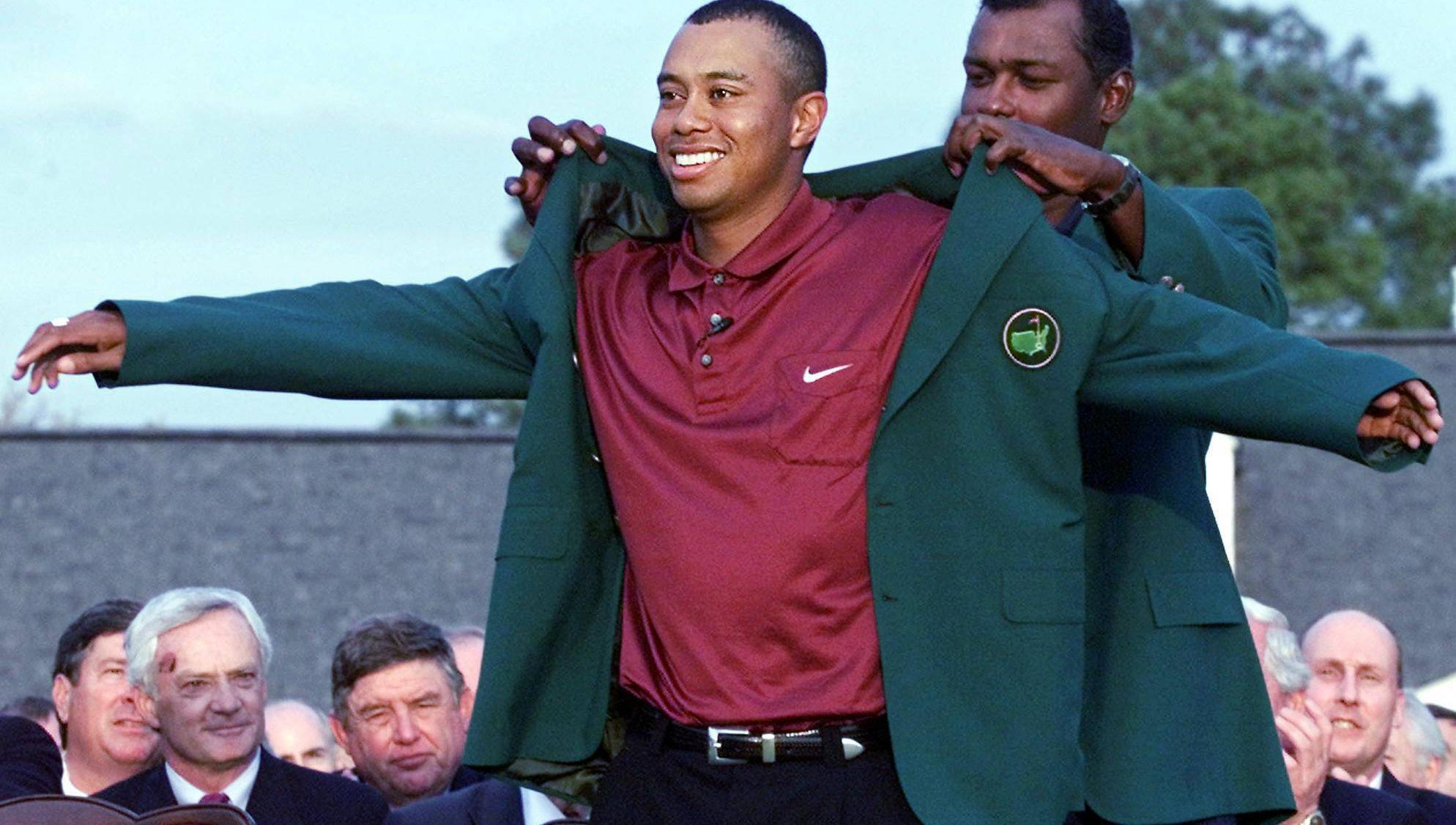
GLORY DAY: Tiger Woods (L) of the US gets his second green jacket from 2000 Masters Champion Vijay Singh (R) of Fiji 08 April, 2001 during the final round of the 2001 Masters Golf Tournament at the Augusta National Golf Club in Augusta, Georgia. Woods won the Masters by one stroke in Augusta 08 April to become the first golfer in history to hold all four professional Major titles at one time. Pic: AFP PHOTO/Timothy A. CLARY

No other sports event does pomp and ceremony quite like the US Masters but if Augusta was to borrow a certain tradition from the GAA’s biggest day then this coming weekend it would be marking the silver jubilee of probably the greatest achievement in the sport’s history.
Twenty-five years ago Tiger Woods not only slipped into the second green jacket of his career; he won a fourth consecutive major championship.
It was almost fitting that he didn’t compile them all in the one calendar year because that way it would have been known by a generic sporting term: the Grand Slam. Woods’ achievement like his talent was so singular it required a term all of its and his own: the Tiger Slam.
Last week in publicising his fine new study of Rory McIlroy, Alan Shipnuck claimed that it could well be the last golf biography ever – if you were to leave Woods out of the equation. There was nothing new to write about old-timers like Nicklaus, Palmer or Hogan while the generation behind McIlroy, he theorised, just weren’t interesting enough to carry a book. But as for Tiger? “There’s a new Tiger book every year.” One of the more recent ones in that canon is by Kevin Cook, zoning in on the opening 16 months of this millennium: The Tiger Slam. Its subtitle may seem grand but hardly hyperbolic: The Inside Story of the Greatest Golf Ever Played.
In a way it’s a timely reminder. As Cook writes, even before a certain car flipped over on its side in Jupiter, Florida, “Later years would diminish his magic and change the world’s perception of him. A younger generation would know of Tiger Woods as tabloid fodder, a balding, limping, middle-aged celebrity in recovery from sex addiction and car crashes that sent his life careering out of control.” But there was a time this hugely-flawed man played the most flawless golf known to man.
Woods began the century like he had finished the previous one – on a tear; when he won the Bay Invitational a month out from the 2000 Masters, it meant he had claimed seven of the previous nine tournaments he had entered. After finishing fifth at Augusta though, Woods skipped the next four tournaments so he could go back into the lab. While chipping balls around with Mark O’Meara and enquiring why his more senior friend tended to get closer to the hole with his chips, O’Meara confided: It’s not you. It’s your ball. It’s archaic.
At that 2000 Masters, 59 of the 95 players, including Woods, had teed up with the Titleist Professional, an old wound ball. A year later when Woods was closing in on the Tiger Slam, it would be just four. Most of the pros were now playing with a Pro V1, similar to O’Meara’s Top Flite, while Woods and a team of technical experts in Bridgestone financed by Nike had collaborated to produce a new ball called Tour Accuracy. After a series of prototypes made in Japan and tried out by Woods in person in Germany, they found it enhanced his average drive off the tee from 289 yards to an otherworldly 305.
Ahead of the 2000 US Open at Pebble Beach Woods would confide to Butch Harmon, “The way I feel about the game right now, I might just blow everybody away.” He would; while the best of the rest of the field – Ernie Els – would shoot three over par, Woods would go 12 under. He’d then win the British Open by eight shots. Bob May would force him to a playoff in the PGA championship at Valhalla but the outcome was the same: Woods won.
In that week’s Sports Illustrated Shipnuck proclaimed, “It’s time to put into words what Woods has said so eloquently with his clubs. He has wrought the greatest season in golf history.” And yet he wasn’t satisfied. The next day his old Stanford teammate Noah Begay, elated with his first top-10 finish in a major that earned him a cheque of $145,000 and exemptions to multiple Tour events, rang him. Where’s the party?! Where are you?!
“On the range,” Woods replied. He was back at Isleworth, already practising out shots he’d need at Augusta nine months later to complete the Tiger Slam.
Cook’s book is a reminder of the uglier side of Woods’ character. A Sports Illustrated writer called Jaime Diaz was the first national reporter to champion Woods and profile his father while he was still a college freshman. They’d agreed to do a series of books together with Diaz having even written the guts of the first one. At the last hour Woods shut it down and turned his back on Diaz.
In late 2000 when Sports Illustrated were presenting him with the Sportsperson of the Year for a second time, a feat that had even eluded Ali, Jordan and Nicklaus, his publicist insisted on removing any copies of their Tiger edition from the golf press room where the ceremony would take place. In that way he predated the social media age.
“He didn’t need us anymore,” an SI writer said. “He’d look through you as if you weren’t there… He wanted to intimidate us.”
He could be like that with almost anyone though in those days. While he arrived at Augusta for the final day of the tournament, carrying a two-shot lead, his mother Tida was alongside Nike CEO Phil Knight when she shouted, “Good luck, Tiger!” He ignored them. As if they weren’t there.
He was that focused all week. When he arrived in Georgia that Monday, he again stayed in a rented house with O’Meara and his wife Alicia who cooked for them. By day then he would go on six-mile runs, hit the gym as well as the course itself; in those days no one else on tour was as committed to his physical conditioning.
It’d pay off. That Sunday evening he’d have two shots to spare over David Duval, three over Phil Mickelson, after nailing an 18-foot putt on the 18th for birdie. Combine all four majors together and Woods had shot an astonishing -75, 55 shots less than Mickelson and Els, the best of the rest.
No other golfer since Ben Hogan has won three majors in a row. The best Nicklaus could manage was two. Arnie the same. And no golfer since Woods has held even three of the four majors at the one time.
And yet when the golfing world rolls into Augusta this week, there’ll be no sight of Woods. No silver jubilee, no red carpet or green jacket re-enactment. Instead he’ll be in a treatment clinic in Switzerland.
That 2001 Augusta win is now as old as he was back then: 25 years of age. It turns out that the man who went as close as anyone to making golf a game of perfect is a highly imperfect man.
Humility was never his forte and it clearly still wasn’t a couple of weeks ago. Driving under the influence when no athlete in sports history could more afford or require a chauffeur. Playing the ‘”I just called the President” card, as if were meant to be impressed rather than appalled by such an association.
And yet he is deserving of our sympathy and empathy. Those few who have occupied the same rarefied air as him have ultimately crashed in some form of another too.
This month marks the 10th anniversary of the passing of Prince, another creative genius who experienced a complex, often troubled, relationship with his father and ultimately became addicted to painkillers: just as whacking all those balls took a toll on Woods’ body, so did jumping off all those pianos in high heels on Prince’s.
The same weekend that marks Prince’s anniversary will see the release of Michael Jackson’s biopic. Jackson died at the same age as Woods’ nearly did a fortnight ago – 50 – the cost of a life lived in the goldfish bowl, the expectations of a father and an addiction.
We can only hope that Woods beats his.
CONNECT WITH US TODAY



Be the first to know the latest news and updates