Inside Andy Moran's Mayo masterplan: How the All-Ireland was won
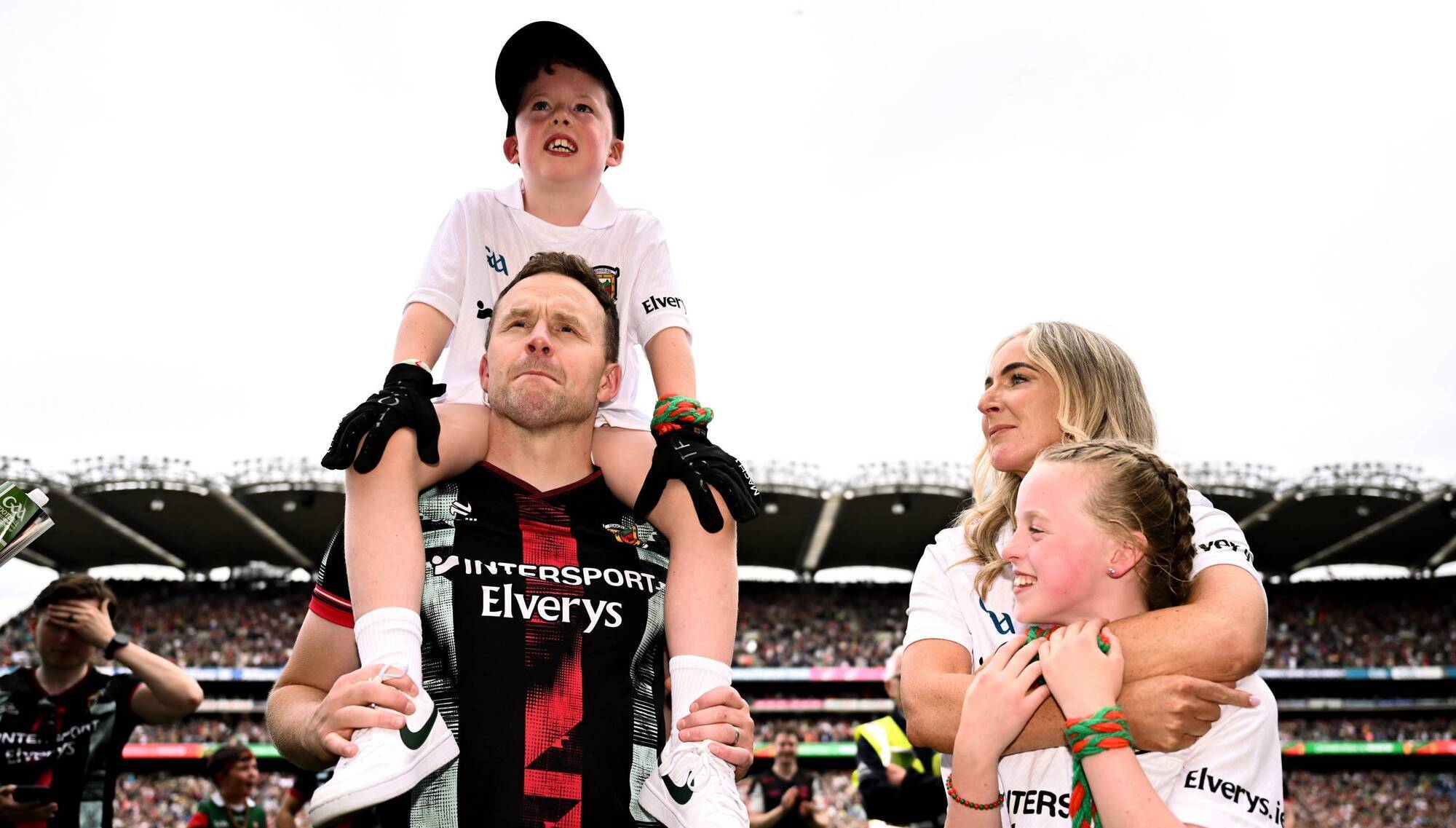
Mayo manager Andy Moran with his wife Jennifer and their children Ollie and Charlotte after the All-Ireland final victory over Kerry. Pic: Ben McShane/Sportsfile
Andy Moran doesn’t so much enter a room as bound into one.
Like the Mayo dressing room.
During his playing days the team once held a fun ‘Know Your Teammate’ quiz where a round included pictures of celebrities some players had been previously confused for.
The room laughed at a particular image of Chris Sutton and how true enough, it passed a remarkable resemblance to David Clarke. Same again when a picture of You’re A Star contestant George Murphy appeared on the screen, the bane of Donie Vaughan’s life for how often the centre back had been mistaken for the folk singer. No guesswork was required though when the image of Toy Story’s Buzz Lightyear popped up. More than once Andy Moran had been called that around the setup because of his unrelenting energy.
Read More
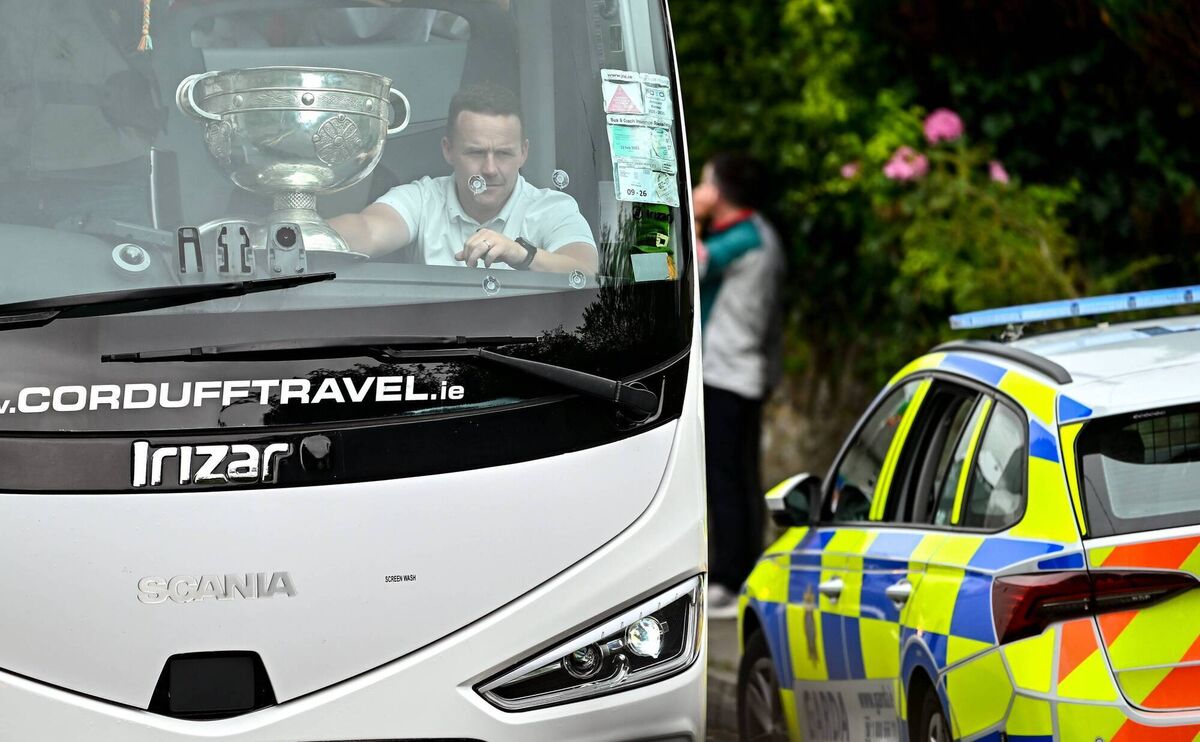
The Friday week after Mayo’s Liberation Day he strides into the lobby of the Castlebar Leisure Centre where he and his wife Jennifer run one of their ‘Movement’ gyms and where he’s agreed to meet between visits to the local hospice and hospital with Sam Maguire.
A group of women on a coffee morning greet him with a big cheer which Moran more than reciprocates, having a photo and a word and a laugh with them all.
There’s a reason he called his business what he does. For him the human body is designed to move, regardless of age. He also passionately believes in the idea of community, a movement, and his gym being a hub for people to come together.
But if there’s something Andy Moran loves as much as moving, it’s talking. He could talk for Mayo. Indeed he had to.
So he takes you into a back room and back to some other rooms he was in. The rooms where it happened.
THE APPRENTICESHIP AND THE INTERVIEW
“Wicklow manager Oisín McConville is being heavy backed to become the next Mayo senior football team manager. His odds have been slashed by Boyle Sports from 12/1 to even money.
Another Crossmaglen and Armagh teammate of McConville that the Mayo County Board could go after is Tony McEntee. McEntee, who recently stepped away from the Sligo job after five years, knows the Mayo set-up well as he was [previously] a selector and seems like the ideal man to take over the hot seat.
The odds have also narrowed on Andy Moran (5/4) and Austin O’Malley (15/8).
However, it is understood there is a growing view within the organisation’s executive committee that appointing a big name from outside the county would prove an inspirational move at this time.”
Connacht Telegraph, late June 2025
KS: Tell us how you made the pitch that you were the man to manage Mayo.
AM: Yeah, weirdly enough, I was interviewed in MacHale Park on July 25, 2025 and we won the All-Ireland in Croke Park on July 26, 2026. Exactly a full year on.
So you had to give a presentation to the managerial appointment committee about what you’ve done. And while people would be quite condescending about [Moran’s time in] Leitrim, I’ll always be grateful to [officers] Enda Stenson, Declan Bohan and Martin McCartin for the opportunity and freedom they gave me.
Obviously, we had [the 2023 Connacht championship defeat in] New York but I mean, if you talk about some of the best days I’ve had or will ever have in my career, the day we beat Tipperary in Páirc Seán [Mac Diarmada] to win promotion [from Division 4 in 2024] will always be right up there.
KS: So you felt you had to address Leitrim and frame it in a certain context?
AM: Oh, absolutely. Because I am the manager that lost to New York and I have to own that. But you also had to say, here are the facts. I took over a setup that had won one game over the previous two years. In my time we won over 55% of our league games. Terry [Hyland] was a top manager but he had limited access to his players during covid so we had to get the likes of Darragh Finn and Dáithí McCabe in to build all the S&C systems nearly from scratch.
Our job was to have all the best players in Leitrim playing for Leitrim, get out of Division 4 and play in Croke Park. And over our three years we did that. We also brought through youth. In year three we had eight debutants.
So I could say to Mayo: Listen, we’ve done this. It’s going to take time but the young fellas will be brought through and I’m the right fella to do that.
KS: From the moment you retired following the 2019 semi-final against Dublin, you clearly had ambitions of someday being part of a Mayo senior management team; just a few months later you were in with the county U20s as a coach to [clubmate] Mike Solan. Had you a preference that if you ever got in with the seniors it would be as a coach or as the manager?
AM: I don’t know yet if I can yet pick between the two of them, to be honest. I absolutely love coaching. Loved 2025 up in Monaghan. But you can’t do both. I tried the first year in Leitrim and it doesn’t work.
You have to know your personality as well. We’re sitting in my business here, we’ve 35 staff working for us, and at the end of the day it’s myself and Jennifer who have the final say. People view me as this sort of nice fella, and yes, I’d like to think I am, but I also had to look at myself and say, Jesus, you’ve ran a business here for over 10 years – you can’t be all nice, or at least a soft touch, you know? So when the Mayo managerial position came up, I was comfortable going for it.
KS: What did you learn from your time as coach to the U20s back in 2020?
AM: That the talent was there. That the calibre of people was there. Enda Hession coming in at 18, a year younger than the rest of them, and how he’d really challenge you.
KS: In what way?
AM: You’d tell him to do something and he’d say straight out to you, ‘Be a bit more precise than that now. What way do you want me to do it?’ I might have wanted him to move from left to right in behind the six so he could kick off his right leg and he’d be going, ‘Well, do you fucking want me here or over there?’ And I remember thinking: That’s brilliant, that’s the kind of humans we want!
[Jack] Carney wasn’t as vocal but he’d challenge you too. I remember us that winter in the back pitch in Castlebar, talking about him needing to move the ball quicker off his hand to his foot and getting a quicker snap so he wouldn’t get blocked. It wasn’t just in 2026 that he learned to kick points from 40 yards out.
We ended up losing in the first round to Galway on penalties, but it was still a great year. Galway went on to win the All-Ireland. Our group had Hession, Carney, David McBrien, Jack Coyne, Paul Towey, Rory Brickenden, so you’d developed that connection with them.
And the most important thing was they themselves knew they were good. What was possible. So when I came to them this year, it was no shock to them. They knew what was coming.
KS: After the 20s campaign, Covid came along. You spent a good bit of it writing your book, Andy: Lessons Learned. Was that with a view of formulating all you’d learned as a player to help inform you as a coach and manager? And did you find reflecting and writing on your playing days was nearly cathartic?
AM: I always thought I’d be very emotional after we’d won an All-Ireland but I haven’t cried yet. But doing the book and having to watch back all the big matches that we lost as well as won, I cried and I cried. The finals in 2013, 2016, 2017. The [2014 semi-final] replay in Limerick against Kerry. I bawled my eyes out.
Like, you were writing about your best mates and what great plays they made in those games. But you were also super-analysing the games, how they swung on the smallest of things and Christ, if we just did this differently. And you were thinking of all the great people that had worked with us but had since moved on, or other great people like my dad [Vincent, who died in 2018] who are no longer with us. It was the greatest therapy I could have done.
But the biggest thing I took as a coach from doing the book was looking at all the personalities you have to deal with. In my last year playing, I took a conscious step back in the dressing room and I could see, ‘Feck, maybe we’re too stringent in what we expect of a fella.’ Not James [Horan] and the management, but us as players. We wanted things done in a certain way and maybe weren’t flexible enough.
KS: So the takeaway for you as a prospective manager was…
AM: It’s the old John Wooden one – love everyone equally, just don’t treat everyone the same. The classic example is how Ferguson dealt with Cantona. I saw it with Ciarán Mac [Donald] when I was playing with him. He was very different to someone like me. To get the most out of him, he needed to be Ciarán McDonald, not some other version of himself. And it’s the same with this group. Jack Coyne will do whatever you ask him to do. But then you have other fellas who need to be shown a bit more love, minded, given a bit more leeway.
KS: Would you have got the Mayo managerial job if you hadn’t done the Monaghan coaching job?
AM: Not a chance. We wouldn’t be where we are now without Monaghan.
KS: Why do you say that?
AM: In Monaghan you were dealing with elite, elite footballers. I mean, the likes of [Stephen] O’Hanlon, [Mícheál] Bannigan, Dessie Ward, [Conor] ‘Sess’ McCarthy, Jack McCarron, Andrew Woods, these boys are top-level forwards. So to work with them, to see how they train… You cannot get Monaghan footballers off the field at the end of a training session. They will not leave.
When we were playing [with Mayo], you might have five minutes of shooting, then S&C would be in on top of you because they were afraid you could overdo it. In Monaghan we had no choice but to stay on and collect the balls after them. The lights wouldn’t go off. So I noticed, okay, it’s not rocket science here. They’re kicking the ball more than other players. So leaving lads room to do that was key when we got in to Mayo.
KS: What else did you stress in your interview that Friday night in MacHale Park?
AM: Well, I didn’t really sell them anything about Leitrim or Monaghan. It was more this is our vision of Mayo football and here’s evidence that we’ve done something like it in the past. And that vision was very simple. Get the team playing in the Mayo style of football, reconnect with the supporters and bring through young players.
KS: What’s the Mayo style? Horanball?
AM: Energy. Play with energy, play with freedom, play with a bit of abandonment while doing it within a structure. I think this team probably kicks the ball more than James’ teams would have but there’s a lot of similarities for sure. And with Johnno’s style and with Maughan’s style. Whether you kick it more or run it more, you play with energy.
When I started out with Monaghan, I asked Gabriel [Bannigan], how do ye view yourselves? What makes ye different? And he said, ‘Well, we have a hape of 5’9”, 5’10” fellas who love taking men on.’ So we said why don’t we play like that?
It was the same going back into Mayo. What’s the personality here? And by nature we’re an open, expressive kind of people.
KS: Was that suppressed by previous setups?
AM: I don’t think it was suppressed. I think we repressed ourselves because we were listening to other people’s opinions of us. You lose a few All-Irelands playing the way we played under James and suddenly the narrative is we’re naïve and you kind of go yourself: ‘Right, we need to do something different’. I never held that opinion. I always felt you have to play to your strengths. We develop wing backs, flyers, runners, athletes. So why not play to that while trying and mould the other stuff? Play like Mayo. Play like the people of Mayo. Play with energy and you’ll give our crowd energy and then they’ll give us back more in return.
KS: So the pitch worked. You got the job.
AM: Yeah. Then the madness started!
FLIGHTS TO PORTUGAL, BACK FROM DUBLIN
“From January to May, Mayo train as a collective unit once per week. Half the weekly amount of their two main protagonists, Dublin and Kerry. Mayo’s training week comprises of a Tuesday session in Castlebar for those based in Connacht, a Wednesday session in Dublin for those based in the capital and a Friday session back in Castlebar for everyone.
In the summer Mayo rarely commence training before 8pm, to enable those travelling across the country to get there and be properly mobilised. By 8pm the entire Dublin squad are already well into their post-session recovery protocol. These are the indiscriminate inches that count at the end of a long season.
Man for man, I see no difference between Dublin and Mayo. But until Mayo’s students settle for courses in NUIG and GMIT and their bankers, accountants, teachers and engineers move home to make a crust, I can’t see them ever winning the All-Ireland.”
Dr Ed Coughlan, former Mayo S&C Coach, Irish Examiner, October 2016
KS: You then met the players in MacHale Park for the first time at the height of the club championships.
AM: Yeah, August 25, 2025. Again I had the powerpoint ready. I’m a good man for powerpoint and video clips!
KS: One of the first things you put to them was for the Dublin-based players to get back home. You never were based in Dublin but you spent a good bit of time on the road at various times in your working career that would have affected your recovery. Did that partly inform you making that request or demand? That this split-squad arrangement finally had to end once and for all?
AM: The physiological is only part of it. It was more the psychological impact it had. People look at something out on the pitch like our press and say that’s why we won the All-Ireland. That’s visible to the naked eye. But Enda Hession having a sauna and ice baths and a barbeque over at his house with over 20 lads the day after a game, they’re invisible moments. And they can only happen if people are local.
Say we have 10 fellas up in Dublin. When and where are they going to talk about the game? It’d only happen if we organised a Zoom meeting or until they met up with the lads at the next training session. When I was playing, there were some years we’d a thing where you had a phone buddy for the week, someone who wouldn’t naturally be in your immediate circle of friends, and you were to have conversations about football and whatever else.
But this year those conversations and meetups were happening organically. Take Bob Tuohy. He’s a really quiet, shy fella. Well, he mightn’t have been that quiet and shy this past week or two but you get the point! When else is he going to talk to a bunch of the lads if not in a setting like over in Hession’s? He’s not going to initiate that. But there he is with 20 of his boys the day after the Monaghan game when the rest of the world is going mad, thinking we nearly blew it.
They’re not listening to the shite that’s in the press or on social media or the streets of Castlebar. They’re in their own little bubble. ‘Geez, this is what we did well. This is what we need to do better.’ And that’s the difference.
KS: How forceful or persuasive did you have to be to convince lads to come home?
AM: [Laughs]. I remember just after I got the job, myself and Jennifer and the two kids went away on holiday to Portugal. And like you usually would, we arrived at the airport two and a half hours before the flight, only I didn’t see Jenny for two hours. I was off in a corner, making phone calls, having arguments with boys like Tommy Conroy trying to get them home.
Some companies were very good to us here in town [Castlebar], in terms of helping them out with jobs and [sponsored] cars and stuff like that.
KS: How directly involved would you have been in trying to help out with that?
AM: I would say between myself and Colm [Boyle], we rang every school principal in Mayo, to see if there was any posts coming up. And we got there. But until one goes, it stays the same. And Hession moved.
KS: What was that conversation like?
AM: It was in the airport that day. I said, ‘There’s a job coming up in Ballaghaderreen. Will you apply for it?’ He said, 'I’ve applied already. I’m coming home.’
KS: A few months later you were heading back out to Portugal. Most teams traditionally have warm-weather champs just before the championship, some just before the league. You had yours the first week of December.
AM: If you were to ask me about the most important parts of our season, I would put Portugal very close to the top. When something like Roscommon happens, you have to have a trust in each other, something to fall back on. Portugal gave us that.
KS: Were you on the field much?
AM: Yeah, twice a day.
KS: Did you start putting in the press even then?
AM: Yeah, we were trying to teach them the initial parts of it. How we wanted to defend, and then obviously Paul [Durcan] was working with our goalkeepers on kickouts. But it wasn’t even that. It was introducing the likes of Kobe and Darragh Beirne and Eoin McGreal to the group, getting to know them as humans. We brought Oisín [Mullin] with us. What a human. He was brilliant for the group.
KS: How?
AM: Just in how respectful he was. There’s no ego, like, no air of ‘I’m better than ye.’ He was so grateful to the lads for, as he’d put it, ‘letting me train with ye all through the winter.’ All of a sudden, you’re in a position where there’s no one bigger than the group, not even a fella playing professional sport. And it was really cool and important for the likes of Kobe and Darragh and Eoin to see that.
KS: Well, mention of Kobe. He was heading to the AFL as well. Did you ever think of not having him involved in 2026? With all he had on with the Leaving and everything? That he may not have been up to the physical demands of senior inter-county? Or even that there was no point in teasing the Mayo public with a glimpse of a future they weren’t going to have?
AM: Well, the first conversation with Ciarán didn’t go so well for me!
KS: Go on!
AM: Well, it wasn’t going to happen! But then as time went on a really nice relationship started to develop. We started ringing each other. And during the championship we’d talk at 8.30 every Tuesday morning for maybe 30, 45 minutes. Just a really cool fella. They say the only real job you have is to be a dad and well, what a son they’ve raised. Everyone knows the football Kobe has, but just as a human, he just has a lovely nature. So down to earth. And his work ethic is unbelievable.
KS: In what way?
AM: The way he trains. Seeing him and Ryano [Donoghue] out in the back pitch in Castlebar which isn’t the prettiest place in the world over the winter, and them just taking penalty after penalty and developing that relationship was really cool. But the thing about Kobe was Ciarán knew he was ready! [Laughs]. There was no doubt in his mind this kid was ready!
I think the only time I frightened Ciarán Mac was when I said he was starting down in Kerry in the league. I could tell he was a bit taken aback. He knew it was a big step. But we were already seeing us playing Kerry in a big game later in the year and Kobe and Darragh playing in it, so we said we needed them to get a feel of what it’d be like.
ROSCOMMON
Andy Moran: “We do know that we are in the first year of a process here. We didn’t sign a one-year deal – we came in for the three years. We know it’s going to build. But you see it with these new rules, if you are not on it and you’re not really focused on what you need to do, unfortunately, you’ll get results like today.”
RTÉ reporter: “But is that a question of hunger then, a question of desire?”
Moran: “There’s no doubt about it, today Roscommon were the hungrier team. And they were the better team.”
RTÉ reporter: “Is that a worry for you?”
Andy: “Well, it’s a worry but it’s a year-one worry. And we’ll build on this. It’s not going to be a pretty couple of days [laughs], but we’ll go away, analyse it, and see where we go from there.”
April 26, 2026
KS: Losing to Roscommon as you did was not part of the masterplan.
AM: No! To be honest, I was fearful going to London [two weeks earlier]. We’d planned this London trip and to get another little preseason in during the middle of the season. But if I had my time again, we’d have played London and come straight home. We had a great time there, met wonderful people, but the training was too much. And I could sense it the week before we played Roscommon: we were a tiny bit too tired.
Also, by the way, Roscommon are a bloody very good team! They finished only behind us, Kerry and Donegal in the league. They could have got to the league final if they had gone at us in the last league game.
KS: The first year of the backdoor [2001], your old mentor Johnno also lost to Roscommon in a Connacht semi-final and then considerably rejigged his team for Galway to win the All-Ireland. Tomás Mannion went from corner to centre back. And he changed his goalkeeper. You had a similar reboot, the big one being leaving out Robbie [Hennelly], a friend and teammate of yours. How did you explain that to him?
AM: I was an older player myself. I played ’til I was 36. And I’ve always felt you should play your way out of the team. If you’re training well and you’re still one of the best six backs on the panel, or one of the best six forwards, or one of the two best midfielders, or the best goalkeeper, you play until you’re not playing well enough to play.
The Tuesday afterwards, myself, Boyler and Paddy [Tally] met in Enniskillen, watched the game back, and we asked ourselves: Imagine it’s the Friday before the Roscommon game: what team would you pick? And we more or less said we’d have picked the same team because they were the guys who were playing well. But then they weren’t. And to me it was as simple as that.
Obviously young McGreal then comes into the team. Darragh comes back in too, like he always was going to; we just felt with their respective physical attributes that Kobe could play two games in four days but Darragh couldn’t, so we left him to the U20s. And the other change then was Jack [Livingstone]. He wasn’t yet ready through the course of the national league. But in that last league game against Roscommon he played really well and when he got his chance in a couple of subsequent challenge games, he took it. And that was it.
KS: What was it like being Andy Moran walking back through the door at home that Sunday evening?
AM: I’ll be honest, I’m by nature a positive guy, but did I doubt myself? A hundred percent, I did. Jesus, it was tough! I came into work the following morning. That was my way of dealing with it; like a lot of Irish men, I felt there was no point lying in bed. But it was raw, like! That night I had an U8 game in Ballyhaunis, right on the border, and I even got a bit of grief there! And I didn’t go into town for a good while after it. Our local in Ballaghaderreen would be Solans. I didn’t go in.
But I got a great call the morning after the game from Seamus [Tuohy, county chairman]. And he said you have our full support, we know what you’re trying to do. That meant a lot.
KS: There was also your own post-match interview performance. That grated with people.
AM: [Smiles] The interview was a funny one. I didn’t know much about [the blowback] because my outlook is when you’re offline, you’re offline and I was definitely going to be offline after that game. But I sensed something so the Thursday after the game I said to Boyler [the management’s media watcher], ‘Did I say something stupid in an interview?!’ And Boyler said, ‘You’re getting a bit of grief about the three-year thing.’
The most important thing for me was how that sat with the players. So I rang Darren [McHale, one of the leadership group] and he said, ‘It’s fine, Andy, but the only thing is boys don’t want this to be a three-year plan. The boys think we can do it this year. You’ve sold this year to us.’
And that was it. We moved on. That Friday the boys who had played against Roscommon trained like dogs and the fellas who hadn’t got a game against Roscommon played a brilliant challenge game against Limerick, trying to implement what we were trying to do. And when we got to the big house, it worked for us.
WELCOME TO THE HOUSE OF FUN
KS: The one game from your journey that now tends to get overlooked is the quarter-final against Cork. But at the time it was huge.
AM: Oh, massive. Cork were a massive threat. They won promotion beating Tyrone in Tyrone, something we couldn’t do. They beat Donegal in Ballybofey which is probably the hardest game on the road you can get.
And all year you’d been telling the boys, ‘Croke Park, Croke Park, Croke Park.’ And then you were there.
KS: The team of the 2010s always viewed themselves as a Croke Park team: wait until we get Keegan and Vaughan up there and they’ll steamroll teams. What made you think this team was a Croke Park team?
AM: Our forwards. I know myself having been one, the best place to play in the world is Croke Park. True bounce. You can take a fella on the half-turn. And that’s someone who had no pace. All of a sudden you had fellas like Ryano, Kobe, Tommy, guys who have serious pace. And it just suited the likes of Jordan, Carney, the young cubs with their personalities. They like crowds. They like expressing themselves in front of them.
But as often I had told them they were going to be a Croke Park team, I didn’t know for sure until 5.30 that Saturday evening. Coming out of that Cork game, I just thought, Wow, the potential here is huge.
KS: That was all the more evident against Louth. After that game you had the famous exchange with John Fogarty. I think it was both a very good and fair question from him and a great and fair answer from you. When did you calculate that was the way to answer it?
AM: It was just on the spot.
KS: You weren’t influenced by Brian Fenton making a similar kind of comment before that when you went over to Joanne [Cantwell] and the panel at pitchside?
AM: Now that you say it, yeah, that probably went into the computer alright.
KS: But had hype cost Mayo before? Was there too much hype? In ’89 you had the plane up and back and all the painted sheep but when did you ever feel hype cost you All-Irelands?
AM: I always thought it was a nonsense. If anything at times we didn’t embrace it enough, staying away from certain situations. I mean, in 2017, it suited me to stay out of it because I had kids, I had a business, and I had my burner phone and all that kind of stuff. But when you’re 18, 19, 20 like these guys, you don’t care! They actually quite enjoy it.
We didn’t tell anyone not to do Instagram. I remember one night Boyler asked, ‘Is it time now to stop signing jerseys?’ And I said, ‘No. These boys have been waiting five years to sign jerseys.’ Embrace it all. Okay, we had to protect Kobe a bit when we were away and if he went to the bathroom, we’d probably send someone with him. But people are really respectful, and these younger guys are so used to social media and being in the public eye.
SLAYING THE DRAGON
“This is 24-7 on the phone. When the lads ring you, you’ve got to answer the phone. You can’t be waiting. Like, Charlotte is on about going to see Toy Story 5 for the last six weeks and I said it’s not going to happen until this is over. You can’t be giving up three hours of your day at any time. That’s just the way it is.”
Andy Moran, July 13, Mayo All-Ireland final press day
KS: It was telling that for the All-Ireland press day you picked two players [Jack Coyne and Carney] who had never played or lost in an All-Ireland final before.
AM: But it’s their team. The lads who are 25 or so, the two Jacks, Hession, David McBrien who wouldn’t say much but is a huge leader in the group. Darren McHale too, though he’s injured. And I said it to them before the Monaghan game. This is yer team now. You need to take this on.
KS: How did they take it on?
AM: At the start of the year we challenged them. But over the year they started to challenge each other. They didn’t need us to do it.
I love doing video analysis. Colm’s the same. We actually love watching games back for hours and hours and breaking it down. And during the league with the games coming thick and fast, we’d present the analysis to the lads. And it worked quite well. We won five of our seven league games.
But after Roscommon, I was talking to a mentor I have, someone outside the county who I won’t name, and they said, ‘Look, I’m not telling you what to do but they’re only seeing football through your eyes. They need to see it – and you need to see it – through their eyes.’ So what we did then was we’d train on Tuesday and then on Fridays we’d only do walkthroughs, no training, and the boys used to present to each other on how they saw the last game. And all of a sudden it just took off.
KS: Ryan has spoken alright about how Carney after the Meath game challenged him and Kobe and Darragh Beirne, that they weren’t working hard enough upfront. But that would hardly have been groundbreaking for a group of Mayo players, right? Your old teammates would talk about how a couple of weeks out from the 2012 All-Ireland quarter-final against Down they had a workshop where each unit presented clips from the Connacht final and how it was transformational.
AM: Oh, I can still remember it. Keith and Ger Caff [Cafferkey] to the backs, Barry [Moran] to the midfielders, and especially Jason Doc [Doherty] to the forwards. You could see lads and the team growing in front of your eyes. But this year we didn’t just ask the lads to analyse themselves. We asked them to analyse the opposition.
KS: How much of, say, Cork did they see?
AM: Everything. Well, between them, everything. We wouldn’t just have had lads watching their win against Donegal the previous day out. A lot of the boys analysed the Cork-Tyrone game in the league. And that way they could talk to each other out on the pitch about how they were seeing the game. How there was this weakness or tendency that a Cork or a Louth or a Kerry had.
KS: You kept to that same routine for the final. No camp in a Johnstown or Carton House the weekend out from this final. Just your Friday evening video work and meetings, pitch session on the Saturday morning and the Sunday then off.
AM: Again we learned from London and the lead-up to the Roscommon game when we overdid it and they were fatigued. With the two-week turnaround there was no point.
KS: In your internal games, how much do the B team set up like the opposition and how much do you have them playing like Mayo so those lads can showcase what they’d do when given the chance to play for Mayo? How much are those games a rehearsal or still an audition?
AM: A bit of both. Like we told Paul Towey he was Eoin McElholm before the Tyrone game. Cian McHale was David Clifford for a few days.
We had four training sessions between the Louth game and the Kerry game and in three of those four training sessions the reserve team beat the A team. And that to me was a huge reflection where the squad was going. The likes of Conal Dawson and John MacMonagle and Séamus Howard who will be huge for us going forward.
KS: What were Cillian [O’Connor] and especially Aidan [O’Shea] like around the place in those weeks? You’re talking about the highest-scorer in championship history and the most-capped outfield player in championship history. And now they’re not featuring. You, their old buddy, isn’t playing them.
AM: There’s a reason Aidan has more championship appearances than any other outfield player ever. He’s a competitor, he’s hungry, he’s mad to play. And in those internal games he really gave it to Bob and Matty [Ruane] and Jordie and Jack. He was the fella pushing them.
Was he close at times to coming on in games [after Omagh]? He absolutely was. But Matty at the time was developing himself as that leading impact sub from midfield. And in the new game you’re always going to bring on one upfront and one in the fullback line. It’s rare that are you are going to bring on two midfielders. And at that stage we saw Aidan either as a midfielder or if we needed something different in the full-forward line.
Cillian was carrying a foot injury all summer but was actually fit for the final. But all the way through he was brilliant around the group, mentoring the likes of Hugh O’Loughlin. ‘I love the way you took that ball. I saw the way you gave that off.’ How lads should kick the ball in. You’ve heard how Aidan challenged Ryan as to how many tackles he could get in. You saw that the first man into Jack Livingstone on the final whistle was Robbie Hennelly.
KS: The white jerseys. How did you approach that?
AM: It’s funny how things work out. Boyler since the start of the year has been obsessed with our first-choice away jersey – let’s just say he’s not a fan! And we actually did a piece up for the county board a few months ago with screenshots from last year’s league final when you can barely make out the difference between the Kerry jersey and our alternative jersey. So when we lost the toss, Boyler went on his little rant again, suggested we go for the white jersey and the county board agreed.
KS: So you broke them in at training?
AM: Yeah. The first couple of sessions we had the lads using the Ballaghaderreen [white] jerseys. Then the match-day jerseys arrived for the last two sessions before the game.
KS: What way did you frame Mayo’s record in All-Ireland finals?
AM: We never mentioned it. I never mentioned them. I just told the lads how jealous I was of them. To get an opportunity to play in the 2026 All-Ireland final.
KS: What did you tell them at half-time?
AM: One of the great things Paddy Tally has brought is a real structure around half-time: Three Messages. And you’ve to write them down otherwise you can go off rambling. So the backs will go into a huddle and come up with their three messages, the forwards will do the same and then the management will have three things and we’ll see how they line up.
A big one for me was to get David McBrien more involved going forward because that way if he engaged somebody it would give Darragh Beirne and Kobe more space. And that’s the way it worked out for the goal.
But my biggest message and last word in the huddle was this: Have fun! I simply told them to have fun. Go out and enjoy slaying that dragon.
To be honest, I’ve never seen them more relaxed than they were at half-time. It was no surprise to me to see them going out to play like they did in the first 10 minutes.
I also noticed that Kerry were late out. And then I saw David [Clifford] pulling them into a huddle. And I just thought, That’s interesting. You never see Kerry late out. I didn’t think that was a normal thing for them to do. I thought, we’re in a really good spot here.
‘WE’RE EQUALS’
“To every young boy and girl across Mayo and the diaspora across the world, never stop dreaming! Stick your chest out and be proud to be from Mayo!”
Jack Coyne, Sunday July 26, 2006, Hogan
Stand, Croke Park
“They sneered at us. They laughed at us. But they won’t laugh at us anymore.”
Andy Moran, Monday July 27 2026, MacHale Park, Castlebar
KS: I have to ask you. Why do you think it was the team of 2026 that brought Sam Maguire back to Mayo rather than those teams of 2013-2017?
AM: Ha, it’s funny. One of the [2010s] lads whispered in my ear the other night, ‘We [the old team] were better!’ You tell me first what you think. You know Mayo football well.
KS: Well, I think it comes down to four things. One: Kerry are brilliant but they’re not Gavin’s Dublin. Two: While the team you played on probably had even more talent, their forwards, as good as the likes of you were, couldn’t skin backs the way this team’s can. Three: The leader of these forwards. O’Donoghue. Mayo were probably as good as Kerry in 2014 and the biggest differentiator was luck but if you were pushed for the main other reason it was Donaghy. This year Mayo had that primal force of nature.
And the fourth is yourself. Mayo had tactically been just level or a bit behind the market leaders. This year with embracing the press and the two-pointer you were ahead of the game.
AM: Interesting! Whatever about that last point, I’d agree with the thrust of the rest of them. The old team ran into a really great force in Dublin. We’re never again going to see a six-in-a-row team.
And you’re 100% right about the forwards and Ryan. I was trying to explain this to Charlotte yesterday. She asked me, ‘Was Kobe’s dad as good as you?!’ And I was trying to explain to an 11-year-old, there’s levels to this, like! Yeah, I was good, very good even, but like a Ciarán Mac was another level. And a Ryan O’Donoghue is another level.
The beauty of this is the people of Belmullet knew that was Ryan O’Donoghue out there in Croke Park. That was the real Ryan O’Donoghue. When things weren’t going his way in the first 20 minutes, dropping balls short and giving the ball away, he went, We’re still going to find a way here!
In James’s time we’d have used the old [John Healy] line, ‘And no one shouted stop.’ And we tried our hardest to shout stop. But Ryano said, No, it finally stops here! I’m shouting stop!
But for me the biggest thing this group had over all the other teams we had was the bench. You look at the last day. Aido is a three-time All-Star and didn’t come on. Matty is an All-Star. Paddy Durcan is an All-Star. Tommy Conroy comes on, straight away kicks a point, wins a free, later assists Jordy for his point. Conor Loftus comes on and direct assists Kobe for his third point. Matty wins a massive turnover for Kobe’s goal chance that [Shane] Murphy saves. Brickenden comes on to cancel out the threat of Tomas Kennedy. Paddy makes a critical interception in the middle of the arc.
We didn’t have that kind of contribution or depth before. And it wasn’t by chance. I mentioned how the B team beat the As in three of their last four games. We didn’t have that going into other All-Ireland finals. The strength of this panel is huge.
KS: What moments since have you most treasured?
AM: Well, it’s been all great. Probably for me as a coach the greatest satisfaction has been to see someone like David McBrien from my own club achieve his potential. Or a Jack Carney kicking two-pointers for fun up in Croke Park all those years on from the back pitch in Castlebar with the U20s. Or Jordan Flynn make 14 tackles in an All-Ireland final. Fourteen! That’s what makes me most emotional.
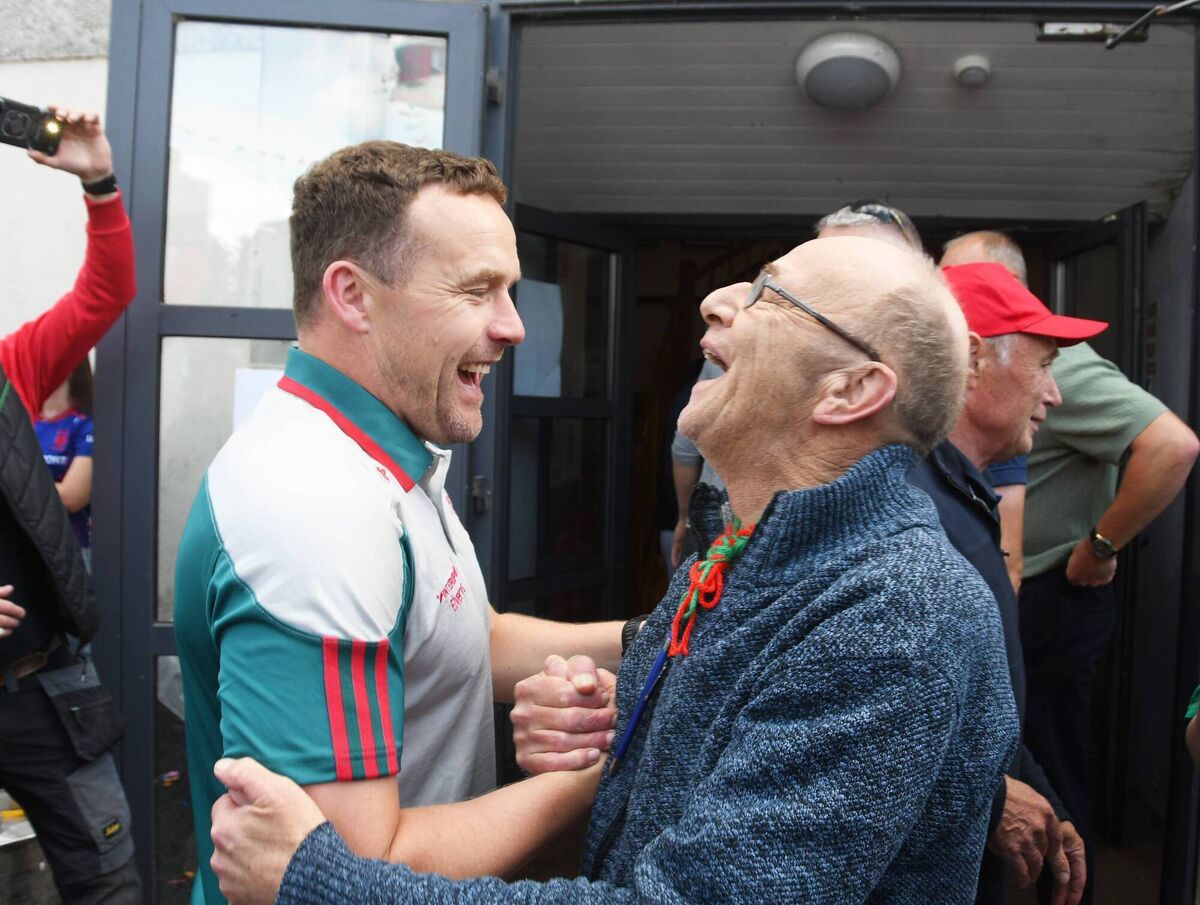
But of course, it’s what it’s done for everyone. I was in the hospice today with a man who is on the last leg of his race and you could just see when he was holding the cup, Christ, we did it! I saw it happen! I just hope people are at peace now. And I think they are. Supporters, former players and managements. You can see it. You can feel it. As a people we have that peace of mind of being able to walk into a room and say, Fuckit, we’re equals!
KS: Because you weren’t before this, right? That was a theme of your old team. Leaving the hotel before the 2016 final it would have been mentioned this was Mayo’s Rosa Parks moment: We’re not moving for anybody because we’re as good as everyone else. And ye played with that defiance, only ye drew, then lost the replay by a point. So you felt the sneering and laughing continued in the subsequent years? That’s where your line at the homecoming came from?
AM: Oh yeah. Because we were sneered at! People can say we weren’t but we feckin’ were! ‘Oh, typical Mayo.’ Even being on podcasts with players that had won All-Irelands and they’d start talking about how they won them and what they did when they won them – you could only participate in that section of the conversation so much. And you’d be thinking: God, I wish we won one. I wish we win one. And now we have. And hopefully there’ll be more to come.
KS: Before you head off now again with the cup, one last one. Did you get to bring Charlotte to Toy Story 5 yet?
AM: Saw it yesterday [the Thursday week after the final]! The 12.40 showing. It was lovely.
KS: Was your fella Buzz any good?
AM: Our mission on this planet is to make a child happy!
And then like that he’s bounding out of the room again, the pied piper of Mayo. Having taken them to infinity and beyond.
CONNECT WITH US TODAY



Be the first to know the latest news and updates