Christy O'Connor: Dangerous head-high tackles in hurling have to be stamped out
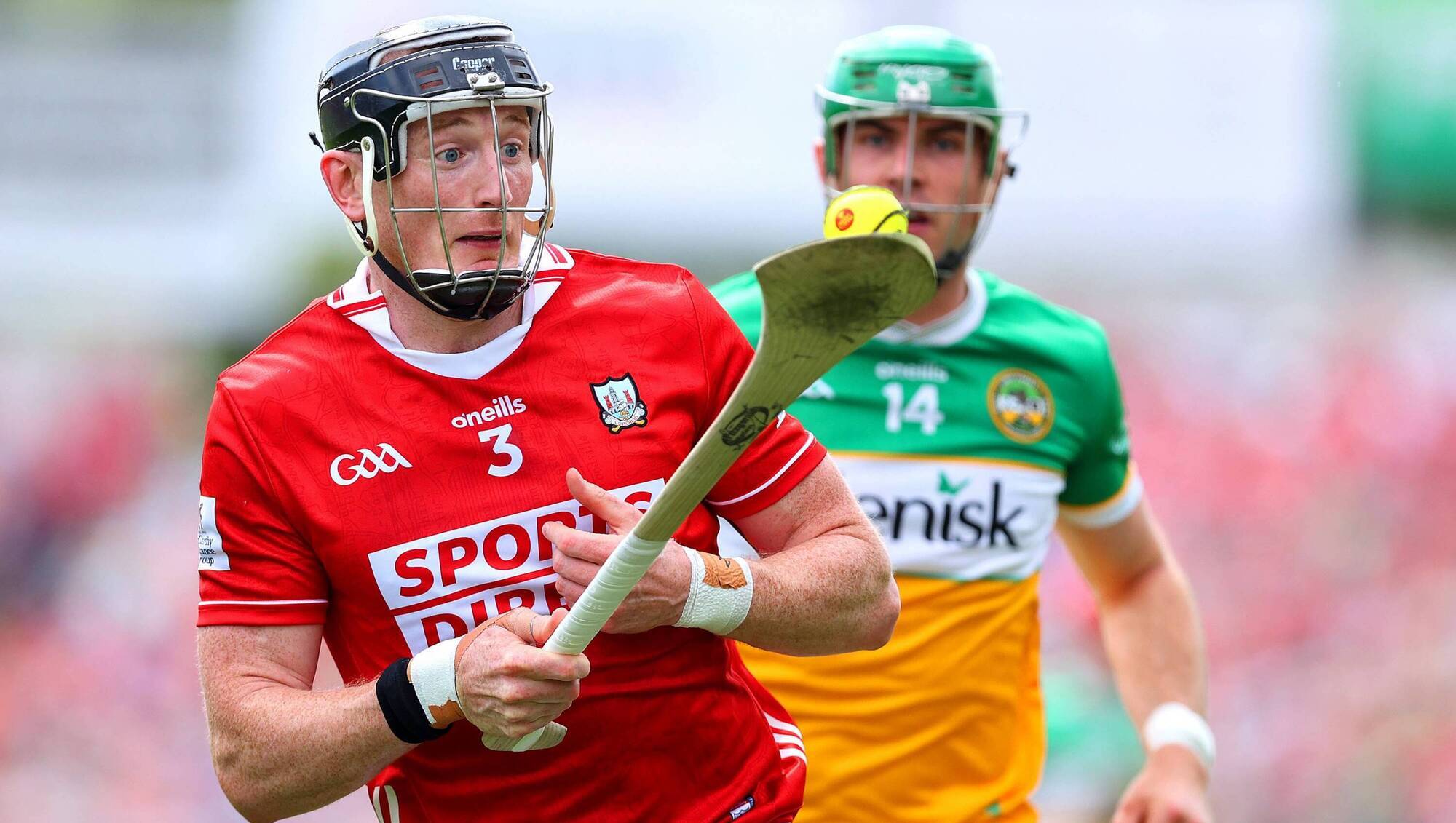
CONTROL: Cork's Damien Cahalane has time on his side to work the ball free of Offaly's Brian Duignan in Sunday's All-Ireland SHC quarter-final at Semple Stadium in Thurles. Pic: Tom O'Hanlon, Inpho

By the time the fourth official put up 13 minutes of additional time on the board in Thurles on Saturday evening, everybody in the ground – players and supporters – just wanted the match to end. Clare were already ahead by 10 points but the whole mood in Semple Stadium was shrouded in silence and enveloped in anxiety as David Reidy was stretchered off the field after a distressing head injury.
Clare added another raft of points in garbage time but the match was devoid of context or meaning by then after Brendan Kenny’s dangerous high tackle on Reidy left him prone of the ground for nearly 15 minutes.
“We're talking about this for the last number of years, these head-high tackles,” said Michael Duignan in his RTÉ co-commentary. “I've heard it recently, people saying there's lads up on ‘The Sunday Game’ calling for lads to be sent off. They are red cards. They are. You can't plough into lads.” Eliminating head-high tackles from the game has been a necessary and worthwhile campaign for many years. Accidents will always happen. Kenny is certainly not a dirty player. His tackle was badly mistimed, but head-high hits have become a recurring and concerning pattern in hurling.
Read More
Players need to have a greater duty of care to their opponents but too many of those tackles are not being punished enough by referees. The players are conditioned to absorb any amount of foul contact. Supporters want gladiatorial type combat instead of a whistle happy referee. Chaotic intensity and ferocity can lead to mistimed shoulder charges. But there can’t be any grey area around head high tackles. Referees must be prepared to err on the side of implementation. It’s a red card offence, all day long.
Everybody - coaches, managers (even in their commentary), referees, pundits and journalists (in how they call out those acts) - must assume a greater duty of responsibility around this issue. But the greatest compliance must come from the players On ‘The Saturday Game’ the night Clare played Tipperary in May, Donal Óg Cusack spoke about Willie Connors’ frontal challenge on Mark Rodgers. Cusack drew attention to how exposed a player is when making a pick-up, which Rodgers was that evening. Cusack was specifically referring to that action, but the sentiment applies to any head contact.
“There is a savage inside in all of us, but I think there must be mutual respect from the players,” said Cusack. “The player is so exposed. The opponents are coming in at pace. I don’t accept that players with that amount of coordination and ability are doing that by accident.
“Players know exactly what they’re doing. It’s something that needs to be stamped out. Because when a serious injury is going to happen to some young man, it’s going to be too late then.” That very nearly did happen on Saturday night. Thankfully, it didn’t. But this issue needs to be seriously addressed. Because it is becoming a worrying pattern in the game.
In September 1926, Cork played Tipperary in Thurles in the Munster final when the venue was then known as the Sportsfield. The match, which ended in a draw, was Cork’s 8th time playing a championship game in Thurles. Exactly 100 years on, Offaly played their 8th championship match in Thurles yesterday.
Competing in a different province, combined with Offaly’s struggles to emerge as a force on the provincial and national stage until the latter end of the last century, is an obvious factor in Thurles being so alien to the county as a venue. But their appearance numbers are even more stark when compared with Cork’s familiarity with Semple Stadium.
Yesterday was Cork’s 130th senior championship match in Thurles. According to the esteemed GAA statistician and historian Leo McGough, 53 of those games took place at the Sportsfield, with the remaining matches held in Semple Stadium. Cork have now won 78 of those matches, drawn 12 and lost 40.
Offaly’s win-rate there now is just 37 per cent, having won three and lost five. Their first appearance at the venue was the 1984 All-Ireland semi-final against Galway. Prior to yesterday, Offaly’s last appearance in Semple Stadium was against Waterford in the 2008 qualifiers, a match they lost the six points.
Their status as a Leinster team was also the reason why Dublin had only played ten championship matches at Semple Stadium prior to Saturday’s All-Ireland quarter-final. Defeat to Clare means that their win percentage is now only 18 per cent, having lost nine of those 11 games. Dublin’s only two wins in Thurles were against Limerick, in the 2011 All-Ireland quarter-final, and the 2015 qualifiers.
Every team is guaranteed at least four championship matches in a season now but, similar to the Cork-Offaly match-up, Dublin were always going to be at a disadvantage playing Clare at a venue where they are so comfortable. As well as senior, all players in Munster get considerable underage exposure to Semple Stadium.
As a historic comparison with Dublin, Saturday was Clare’s 91st championship match in Thurles. Having won 33, drawn seven and lost 51, Clare’s win rate at the venue is still only 36 per cent. However, Clare have had a brilliant track record there in the last five years, having now won eight of their ten championship games at the venue. The only two games they lost were the 2022 and 2024 Munster finals to Limerick, with the 2022 defeat coming after extra-time.
Read More
Aside from the recent struggles of Leinster teams against Munster sides, the weekend was another illustration of how difficult it is for some Leinster teams to win in Thurles.
Every side wants to play in Semple Stadium. It was a centralised location for all four teams on Saturday and Sunday. The near capacity attendance was the obvious reason the Cork-Offaly game was staged in Semple Stadium. Yet with only 13,279 in Thurles for the Clare-Dublin match, could that game not have been held in Portlaoise?
It is a fair question to ask if Leinster teams should have to take on Munster sides at a venue where they are far more comfortable.
Late on in Saturday’s game in Killarney, David Clifford eschewed the opportunity of a handy point by dropping the pedal, striding forward and pulling the trigger. Clifford was just marginally off-cue and the ball hammered off the side-net stanchion.
Having already converted nine of 11 shots, a green flag would have taken Clifford’s tally to 2-10, but even a white flag would have bumped Clifford into outright 3rd in the all-time championship scoring charts. Still, his haul on the day saw Clifford join Dean Rock at joint-third.
Cillian O’Connor is still a mile out in front, followed by Colm Cooper, but it’s possible, and more than likely probable, that Clifford will have edged past Cooper by the end of this championship.
Playing in his 50th championship match on Saturday, only five other players have made their way into the top 20 scoring chart having played 50 games or less; Mikey Sheehy, Seán O’Shea, Maurice Fitzgerald, Paddy Bradley and Brian Stafford.
Nobody in that top 20 though, has a better scoring average than Clifford, which is now running at 6.5 points per game. Only two other players in the top 40 have a better scoring average than Clifford – Matt Connor and Declan Browne.
Cillian O’Connor is currently 138 points ahead of Clifford, who has now amassed 26-253 (331 points). But considering his age and scoring rate, combined with the new scoring enhancements, it seems only a matter of when, not if, Clifford will get to the top of that scoring chart.
A collection of the latest sports news, reports and analysis from Cork.
CONNECT WITH US TODAY



Be the first to know the latest news and updates