Derek McGrath: Even the darkest night will end and the sun will rise
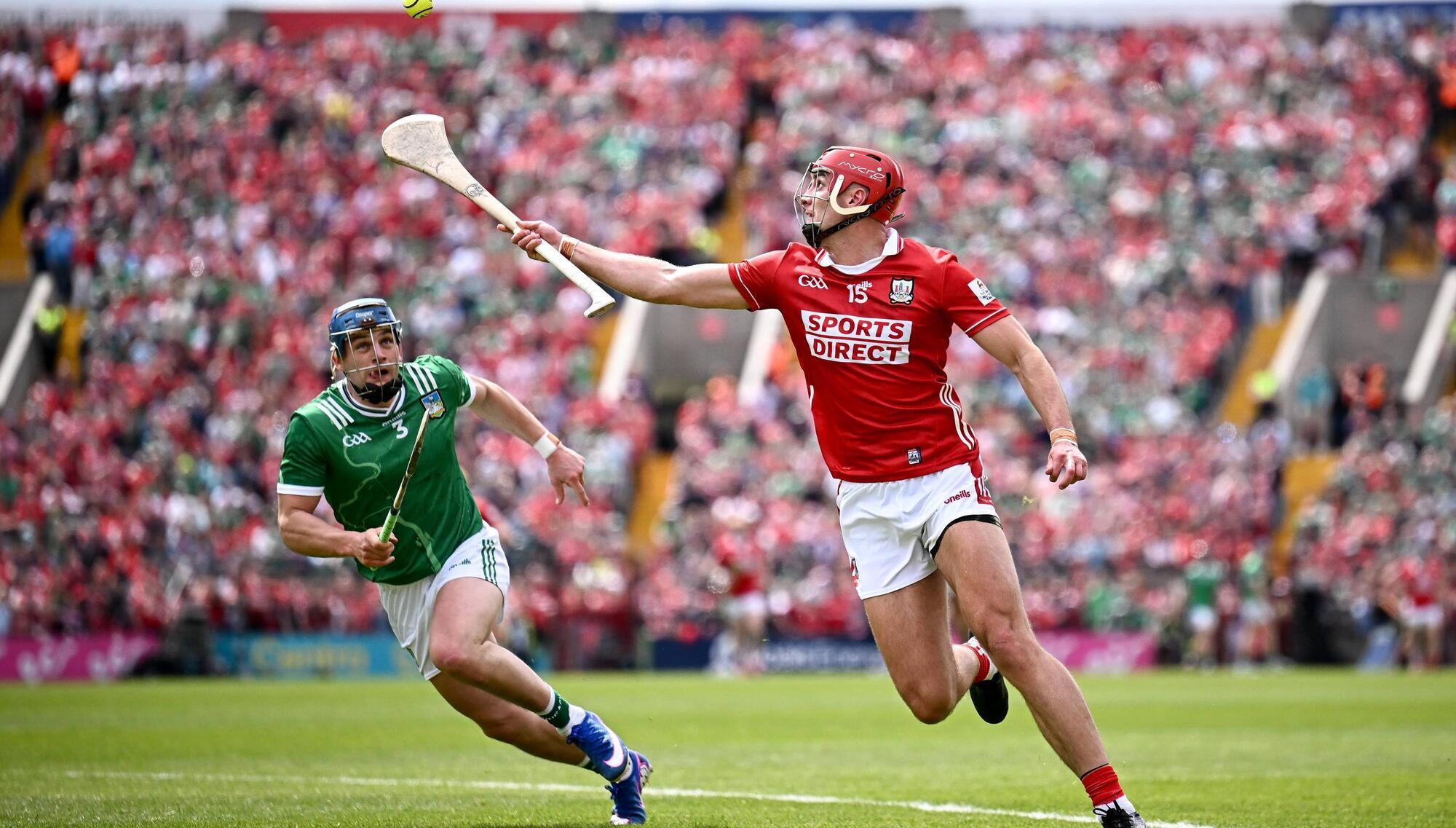
Brian Hayes of Cork in action against Mike Casey of Limerick during round robin phase. Pic: Seb Daly/Sportsfile
A chance encounter can sometimes tell you more than hours of interviews. Last Sunday night, while celebrating my 50th birthday, our family found ourselves among the thousands gathered in the 3Arena for Les Misérables. As the final applause echoed around the arena and people began making their way towards the exits, we happened upon Dublin hurling manager Niall Ó Ceallacháin. Less than a week before a Leinster final against Galway, the booming chorus of One Day More paled into insignificance as my youngest Odhran beamed with delight as Niall shook his hand and said hello. As we exchanged a few words at the end of a production built around resilience, redemption and the courage to confront hard truths, there was something strangely fitting about it all. Victor Hugo's masterpiece is ultimately a story about growth through adversity. The best sporting teams often follow a similar path.
George Kohlrieser, in his influential book 'Care to Dare', argues that growth only occurs when people care deeply enough about a cause to risk failure in pursuit of it. Teams that merely want success tend to protect themselves. Teams that genuinely care are prepared to expose weaknesses, challenge assumptions and learn from setbacks. That philosophy came to mind when reflecting on Ó Ceallacháin's remarkable honesty after Dublin's All-Ireland semi-final defeat to Cork last summer. Having watched his side concede seven goals, he offered no excuses. "We intentionally didn't," he said when questioned about deploying a sweeper, adding that Dublin felt "there's just no point in setting up with a zonal back six against Cork." The criticism that followed was accepted rather than resisted. More importantly, the lesson was absorbed.
As Dublin prepare to face Galway in Saturday evening's Leinster final, the most striking aspect of their season has not been their improvement but their adaptability. Liam Rushe's return has provided leadership and structure. Brian Hayes has seamlessly alternated between sweeper and attacker, and Dublin's defensive system now possesses a flexibility that simply wasn't there 12 months ago. They cared enough to examine what went wrong. Care must be a management's first thread of connective tissue.

The calls of 'ah he's pushing on' and 'we need legs' have been ignored as Rushe has provided stability and poise to their defensive set-up. However it’s the subtle slides that happen when he has to man mark (as he did against Lee Chin) that make Dublin's adaptability the most impressive. This could be seen against both Galway and Wexford where Rushe physically matched up with opponents but Dublin’s defensive protection was provided by Conor O'Donoghue going to midfield and Brian Hayes' freakish athleticism being used to both sweep and attack. This slide, allied to the free role give to Donal Burke and the twin towers of Ronan Hayes and John Hetherton, ensure that they are now anything other than one dimensional and have a sound defensive platform to supplement their forwards.
If Dublin’s evolution has been driven by learning from failure, Galway’s has been shaped by courage to embrace change. Niland, Rabbitte and Daniels' emergence have had a dual purpose. Firstly they subliminally allow a narrative build amongst the outside voices that the Tribesmen are building for an exciting future whilst the present is the immediate focus inside the circle. Secondly the tactical shift, often scorned upon in the past, of playing a lone attacker has provided the difference and puzzles opposing management teams and players. Do not underestimate (as I well know) Donoghue's ability to plot for a final. Big occasions reward clarity and discipline and Galway will arrive carrying both. In many respects they represent another expression of Kohlrieser's philosophy -- the courage to trust youth, the courage to evolve, to step into uncertainty before certainty eventually arrives.
The same principles of trust and courage have been long standing principles of Limerick'. Speaking recently, Cian Lynch reflected on how perspective changes with experience, family and time. There was no talk of legacy or medals, merely an appreciation of the journey, of finding joy in the process and understanding what really matters beyond the result. Lynch’s musings of “drive(ing) it on together and run(ning) behind each other” fit perfectly with Kiely’s 'next man up' mantra. Limerick's wider lens, definitely prompted by Caroline Currid's probing, enables the squad to see sport as an opportunity to contribute positively to those around them, to be a source of good conversation and connection within their community.
The connection is supported by the plan, a mixture of mission and logic. Consider the motivational impact, the personal resets that Diarmuid Byrnes, Darragh O'Donovan and Dan Morrissey seem to have undertaken. Hunger supported by detail is a powerful combination. The throw-in has become a source of focus with Limerick winning five of the last six restarts. Knowing that Gillane will be tagged and marked, will we see him drift from goal to open up avenues for Aidan O'Connor, Adam English running from deep with perhaps Hegarty and sporadically Shane O'Brien benefitting from Cork's obsessive focus on Gillane. Limerick's wall will be higher than ever, allowing no counter attack by Cork into grass but rather into bodies.
Perhaps the clearest illustration of Cork's evolution throughout 2026 has been subtle tactical shifts. Determined not to get caught when meeting unconventional approaches Ben O'Connor's early-season insistence that “we need to play in lots of different ways” will never be more tested than over the coming weekend. So what have been the subtle tactical shifts and will they tweak it Sunday?
(aka Cathal O'Neill and Gearóid Hegarty)
If you like a deep dive into the game, pause the action from Cork's encounter with Clare on 45 mins 05 seconds. Cork's subtle transformation is evident. Shane Kingston splits the posts yet the more revealing detail was occurring 60 yards behind the play with Barry Walsh positioned deep inside Cork's own defensive structure.
For decades, hurling orthodoxy would have viewed that image as contradictory. If a forward is scoring, surely he should be near the opposition goal. Teams now increasingly understand something different. The freedom to attack is often created by somebody else’s willingness to defend. Walsh's position (at least five times during the second half) was not a sign of caution, it was a sign of trust. With himself and Dudsy Healy dropping into defensive areas, that security cordon allows two of Rob or Eoin Downey and Mark Coleman to drop to protect the full back line, but also crucially be both an out ball for Patrick Collins and breaking ball gatherers.
This defensive shield and pack reinforced by Tim O'Mahony and Tommy O'Connell ensures the front four of Barrett, Hayes, Buckley and Connolly have the confidence to play with greater expression. Cork are no longer defending with six defenders and attacking with six forwards, they are now doing both together better than they have before.
The ultimate test may well arrive Sunday if Cian Lynch rocks up to centre forward. The Rebels' policing of both Diarmuid Stritch and Tony Kelly shows definite signs of that are of their game improving. The pack will likely be reinforced by the hunting Barrett and although Buckley has found himself part of a deep inside line thus far, anyone who has watched Ben O'Connor's U-20 teams over the years, or indeed earlier league performances, will have seen Buckley operate further out the field. They may well revisit the double centre forward approach which will allow the hunt and the transition in equal measure and to counter the wandering Casey and allow Rob Downey sit. Buckley's ability to win frees, his evasiveness and his team ethic may see him work with Tommy O'Connell when O'Connell locks on to Lynch to become a de facto midfielder.
I expect the long, down-the-middle-on-Brian Hayes puckout to be revisited with a vicious emphasis on the breaks. Limerick's likely knowledge that this is on the way should ensure that Cork's brains trust should tweak to use perhaps Hayes as a decoy and allow unexpected runners like O'Connell or O'Mahony to break in behind, as opposed to Barrett and Walsh.
To win, Cork will need to find a way of adopting many approaches within the one approach without risking losing their flow. That’s the only way Limerick can be beaten.
There is one final irony to all this build-up. For all the significance attached to the Munster final, there is a growing sense that both sides will cross paths again and Croke Park on the July 19 is a very live probability. Kohlrieser often writes that the strongest performers are those who can commit fully to the present without being imprisoned by the outcome. All four counties dare because they are attached to a purpose greater than a single result. Perhaps that was the real lesson from a chance meeting in the 3 Arena. Les Misérables isn’t about victory, it’s about relationships that shape and sustain us and ultimately define who we become. As the curtain fell Sunday night one line lingered above all others: “Even the darkest night will end and the sun will rise”. Whatever happens this weekend, the journey for these teams will continue. The trophies matter, the rivalries matter, but the greatest prize may lie elsewhere. It may lie in the memories, the shared purpose that allows ordinary players make us realise that courage grows where trust lives. Limerick and Galway for the semis. Limerick and Cork for the July 19.
CONNECT WITH US TODAY



Be the first to know the latest news and updates