Home and away: the pinch points and the pitfalls on the road to July
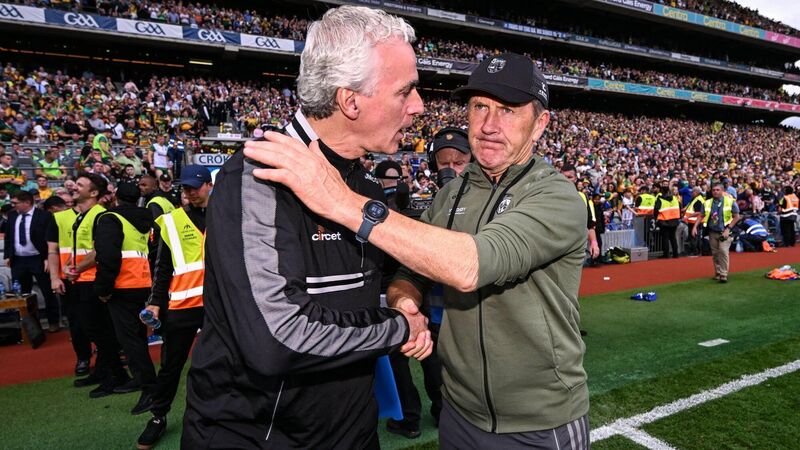
NEW FORMAT: Donegal manager Jim McGuinness, left, and Kerry manager Jack O'Connor after the GAA Football All-Ireland Senior Championship final. Pic: Ramsey Cardy/Sportsfile
It’s championship football, Jim and Jack, but not as we’ve known it.
Under this format, the sixth we will have had over the past decade, there is an understated, almost casual, disregard for some of the championship’s traditions and conventions which does not yet seem to have dawned on the public, whatever about Messrs McGuinness and O’Connor.
It was often levelled at the outgoing championship that it lacked jeopardy, a bit like the security guard duped and liquored up by Richard Pryor in Superman III that claimed his drink hadn’t enough vodka.
Well, as Pryor remarks while piling a bottle of Smirnoff into his unsuspecting drinking partner’s glass that keels him over, there’s vodka – or at least jeopardy – in it now, buddy.
Although you can afford to lose one game between the end of the provincial championships and the commencement of the All-Ireland quarter-finals, teams will be on a higher state of alert, waiting to see who they’re drawn against next (against a top-16 opponent only, unlike the old qualifiers), than they were knowing they just had to avoid finishing fourth of four in the days of the old Sam Maguire groups.
Because this is what you have to realise about this new format.
Before the All-Ireland quarter-finals there are no games on neutral ground. So much hinges on the draw. The luck of the draw. Getting a home draw.
A couple of games on the road and you might be in more than just jeopardy; the likelihood is you’ll be out of the championship. For decades people cried for an open draw championship, along the lines of the Centenary Cup that saw Micko’s Kerry survive a first-round trip to Ballybofey but then crash out to Derry the next day upon having to travel again.
Now we pretty much have that open draw which, as our mock draw illustrated, could yield similar outcomes and surprises to that of 1984.
Winning a provincial final as opposed to merely reaching one offers you no advantage in the All-Ireland series.
Everywhere you’ve looked in recent weeks you’ve had multiple pundits declaring who they fancy for each of the provincial titles. As if it still matters like it used to.
It doesn’t.
For the first time in the history of the championship the winner of a provincial final enjoys no advantage over a provincial runner-up. For all of the 20th century, as well as in the Covid years, whoever won a provincial final progressed to the All-Ireland semi-finals; the loser was gone.
In the qualifiers years (2001-2018 and again in 2022), the difference between winning and losing a provincial final was a ticket to the last eight or having to navigate the last-12 round. Even in the time of the Super 8s and Sam Maguire groups, winning a provincial title reduced the number of other provincial champions you had to play in your group – you enjoyed a higher seeding.
Not in this format, the sixth variation the championship has had in the past decade. Win or lose your provincial final, you start at the same base: at home in the first round against a team that didn’t make the provincial final.
So, reaching a provincial final is a big deal. But winning one, outside of being its own reward, isn’t when it comes to the All-Ireland itself.
For the sake of argument we have Kerry edging Cork in a Munster final back played in front of 30,000-plus in Killarney and the same day (Sunday May 10) in Salthill, Mayo finally finishing on the right side of a one-score Connacht final against Galway.
A week later then we envisage Meath winning their first Leinster title in 16 years – and their first undisputed one in 25 – by beating Dublin in the decider.
The same day Clones will host an Ulster final that we foresee requiring extra time for the fifth consecutive year. But now that there is a facility for provincial football finals (but not hurling ones) to have replays, Donegal and Derry convene again the following week with Donegal prevailing.
The real fun though only begins then. Or at least the novelty and our mock draw to show how this all works.
The first two teams out of the hat, broadcast live on GAA+, are not necessarily ones anyone had hoped to be paired together. Mayo and Roscommon are already down to play each other in the Connacht semi-final, and in the All-Ireland series there is no provision preventing teams who have already met prior to a provincial final playing each other again in the All-Ireland series (The same applies in the Tailteann Cup, by the way. Sligo-Leitrim played each other in the first round in Connacht, and they could possibly meet again in the first round of the Tailteann).
Which is particularly bad news for Roscommon here; just as they’re down to play in Castlebar in Connacht, we have them playing – and losing – again narrowly in MacHale Park in the first round of the All-Ireland SFC.
It comes all the more into play in the biggest game of the round. It would take Donegal everything to beat Armagh once in a given summer. But a second time, especially after being taken to an Ulster final replay and only having a week to recover from that marathon win over Derry? Donegal have previously struggled the next day out coming off the high of winning an Ulster; losing to Cork in 2024, then at home to Tyrone last year. We see a similar dip here. Armagh, having had four weeks to regroup from exiting Ulster, would be primed to turn the tables on Donegal, just as they did in 2022.
There’s one other enticing pairing in this round. Dublin and Tyrone are drawn against each other again, just like they were pitted against each other in last year’s All-Ireland quarter-final. And again we see Tyrone prevailing, even with the game again in Dublin. They may be erratic but they’re explosive. And too dangerous to not take down at least one big name.
This is where it really starts heating up. Once more there is no mechanism to prevent a repeat of an early round game in Ulster. And so Tyrone and Armagh have to slug it once more. And this time it’s Tyrone who win, helped by both home advantage and the law of averages; they’re too good to lose both games to one of their most arch rivals.
Where home advantage really shows though is in the identity of two of the losers in what will become commonly known as ‘the winners’ round’. The way our draw works out, Salthill hosts a battle of the provincial champions, Galway and Kerry, and it’s Galway who shade it, underlining that they have as much size and scoring power as anyone, even the defending All-Ireland champions.
Elsewhere the same weekend the Cork football renaissance continues. Having been good enough to beat Mayo in Limerick in 2023 and Donegal at home in 2024, John Cleary’s crew show they’re definitely good enough to beat Mayo in Cork in 2026.
Which means already there isn’t a single unbeaten team remaining in the championship. All four provincial winners have been flung through the backdoor.
Mention of which….
The same weekend that a few big names lose in the winners’ round, a few others dust themselves off with away wins in the losers’ round: Dublin coming out of Breffni with the W and Donegal once more emerging victorious from Clones to complete a miserable year for Monaghan.
Now this is the piranha pit. As it happened, the first two teams out of our hat were Armagh and Donegal. But as there is a stipulation here that teams who met in Round 1 can’t meet each other again in Round 3, Donegal here had to go back into the hat and Armagh instead were left with a more novel clash against neighbours, playing and beating Louth at home.
Donegal still got a big-hitter though. The biggest hitters of all, as it happens – Kerry – setting up the biggest game an All-Ireland series has had outside of Croke Park since Kilkenny and Tipp squared off in Nowlan Park in the 2013 qualifiers. The pairing many anticipated being the All-Ireland final ends up being played in a provincial ground, but all the more fascinating for it.
And crucially that provincial ground is Ballybofey. For the second time in a week Jack O’Connor’s team has to travel away to play a team that they’ve previously met and beaten in an All-Ireland final. And for the second time in a week they lose by a kick of a ball.
Although this format is one they’re well familiar with from their own county championship, the draw – or specifically the lack of a home one – hasn’t been kind to them. It’s ’84 all over again for them, meaning for only the second time in this millennium, Kerry won’t play any championship in Croke Park.
After that shockwave, it’s nearly an afterthought that Dublin also crash out of the championship early, losing to a Mayo buoyed by its home crowd. For the first time since 2003, Dublin won’t be one of the last eight teams in the championship.
When Galway beat Kerry in Salthill back in Round 2, they did more than secure a ticket for the All-Ireland quarter-final – they also bought themselves three weeks to recover and prepare for it.
Meanwhile, their quarter-final opponents – as it happens, Donegal – had to slave away through the backdoor, including that Battle of Ballybofey against Kerry. And it’s all caught up with the Ulster champions. Having to go to a replay to win the Ulster final, which left them fatigued playing Armagh in Round 1, and open to playing a Kerry in Round 3, and then facing a rested Galway in Croke Park, their sixth game in the space of 42 days.
The first two teams drawn out of the hat for this round were actually Derry and Meath, but as they had already met back in Round 1, a redraw was required. And so the way it worked out, Meath ended up pitted against – and losing to – a dangerous, rested Tyrone, while Derry couldn’t stop the Mo effect – momentum and Moran – that Mayo now have.
In the remaining quarter-final, Armagh’s greater know-how around Croke Park seems them edge Cork by a kick of a ball.
And so there were four. All from either Ulster or Connacht as it happens. Which means we have to have cross-provincial semi-finals here. Armagh and Tyrone kicked off this entire championship way back in April in the Athletic Grounds, while Galway and Mayo once again constituted the Connacht final matchup back in May.
And so we end up with the following…
Galway-Armagh is always close. And this is no different, only Galway end up on the right side of another one-score game, fuelled by a sense they were due one after the 2024 final.
And for a second straight year Tyrone are probably flattered by reaching an All-Ireland semi-final, this time being sent home by a rampant Mayo on the verge of their great dream – or worst nightmare – being realised.
This year both Mayo and Galway will celebrate – or a better word might be mark – a jubilee of sorts.
For Galway it’s a silver one, it now being 25 years since a Mayo man, the one and only John O’Mahony, led them to a second All-Ireland title on his beat.
As for Mayo, theirs is even more of an antique. It’s not even a golden jubilee. When it’s the 75th anniversary of something like your last All-Ireland, they call that a diamond jubilee.
Here’s the thing though. As long as Mayo’s wait for an All-Ireland is, for all the finals – 11 – they’ve lost since while Galway in the interim have won six, they’re not the team that have been constantly knocking on the door in recent years.
In the four seasons prior to this one, Mayo hadn’t even contested an All-Ireland semi-final. In the meantime time Galway played in two finals, becoming essentially the new Mayo. This is year one of the Andy Moran project. It is year seven of Pádraic Joyce’s.
And so having ended up with this pairing, we’ve factored in all that experience and desperation, along with that other not-insignificant factor, the law of averages, and the fact Mayo we already have Mayo down beating Galway in both league and Connacht in 2026.
End result? A two-point game.
Year One isn’t quite long enough for Andy to complete this particular task, as long and as agonising as 75 years for his county may be.
Instead it’s third-time lucky for Joyce.
This is no random winner we’ve arrived at, as much as chance – luck – has played a part.
It brings home some of the subtle, significant differences this championship format has over others.
We repeat, reaching a provincial final significantly helps your All-Ireland prospects. Winning one does not. Galway didn’t win Connacht here; Mayo did, as much consolation as that might be to them upon losing an All-Ireland to their nearest and dearest. But reaching a Connacht final gave them a home-tie in Round 1, allowing them to advance (past Down) to Round 2A.
Here, another factor kicked in. Luck. They were drawn at home to Kerry. Had they been drawn away, the likelihood is they’d have been out the following week in a bearpit of a backdoor, possibly playing a Donegal in Ballybofey like it worked out for Jack O’Connor’s men in our mock draw.
And crucially they had the ideal run-in time for each championship game – a two- or three-week break. Their All-Ireland quarter-finalists, even one as formidable as Ulster champions Donegal, had no such respite coming into Croke Park.
Which is why we’ll say it again. It’s championship football, Jim and Jack, but not as you’ve known it.
CONNECT WITH US TODAY



Be the first to know the latest news and updates