Kieran Shannon: Provincial football titles have never carried so little value
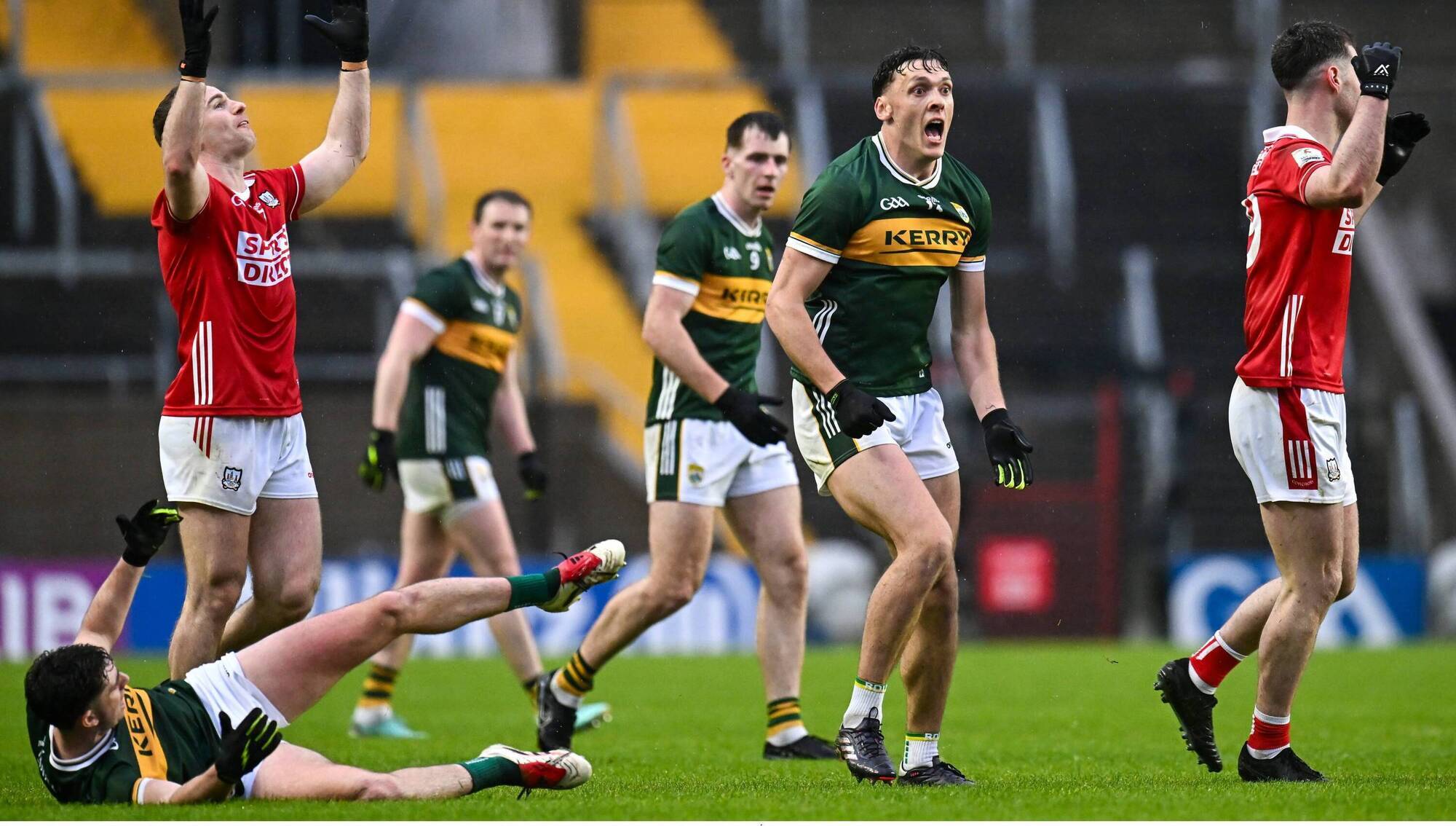
Kerry drawing Donegal and Cork playing Meath in round 1 of the All-Ireland SFC has overshadowed the Munster SFC final. Pic: Piaras Ó Mídheach/Sportsfile
It might just hit home now after that draw.
All that’s at stake in a provincial football final is pride and a piece of tin, nothing more.
No bye to a later round. No assurance you’ll play a lower seed than the vanquished provincial finalists will. After – or in fact even before – you walk out of Killarney, Clones, Hyde Park or Croke Park with that cup, you’re starting out in the All-Ireland series in the same place as you were.
Take Kerry and Cork who meet next Sunday in Killarney. No other rivalry in Gaelic games has drawn more people through the gates over the decades. When Cork in 1974 retained the Munster title in their bid to retain the All-Ireland title, 49,822 punters packed into Fitzgerald Stadium, the first of 25 occasions over a 26-year period where the attendance for a championship clash between the counties exceeded the 40,000 mark. The crowds were so high because the stakes were so high: a ticket to the All-Ireland semi-final, a fixture whose average crowds were dwarfed by those Kerry and Cork attracted over that period of time.
Read More
In the 2000s with the advent of the backdoor and the counties tending to meet later again in the year in Croke Park, attendances at Cork-Kerry Munster championship games dropped to an average of 29,000. But for Killarney it was 32,800. Even in the 2010s as Cork incrementally regressed, the average crowd for Munster championship games between the counties remained at 33,000. Although the Cork public had long had a preference for hurling, traditionally its affection for sojourns to Killarney equalled those to Thurles.
Two years ago when the counties met again in Fitzgerald Stadium, only half the usual crowd – 17,560 to be precise – were present to see Jack O’Connor’s team beat John Cleary’s by three points. But that was still a decent attendance, given the circumstances. Coming into it, Cork, while improving, had never threatened to win promotion from Division Two. It was only a Munster semi-final, not a Munster final. The Munster final itself, when Clare hosted Kerry in Ennis, was attended by just 12,000.
It was little wonder that Munster Council subsequently went to considerable lengths to increase the likelihood of Cork and Kerry meeting in a Munster final ensuring the protestations of other counties within the province. In the four Munster finals there had been post-Covid, Kerry had played either Clare or Limerick and the largest crowd had been only 14,587. With Cork you’d likely double that. Especially a continuously improving one.
Cork’s progress has not stalled since the draw was made last November. Precisely 10 years on from being relegated from Division One and then losing to Tipperary in the Munster semi-final, they’ve won promotion back to the top flight. Just as crucially, they’ve regained the admiration of the Cork public with their marriage of flair and fight. All things being equal, that support would be manifest in a large exodus to Killarney next weekend and a sense of anticipation gripping the county and that town that the fixture hasn’t known since the 2015 Munster final and replay. It promised to be a throwback, celebration, carnival.
But now, the way things are working out? It could be just an afterthought, something overshadowed by and squeezed in between the hurlers playing in Waterford on Saturday and the football match that Killarney and the whole country is really looking forward to.
An element of the Kerry public that once wouldn’t dream to miss a Cork-Kerry Munster final might wait for the visit of Donegal, just like in the past they would wait until the All-Ireland final to make any trip to Croke Park.
In Cork too the public’s attention has already turned to renewing battle with Meath more so than any upcoming battle with the oldest enemy of all.
For the first time in championship history the All-Ireland draw was made with no regard for who was the Munster champions. Kerry were drawn out of the hat by Tom Ryan as just that: Kerry. Regardless of whether they beat Cork or not in the Munster final, they’d be at home against whoever was drawn out next from the other hat: Donegal.
It reinforced the reality of this new format. Winning a provincial final gives you no advantage in the All-Ireland series. Reaching one though significantly does.
It was said after Donegal’s Ulster quarter-final defeat to Down that it wouldn’t harm their All-Ireland prospects, that at this stage in their development they didn’t need yet another Ulster title, or at least another Ulster final appearance, having made 12 of the previous 15.
But look where they find themselves now. On the road. Against the All-Ireland champions. A team now smarting themselves from having heavily lost a national final in Croke Park.
Home advantage gives Kerry the advantage, meaning Donegal are now more likely than not going to be pitted in a last-chance-saloon losers group that could feature other heavy hitters who failed to reach their provincial final – a Tyrone, Mayo, Meath – and could be drawn away to them too.
There is an upside, even a beauty, to this new format. We’re back to having a draw every few weeks reminiscent of the early years of the qualifiers – Dublin-Armagh 2003, Kerry-Tyrone 2012 – or even the glory years of the FA Cup.
Every game from here on in up until the All-Ireland quarter-finals has no more game on neutral ground. The risk of being drawn on the road increases the jeopardy and novelty that the Sam Maguire groups never could.
But there’s an obvious downside. At least for the provincial councils like Munster who were counting on a big pay day next Sunday in Killarney. A provincial football title has never carried so little value.
For sure Armagh would love to win their first Anglo-Celt Cup since 2008 so their current generation of players tick off another box. Monaghan will never tire of winning Ulsters. Galway will want to win a five-in-a-row, equalling the Mayo team of 2011-2015. Even Dublin will relish this particular Leinster title. And how Cork crave ending their Killarney famine that goes back to ’95.
But next year? Or the year after that?
It’ll be like a Division Two league final. Nice to win, but merely that.